
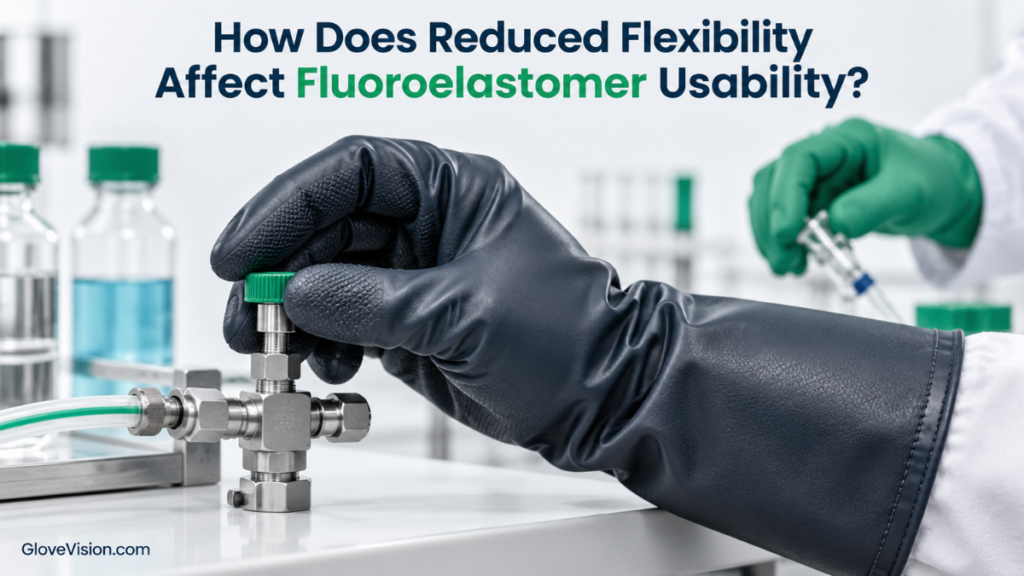
How Does Reduced Flexibility Affect Fluoroelastomer Usability?
Reduced flexibility limits Fluoroelastomer Gloves when the finished construction creates enough resistance to finger, thumb, palm, or wrist movement to reduce task control, tactile feedback, grip efficiency, movement speed, or endurance.
The limitation is product-specific rather than inherent to every Fluoroelastomer Glove. Polymer formulation, low-temperature behavior, thickness, composite construction, fit, lining, cuff design, grip surface, and task temperature can all change usability, so selection must move through flexibility factors, hand mobility, task sensitivity, optimization, alternatives, and exact-product verification.
What Determines Whether Fluoroelastomer Gloves Flexibility Becomes a Practical Limitation?
Fluoroelastomer Gloves flexibility becomes a practical limitation only when the exact finished glove resists required hand movements enough to interfere with safe task performance. The effect depends on formulation, construction, fit, temperature, and the precision demanded by the work.
How Does Thickness Affect Fluoroelastomer Gloves Flexibility?
More material can increase bulk and resistance to bending in many glove constructions, potentially reducing tactile feedback or ease of movement. The actual result remains product-specific because formulation, layer design, fit, and construction also matter.
Thickness also changes the barrier diffusion path, but thickness alone does not establish chemical performance across different glove models. Applicable chemical-specific product evidence should determine permeation performance.
Why Does Fluoroelastomer Formulation Affect Flexibility?
Fluoroelastomer families can differ substantially in low-temperature flexibility. Chemours’ Viton™ selection data show a trade-off between fluid resistance and low-temperature flexibility and document different TR-10 values across major products. This is polymer/vulcanizate evidence rather than a dexterity rating for a finished glove. [Viton]
Why Does Finished Construction Matter More Than Polymer Name?
A homogeneous Fluoroelastomer Glove, fluoroelastomer coating, composite barrier, lined construction, and multilayer system can behave differently during hand movement. The broad polymer family therefore cannot establish the bending behavior, tactility, grip, or dexterity of the complete glove.
How Does Fit Affect Fluoroelastomer Gloves Movement?
Poor fit can create excess fingertip material, palm bunching, thumb misalignment, internal slippage, restricted finger spread, or cuff interference. OSHA’s PPE selection guidance emphasizes careful consideration of fit and comfort and selection of the correct size. [OSHA]
Adequate chemical barrier + poor fit = potentially poor task usability.
How Can Low Temperature Change Fluoroelastomer Gloves Flexibility?
Lower temperature can reduce elastomer mobility, but the magnitude is strongly grade-dependent. Chemours identifies GLT products for strong FKM low-temperature flexibility and GFLT products for a combination of low-temperature flexibility and fluid resistance. These formulation-level properties should not be converted directly into claims about finished-glove dexterity. [Viton]
Why Does Task Demand Determine Whether Fluoroelastomer Gloves Flexibility Matters?
A glove that remains usable while stabilizing a large container may interfere with tubing, fittings, sampling equipment, or small controls. The same glove can therefore be usable for one task and unsuitable for another. This distinction is important when moving from general glove materials explained guidance to exact finished-product selection.
Fluoroelastomer Gloves Flexibility-Limiting Factors Table
| Factor | Possible Movement Effect | Potential Task Consequence | Evidence Boundary |
|---|---|---|---|
| Greater finished thickness | More bulk or bending resistance may occur | Reduced tactility or mobility | Product-specific |
| Polymer formulation | Changes elastomer mobility | Different flexibility response | Grade-specific |
| Low temperature | May increase apparent stiffness | Reduced hand control | Grade + temperature specific |
| Composite or layered construction | Changes total bending behavior | Mobility may improve or worsen | Whole-product evaluation |
| Lining | Adds material and interfaces | Reduced tactile feedback possible | Exact construction |
| Poor fit | Bunching or restricted movement | Lower precision or control | Size/model specific |
| Long or stiff cuff | Can affect wrist movement | Reduced reach or rotation | Exact glove/task |
| High-precision task | Requires greater hand control | Small mobility loss matters more | Task-specific |
How Does Reduced Mobility in Fluoroelastomer Gloves Affect Dexterity and Grip?
Reduced mobility affects Fluoroelastomer Gloves when resistance from the finished construction interferes with the finger, thumb, palm, or wrist movements required to control objects safely.
Why Can Bending Resistance Affect Hand Movement?
Greater resistance to flexion can require more effort to close or reposition the hand, so movement may become slower or less efficient. This is a mechanical task principle rather than a diagnosis of injury or fatigue.
Why Does Polymer Chain Mobility Matter?
Elastomeric movement depends partly on molecular mobility at the service temperature. Reduced molecular mobility can increase apparent material stiffness, but polymer behavior alone cannot establish how an entire finished glove will feel or perform during a specific task.
Why Does the Thumb Reveal Fluoroelastomer Gloves Mobility Problems Quickly?
Thumb opposition supports pinch grip, tool control, component rotation, small-part manipulation, and controlled release. A construction that meaningfully restricts thumb movement can therefore have a disproportionate effect on precision tasks.
How Can Reduced Flexibility Affect Fine Pinch Tasks?
Small fasteners, tubing connections, sampling equipment, instrument controls, and small components can expose movement limitations quickly. The practical pathway is movement resistance → reduced pinch control → slower or less precise handling → exact glove/task evaluation.
How Can Reduced Flexibility Affect Power Grip?
Holding large containers, controlling hoses, rotating handles, or operating valves may require repeated finger and palm flexion. Increased glove resistance can increase task effort, but that observation should not be converted into an injury or medical-fatigue claim without appropriate evidence.
Why Do Grip and Flexibility Need Separate Evaluation?
OSHA identifies dexterity and dry, wet, or oily grip among the practical variables that can affect glove selection. A flexible glove can still have inadequate traction, while a chemically protective glove can be difficult to control if its surface and movement characteristics do not suit the task. [OSHA]
How Can Tactile Feedback Affect Precision?
Reduced tactile feedback may make positioning slower, make small components harder to sense, encourage excessive squeezing, or make control movement more difficult to judge. The magnitude should not be quantified without relevant finished-product test data.
Which Task Conditions Make Fluoroelastomer Gloves Flexibility Most Important?
Fluoroelastomer Gloves flexibility matters most when the task requires precise hand control, repeated movement, longer work periods, cold conditions, multiple protective layers, or reliable grip on wet, oily, or otherwise challenging surfaces.
When Does Fine Manipulation Make Fluoroelastomer Gloves Flexibility Critical?
Small valves, laboratory handling, sampling, precision maintenance, instrument adjustment, and small fittings can require controlled thumb opposition, pinch, rotation, and tactile feedback. A more dexterous product should be considered only after adequate chemical protection is established.
When Does Repetition Increase the Importance of Fluoroelastomer Gloves Mobility?
Repeated hand movement combined with glove resistance can make accumulated task effort and reduced movement efficiency more important operationally. This is a task-usability consideration, not a medical prediction.
Why Does Exposure Duration Matter for Fluoroelastomer Gloves?
OSHA’s hand-protection guidance states that work activities should be studied for required dexterity as well as duration, frequency, degree of exposure, and physical stresses. Longer or repeated tasks can therefore make fit, movement resistance, grip, and stable glove positioning more important to practical selection. [OSHA]
When Does Cold Require Grade-Specific Attention for Fluoroelastomer Gloves?
Chemours documents meaningful differences in low-temperature flexibility among Viton™ products. The relevant chain is lower service temperature → grade-specific material response → potential mobility change → exact formulation and finished-product verification. Polymer low-temperature data should not be treated as direct glove-dexterity scores. [Viton]
When Does Layering Increase Fluoroelastomer Gloves Usability Demands?
A liner, chemical layer, mechanical overglove, or other layered system can add bulk, interface friction, tactile separation, or bending resistance around finger joints. The complete system should therefore be evaluated rather than assuming that the behavior of one layer predicts the whole system.
When Does Wet or Oily Handling Make Fluoroelastomer Gloves Grip Critical?
OSHA recommends considering dry, wet, and oily grip requirements alongside dexterity, chemical identity, temperature, physical durability, coverage, size, and comfort. Chemical resistance does not compensate for inadequate task control. [OSHA]
Fluoroelastomer Gloves Task-Sensitivity Matrix
| Task | Dexterity Demand | Flexibility Sensitivity | Primary Usability Concern |
|---|---|---|---|
| Large container handling | Low–moderate | Moderate | Grip + barrier |
| Hose handling | Moderate | Moderate | Grip + hand movement |
| Valve operation | Moderate | Moderate–high | Rotation + control |
| Small fittings | High | High | Pinch + tactility |
| Laboratory manipulation | High | High | Fine control |
| Sampling | High | High | Precision + contamination control |
| Repetitive maintenance | Moderate–high | High | Repeated movement |
| Cold-environment handling | Task-dependent | Potentially high | Grade-specific mobility |
| Layered chemical system | Task-dependent | Potentially high | Bulk + tactile separation |
How Can Fluoroelastomer Gloves Flexibility Be Improved or Replaced Without Sacrificing Protection?
Reduced flexibility should first be addressed by optimizing the chemically adequate product through fit, construction, thickness, temperature capability, grip, or task design before switching to another barrier.
When Can a Thinner Fluoroelastomer Gloves Construction Improve Usability?
A thinner exact product may reduce bulk, bending resistance, or interference with tactile feedback. It should be selected only when applicable chemical-specific permeation and degradation evidence, mechanical durability, and the intended exposure duration remain adequate. Minimum thickness should never be chosen from comfort alone.
Why Can Low-Temperature Fluoroelastomer Grades Matter?
Chemours identifies GLT products for strong FKM low-temperature flexibility and GFLT products for a combination of low-temperature flexibility and fluid resistance. These descriptions demonstrate formulation potential, not automatic superiority in glove dexterity. An actual protective glove still requires chemical- and product-specific verification. [Viton]
How Can Composite Construction Change Fluoroelastomer Gloves Usability?
A fluoroelastomer coating over another material can move differently from a homogeneous barrier. Total thickness, substrate, lining, interfaces, cuff, and grip finish should be evaluated as one finished system. Do not infer which layer controls overall flexibility or chemical resistance without applicable evidence.
Why Does Correct Fit Matter for Fluoroelastomer Gloves?
Correct sizing can reduce fingertip excess, palm bunching, thumb restriction, and internal slippage. Fit optimization must still preserve the coverage required by the chemical and task hazard.
How Can Better Grip Improve Fluoroelastomer Gloves Task Control?
A task-suitable surface can improve object control and reduce the force required to prevent slipping. Grip should be evaluated against the actual dry, wet, oily, or otherwise relevant handling surface rather than inferred from a generic texture description.
When Can an Overglove Help Fluoroelastomer Gloves?
A validated overglove or layered system can be considered when the chemical barrier requires mechanical protection and the additional bulk remains acceptable. The complete layered system must be assessed because adding a layer does not automatically improve overall protection or usability.
When Can Another Polymer Be More Practical Than Fluoroelastomer Gloves?
Another material should enter the usability comparison only after the exact alternative passes the same chemical-protection gate. Depending on the exposure, candidates may include products discussed under Butyl selection trade-offs, Neoprene specialization trade-offs, or PVA selection trade-offs. No material should receive a universal dexterity ranking.
When Should Fluoroelastomer Gloves Still Be Preferred Despite Reduced Flexibility?
Keep the exact Fluoroelastomer Glove in consideration when its chemical protection provides a necessary advantage, alternatives lack adequate verified resistance, its usability remains manageable, or the task can be modified without reducing protection. Required chemical protection remains the first gate. The broader decision context is covered under Fluoroelastomer adoption limits.
When Should the Task Be Redesigned Around Fluoroelastomer Gloves?
If no chemically adequate glove allows the required manipulation, consider larger controls, improved tool handles, reduced direct handling, remote handling, better transfer equipment, or a different process sequence rather than weakening the chemical barrier to gain flexibility.
Fluoroelastomer Gloves Flexibility-Mitigation Decision Matrix
| Usability Problem | First Mitigation to Evaluate | Chemical Requirement | Escalation |
|---|---|---|---|
| Excess bulk or movement resistance | Thinner validated exact product | Adequate permeation and degradation evidence | Compare another barrier |
| Cold-related stiffness | Suitable low-temperature formulation/product | Chemical profile remains adequate | Compare verified alternative |
| Poor fit | Correct size or model | Coverage maintained | Different construction |
| Poor grip | Suitable surface, product, or task tool | Barrier remains adequate | Task redesign |
| Mechanical damage risk | Validated overglove or system | Complete system assessed | Stronger construction |
| Excess layering | Remove unnecessary layer only when safe | Full hazard coverage maintained | Redesign system |
| Fine manipulation | More ergonomic chemically adequate product | No chemical compromise | Redesign task |
| No acceptable Fluoroelastomer option | Chemically adequate alternative product | Complete exposure remains covered | Specialist assessment |
How Should Fluoroelastomer Gloves Usability Be Verified Before Final Selection?
Fluoroelastomer Gloves usability should be verified only after the exact product has passed the chemical-protection requirement, then evaluated against the movements, grip conditions, coverage, duration, and mechanical demands of the actual task.
What Chemical Gate Must Fluoroelastomer Gloves Pass First?
Confirm the exact chemical, CAS number where useful, concentration, complete mixture, temperature, splash or continuous-contact pattern, immersion where relevant, duration, frequency, permeation evidence, and degradation evidence.
ASTM F739-20 addresses permeation through protective-clothing materials under continuous-contact test conditions and states that test data cannot by themselves be used to infer safe exposure levels. Barrier-test results therefore should not be treated as ergonomic evidence or converted automatically into a workplace safe-wear schedule. [ASTM]
Which Fluoroelastomer Gloves Product Details Must Be Recorded?
Record the manufacturer, exact model, disclosed formulation or grade where available, thickness, homogeneous or composite construction, underlying layers, lining, cuff, grip surface, size, and applicable chemical-test documentation.
Which Hand Movements Should Be Evaluated in Fluoroelastomer Gloves?
Replicate only task-relevant movements: finger flexion and extension, thumb opposition, pinch, power grip, rotation, wrist movement, tool manipulation, valve operation, and small-object handling.
How Should Fluoroelastomer Gloves Grip Be Evaluated?
Evaluate the grip conditions that actually control the task, including dry, wet, or oily handling where relevant. OSHA identifies dry, wet, and oily grip requirements among the variables to consider when selecting protective gloves. Where practical, use representative uncontaminated or appropriately controlled surfaces rather than creating unnecessary chemical exposure solely for usability testing. [OSHA]
How Should Longer-Duration Fluoroelastomer Gloves Usability Be Evaluated?
Observe consistency of movement, fit stability, grip control, repeated flexing, cuff interference, and the ability to remove the glove safely over the task-relevant period. Subjective effort should remain a usability observation rather than being converted into a medical diagnosis.
How Should Alternative Gloves Be Compared With Fluoroelastomer Gloves?
Hold the exact chemical or mixture, concentration, temperature, exposure pattern, duration, coverage requirement, and mechanical task constant. Only alternatives that provide adequate chemical protection should proceed to the dexterity, grip, fit, and complete-task comparison.
When Should Exact Fluoroelastomer Gloves Be Rejected?
Reject the exact product—rather than automatically rejecting the entire Fluoroelastomer family—when required manipulation cannot be performed adequately, fit cannot be corrected, grip remains inadequate, mechanical integrity is insufficient, required coverage cannot be achieved, or another chemically adequate product provides a better complete-task match.
Fluoroelastomer Gloves Usability Verification Checklist
Chemical Gate
- Exact chemical is identified.
- CAS number and concentration are confirmed where applicable.
- Complete mixture is reviewed.
- Temperature is defined.
- Contact pattern, duration, and frequency are established.
- Applicable permeation evidence is adequate.
- Applicable degradation evidence is adequate.
Exact Product
- Manufacturer and model are confirmed.
- Grade or formulation is identified where available.
- Thickness is documented.
- Complete construction is understood.
- Cuff and coverage are appropriate.
- Correct size is selected.
Mobility
- Finger flexion is adequate.
- Thumb opposition is adequate.
- Pinch control is adequate.
- Power grip is adequate.
- Wrist and rotational movement are adequate.
- Repeated movement remains controllable.
Grip and Task
- Relevant dry, wet, or oily grip requirement is assessed.
- Tool handling is adequate.
- Valve or control manipulation is adequate.
- Fine-object handling is adequate where required.
- Mechanical durability is adequate.
- Safe removal is possible.
Alternative Comparison
- Only chemically adequate alternatives are included.
- The same task and exposure conditions are used.
- Fit and dexterity are compared.
- Grip is compared.
- Coverage and mechanical performance are compared.
Final Decision
What Should Readers Remember About Reduced Flexibility in Fluoroelastomer Gloves?
Reduced flexibility can limit Fluoroelastomer Gloves when the finished construction interferes with the finger, thumb, wrist, grip, or tactile control required by the task. The practical effect depends on formulation, thickness, construction, fit, temperature, grip surface, duration, and required movements—not simply on the word “fluoroelastomer.”
Chemical protection remains the first gate. Optimize the exact Fluoroelastomer Glove through appropriate formulation, construction, fit, grip, or task design where possible, and move to another material only when the alternative provides adequate chemical protection with better complete-task usability. Do not trade required chemical protection for flexibility; compare ergonomics only among products that adequately protect against the complete exposure.
Which Questions Clarify Reduced Flexibility in Fluoroelastomer Gloves?
Are Fluoroelastomer Gloves Always Stiff?
No. Finished-glove behavior varies with formulation, thickness, composite construction, fit, lining, cuff, temperature, and task requirements. A broad material-family description should therefore not be treated as a stiffness or dexterity rating for every finished Fluoroelastomer Glove.
Does Greater Thickness Always Reduce Fluoroelastomer Gloves Dexterity?
No. Greater finished thickness can increase bulk or bending resistance in many constructions, but the actual dexterity effect also depends on formulation, design, fit, layers, and task. Thickness alone should not be used as an ergonomic ranking or as a universal predictor of chemical performance.
Does Cold Make Fluoroelastomer Gloves Unusable?
Not universally. Low-temperature behavior is strongly formulation-dependent. A formulation designed for improved low-temperature flexibility may behave differently from another fluoroelastomer formulation, but finished-glove usability still requires exact-product, temperature, and task evaluation.
Can More Flexible Fluoroelastomer Gloves Still Provide Strong Chemical Protection?
Yes, when applicable evidence supports the exact product and exposure. A more flexible construction can remain chemically suitable when its permeation, degradation, mechanical integrity, coverage, and exposure conditions are adequately supported. Flexibility itself does not prove chemical resistance.
When Should Reduced Flexibility Justify Replacing Fluoroelastomer Gloves?
Compare or replace the exact product when required manipulation remains inadequate after reasonable product and task optimization. The replacement must first provide adequate verified chemical protection for the complete exposure; only then should better fit, mobility, grip, or task usability determine the final choice.