
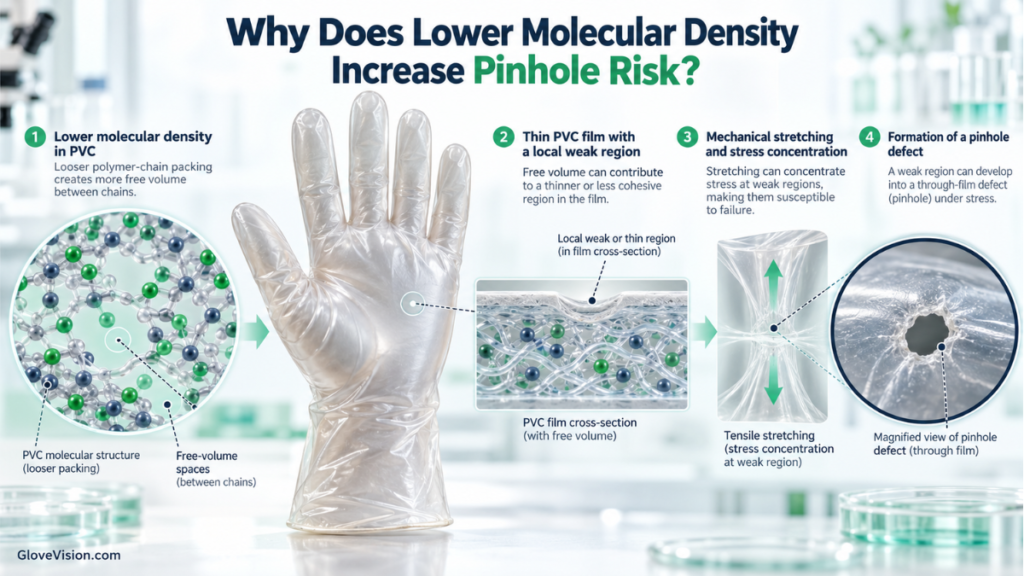
Why Does Lower Molecular Density Increase Pinhole Risk?
Lower effective molecular packing can contribute indirectly to PVC Gloves vulnerability by changing polymer free volume and mechanical behavior, but it does not directly create a glove pinhole. A through-hole develops at the film scale when a thin, defective, degraded, or mechanically stressed region loses integrity.
Molecular free-volume cavities are sub-nanometer features, whereas pinholes are finished-film leakage defects. Plasticizer loading, mechanical properties, local thickness, film uniformity, processing quality, chemical exposure, aging, and applied stress must therefore be separated as the pathway moves from molecular packing and free volume to mechanical cohesion, film defects, use stress, and direct finished-glove verification.
What Does Lower Molecular Packing Mean in PVC Gloves?
“Lower molecular density” is best interpreted as lower effective chain packing or greater free volume within a plasticized PVC matrix—not as physical holes already passing through PVC Gloves. Molecular free volume and finished-film pinholes occur at fundamentally different physical scales.
What Is Molecular Packing in PVC Gloves?
Molecular packing describes how polymer chains occupy space and interact within the material. Plasticizer molecules, polymer-chain arrangement, molecular motion, and structural disorder can influence the space available for segmental movement.
An actual glove film should not be imagined as having one perfectly uniform microscopic packing state throughout its entire surface. This distinction is part of the broader relationship between polymer structure and the protective properties described in glove materials explained.
Why Is “Lower Molecular Density” an Imperfect Term?
Terms such as effective chain packing, specific volume, free-volume fraction, mean local free-volume size, plasticizer content, and mechanical properties describe the relevant mechanisms more precisely. Density should not be treated as one scalar predictor of finished-glove holes.
How Do Plasticizers Change PVC Gloves Free Volume?
A 2003 study compared PVC containing 10 wt% and 30 wt% di-n-butyl phthalate and found that specific free volume and mean local free-volume-hole size increased with plasticizer content. The study examined two experimental PVC/DBP materials—not finished gloves—and did not measure glove pinhole frequency or leak rate. [PVC Free Volume]
Two experimental PVC formulations ≠ a universal PVC Gloves formulation rule.
Why Are Molecular Free-Volume Cavities Not Pinhole Defects?
The free-volume study describes sub-nanometer local cavities associated with structural disorder in an amorphous polymer. A glove pinhole is instead a through-thickness film defect capable of creating a leakage pathway under an applicable finished-glove test.
Same word “hole” → completely different physical scales.
Why Does the Scale Distinction Matter for PVC Gloves?
Free volume can influence segmental mobility, diffusion, relaxation, and macroscopic material behavior. Direct leakage, however, requires a physical through-film pathway or another applicable integrity failure.
PVC Gloves Molecular-Packing vs Pinhole Factors Table
| Scale | Feature | Primary Relevance | Through-Film Pinhole? |
|---|---|---|---|
| Molecular | Free-volume cavity | Mobility, diffusion, material behavior | No |
| Polymer / material | Strength, toughness, elongation | Resistance to deformation or failure | No |
| Film | Local thin region | Lower local material margin | Not necessarily |
| Film / manufacturing | Inclusion, fisheye, void, poor uniformity | Possible local defect or stress concentrator | May contribute |
| Finished glove | Tear or physical hole | Direct leakage pathway | Yes |
How Can Free Volume and Film Cohesion Affect PVC Gloves Vulnerability?
Greater free volume can matter to PVC Gloves pinhole vulnerability only indirectly. Formulation changes that alter molecular mobility can also change mechanical properties, which can influence how a film responds when stress is concentrated around an existing weak, thin, or defective region.
How Does Plasticization Increase Free Volume in PVC Gloves?
In the studied PVC/DBP materials, increasing DBP content from 10 wt% to 30 wt% increased specific free volume and mean local free-volume size. The result establishes a material mechanism for those formulations, not a numerical rule for glove films. [PVC Free Volume]
Why Can Greater Free Volume Increase PVC Gloves Flexibility?
Greater molecular mobility can allow easier rearrangement during deformation, and the higher-plasticizer material in the cited free-volume study also showed a lower glass-transition temperature. Greater flexibility, however, does not automatically mean reduced integrity.
Why Can Plasticizer Loading Change PVC Gloves Strength and Toughness?
A 1998 study of highly plasticized experimental PVC membranes found a non-linear mechanical response: strength, stiffness, and toughness increased at low plasticizer ratios and then decreased as additional plasticizer was added above the observed property peaks. These were experimental PVC membranes rather than finished PVC Gloves, so the results describe a material tendency rather than a glove-pinhole rate. [PVC Mechanical Study]
Plasticizer loading → formulation-dependent, non-linear mechanical response.
Why Does Toughness Matter Separately From Softness in PVC Gloves?
Softness, stiffness, tensile strength, elongation, toughness, and puncture behavior describe different material responses. A soft formulation can retain useful integrity, while a stiff material can still fail when it is brittle, damaged, or locally defective. This is also why material selection should consider construction-specific trade-offs rather than softness alone; for example, Butyl selection trade-offs reflect a different balance of material properties and task demands.
How Can a Small PVC Gloves Film Defect Grow Under Stress?
A local notch, inclusion, thin region, or other weak zone can concentrate applied stress. Stretching or repeated loading can then enlarge that weak region until a macroscopic tear or through-hole develops. This is a general film-mechanics pathway—not direct evidence that molecular free volume itself becomes a pinhole.
Why Does Lower Mechanical Strength Not Automatically Predict PVC Gloves Pinhole Rate?
Finished defect frequency also depends on thickness distribution, manufacturing uniformity, the existing flaw population, glove geometry, fit, applied strain, chemical degradation, and production quality. Tensile or puncture properties therefore cannot be converted directly into a pinhole-frequency prediction.
Which Thin-Film and Manufacturing Conditions Increase Pinhole Vulnerability in PVC Gloves?
Film-scale nonuniformity is more directly relevant to PVC Gloves pinhole risk than molecular free volume. Local thin regions, inclusions, malformed areas, poor film continuity, and existing holes can reduce the integrity margin of the finished film or provide locations where stress becomes concentrated.
Why Do Local Thin Spots Matter More Than Average Thickness Alone?
A local reduction in film cross-section leaves less material at that location to carry an applied load. The resulting region may therefore have a lower margin against deformation or defect growth, but local thinness is not automatically a pinhole.
Can a Thin PVC Glove Still Be Hole-Free?
Yes. A glove can be relatively thin yet uniform, mechanically adequate, properly manufactured, and free of leak-detectable holes. Nominal thickness alone therefore cannot establish pinhole frequency.
Nominal thinness ≠ pinhole.
Why Does Material Uniformity Matter for PVC Gloves?
FDA’s Medical Glove Guidance Manual treats barrier integrity alongside finished-device characteristics such as dimensions, thickness, tensile strength, elongation, embedded debris, fisheyes, folds or webbing, and material uniformity. This is useful evidence that hole integrity and other quality parameters are evaluated separately, but the guidance concerns medical gloves and should not be generalized into a universal industrial PVC specification. [FDA]
That construction-specific distinction is also relevant when comparing broader material behavior, such as the different specialization considerations described in Neoprene specialization trade-offs.
How Can Embedded Debris or Fisheyes Affect PVC Gloves?
An inclusion or malformed region can produce nonuniform local geometry or act as a stress concentrator. That makes it a relevant quality concern, but not every visible mark, inclusion, or fisheye is necessarily a through-film hole.
How Should Poor Fusion or Incomplete Film Formation Be Discussed?
Incomplete continuity, heterogeneous film formation, weak local regions, and coating nonuniformity are plausible manufacturing-mechanism concerns. A specific defect should not be attributed to poor fusion or another manufacturing cause without supporting process or lot evidence.
Why Must Hole Integrity Be Measured Directly for PVC Gloves?
For medical gloves, FDA recognizes ASTM D5151-19(2023), Standard Test Method for Detection of Holes in Medical Gloves. FDA’s recognition record states that the method detects holes that permit water leakage under the conditions of the test; it does not establish safe use or chemical permeation resistance. [FDA/ASTM D5151]
FDA separately recognizes ASTM D5250-19(2023), Standard Specification for Poly(vinyl chloride) Gloves for Medical Application, with partial recognition. Its scope is medical PVC gloves, so it should not be presented as a universal industrial PVC glove specification. [FDA/ASTM D5250]
PVC Gloves Pinhole-Risk Accelerator Matrix
| Factor | Mechanism | Relationship to Pinhole Risk |
|---|---|---|
| Greater molecular free volume | Alters material mobility and properties | Indirect |
| High or unfavorable plasticizer loading | May alter strength and toughness | Indirect; formulation-specific |
| Local thin spot | Reduces local film cross-section | More direct vulnerability factor |
| Inclusion / fisheye | Creates local nonuniformity | Potential defect or stress concentrator |
| Poor film continuity | Creates local structural weakness | Potential direct integrity concern |
| Mechanical stretching | Loads weak regions | Can propagate an existing defect |
| Tear / puncture | Through-film damage | Direct leak pathway |
| Existing hole | Continuous opening through film | Immediate leak defect |
How Do Mechanical Stress, Chemical Exposure, and Aging Expand Defects in PVC Gloves?
PVC Gloves can lose integrity during use when stretching, repeated flexing, abrasion, puncture, or chemical degradation acts strongly enough on the film—especially around an existing weak, thinned, or defective region—to create or propagate a through-film defect.
How Can Donning Stress Increase PVC Gloves Failure Risk?
A tight fit or high stretch can increase local strain. If a weak region is already present, that additional strain can increase the chance of tear propagation. This does not mean donning automatically creates pinholes in thin PVC Gloves.
Why Can Repeated Flexing Matter for PVC Gloves?
Repeated movement can repeatedly load finger regions, thumb areas, webs, and palm folds. These are plausible high-motion regions, not universal first-failure sites, and actual failure location depends on product construction, fit, task, and defect distribution.
How Do Rough or Sharp Surfaces Change PVC Gloves Failure Mechanisms?
Abrasion, puncture, cuts, and tears are film-scale mechanical mechanisms capable of producing direct barrier damage independently of molecular free volume.
How Can Plasticizer Extraction Affect Later PVC Gloves Integrity?
A 2005 study of a 0.5-mm plasticized PVC membrane found that ethanol exposure could remove plasticizer and alter mechanical behavior, with stronger changes under the more severe exposure conditions studied. This supports the narrower conclusion that chemical extraction can materially change plasticized PVC; it does not establish that ethanol exposure directly causes pinholes in PVC Gloves. [PVC Aging Study]
How Can Chemical Swelling or Degradation Compound PVC Gloves Mechanical Stress?
If chemical exposure changes material properties, normal movement can act on an altered film and reduce the remaining integrity margin. Whether that mechanism is relevant to a real glove requires chemical-specific compatibility and degradation evidence for the exact product. This need for chemical-specific selection is also why materials with very different exposure boundaries—such as those discussed in PVA selection trade-offs—cannot be substituted solely on the basis of generic material strength.
When Is the PVC Gloves Pinhole Boundary Exceeded?
A product should be rejected, replaced, or escalated when a through-hole is detected, an applicable leak test fails, a tear or puncture forms, severe cracking or degradation compromises required integrity, repeated unexpected defects suggest a possible lot or manufacturing concern, or the chemical exposure exceeds validated conditions.
PVC Gloves Defect-and-Stress Decision Matrix
| Condition | Film Response | Integrity Concern | Response |
|---|---|---|---|
| Excess stretch | Higher local strain | Weak region may propagate | Check size / product |
| Repeated flexing | Repeated local loading | Defect growth possible | Use inspection / replacement criteria |
| Abrasion | Surface or material loss | Local thinning | Remove when integrity is affected |
| Puncture / sharp edge | Through-film damage | Direct leak | Replace immediately |
| Plasticizer extraction | Mechanical properties may change | Cracking or tear vulnerability may change | Reassess / replace |
| Swelling / softening | Material response altered | Integrity uncertain | Verify compatibility |
| Existing thin / defective region | Stress concentration | Higher local vulnerability | QC / inspection |
| Detected hole | Through-film path | Barrier failure | Reject / replace |
How Should PVC Gloves Be Verified for Pinhole and Barrier Integrity?
PVC Gloves integrity should be verified using finished-product quality and direct leak evidence appropriate to the glove category. Molecular density, free-volume measurements, tensile properties, or average thickness cannot substitute for direct assessment of whether the actual glove film contains a through-hole.
Which Finished-Glove Parameters Matter for PVC Gloves?
In the medical-glove context, FDA guidance treats barrier integrity and other finished-device quality characteristics as separate considerations. The important principle is parameter separation: thickness, mechanical properties, visible quality, and direct hole integrity answer different questions. The medical-glove framework should not be applied automatically to unrelated industrial chemical gloves. [FDA]
Why Is Direct Hole Testing More Defensible Than Density Inference for PVC Gloves?
Direct integrity testing asks whether an actual through-film leakage pathway exists under the specified test conditions. FDA’s direct recognition record for ASTM D5151-19(2023) states that the method covers detection of holes in medical gloves and is limited to holes that allow water leakage under the test conditions. The same record states that safe and proper glove use is outside the test method’s scope. [FDA/ASTM D5151]
What Does ASTM D5250 Contribute to PVC Gloves Verification?
FDA’s direct recognition record identifies ASTM D5250-19(2023) as Standard Specification for Poly(vinyl chloride) Gloves for Medical Application. The FDA record shows partial recognition and describes a scope covering PVC gloves used for medical examinations, diagnostic and therapeutic procedures, and handling contaminated medical material. It therefore provides a medical-PVC-glove example rather than a universal specification for all industrial PVC Gloves. [FDA/ASTM D5250]
How Should AQL Be Discussed for PVC Gloves?
AQL and other lot-acceptance criteria should be applied only within the specification, regulatory framework, and product category to which they belong. Medical-glove acceptance criteria should therefore not be converted into a universal AQL requirement for industrial or chemical-protective PVC Gloves. When an AQL is relevant, verify the applicable current product specification or regulatory requirement rather than inferring it from PVC material identity alone. [FDA]
How Should Tensile Strength and Elongation Be Used for PVC Gloves?
Tensile strength and elongation characterize mechanical behavior and can help assess resistance to loading, stretch capability, or aging effects. They remain separate from direct hole integrity.
Acceptable tensile or elongation performance does not prove absence of pinholes.
Passing a hole test does not automatically establish adequate chemical resistance.
Why Must PVC Gloves Chemical Barrier Evidence Be Kept Separate?
A water-leak test identifies physical holes under its test conditions. ASTM D5151’s recognized scope is specifically hole detection by water leakage in medical gloves; it does not establish chemical permeation resistance. Chemical selection therefore requires separate evidence appropriate to the exact chemical, concentration, temperature, contact duration, glove construction, permeation behavior, and degradation response. [FDA/ASTM D5151]
When Should Alternative Materials Be Compared With PVC Gloves?
Compare another verified barrier when the PVC product lacks applicable chemical resistance, mechanical demands exceed its construction, repeated integrity failures occur, or another material better matches the complete task. Highly specialized chemical barriers also carry their own selection limitations; Fluoroelastomer adoption limits provide one example of why alternative materials still require exposure-specific evaluation rather than universal ranking.
PVC Gloves Barrier-Integrity Verification Checklist
Product Category
- Exact glove manufacturer and model identified.
- Medical, industrial, chemical-protective, or other category confirmed.
- Applicable specification or test standard identified.
- Medical-glove acceptance criteria are not applied automatically to unrelated product categories.
Film and Construction
- Thickness specification reviewed.
- Uniformity and visible quality are acceptable.
- No obvious holes, tears, or punctures are present.
- No unacceptable inclusions or malformed regions are present.
- Fit does not create excessive stretch.
Mechanical Evidence
- Relevant tensile and elongation data reviewed where applicable.
- Mechanical durability matches the task.
- Aging requirements reviewed where applicable.
- Mechanical metrics are not substituted for direct leak testing.
Hole and Leak Integrity
- Applicable direct hole or leak test identified.
- Product meets applicable lot or acceptance criteria.
- Medical-glove AQL or other acceptance criteria are used only where applicable.
- Repeated or clustered defects are escalated.
Chemical and Use Conditions
- Exact chemical compatibility confirmed.
- Permeation and degradation data reviewed where required.
- Chemical extraction or swelling concerns assessed.
- Abrasion and puncture stresses considered.
- Replacement criteria defined.
Final Decision
What Should Readers Remember About Pinhole Risk in PVC Gloves?
Greater free volume or lower effective chain packing can change the physical behavior of plasticized PVC, while plasticizer loading can alter strength, stiffness, toughness, and ductility in formulation-dependent ways. Those material effects may influence how an existing weak region responds to stress, but molecular free-volume cavities are not physical glove pinholes. Treat molecular packing as an indirect material factor rather than a direct leak measurement.
Actual PVC Gloves pinhole risk belongs at the finished-film level. Thickness uniformity, inclusions, film quality, existing defects, mechanical loading, chemical degradation, aging, and manufacturing consistency influence whether a through-hole develops, so direct glove-integrity testing is more decisive than molecular-density inference. Treat a pinhole as a finished-film defect that requires direct evidence.
Which Questions Clarify Pinhole Risk in PVC Gloves?
Does Lower Molecular Density Automatically Cause Pinholes in PVC Gloves?
No. Lower effective chain packing or greater free volume can change PVC material behavior, but a pinhole requires an actual through-film defect. Film thickness, flaws, processing, mechanical stress, chemical degradation, and finished-product quality determine whether such a defect develops.
Are Molecular Free-Volume Holes the Same as PVC Gloves Pinholes?
No. Molecular free-volume holes are sub-nanometer cavities within polymer structure. A PVC Gloves pinhole is a film-scale through-defect capable of permitting leakage under an applicable integrity test.
Can More Plasticizer Increase PVC Gloves Pinhole Risk?
It can contribute indirectly under some formulations because plasticizer loading changes free volume and mechanical properties. However, the relationship is non-linear and formulation-dependent, and the cited mechanical research does not establish a direct plasticizer-to-glove-pinhole relationship.
Are Thin PVC Gloves Automatically More Likely to Have Pinholes?
No. Nominal thickness alone does not establish hole frequency. A thinner but uniform and adequately manufactured glove can satisfy applicable integrity requirements, while a thicker glove can still contain defects. Local uniformity and direct testing matter.
What Is the Best Way to Know Whether PVC Gloves Have Pinholes?
Use the direct finished-glove integrity method and acceptance criteria applicable to the product category. For medical gloves, recognized water-leak methods such as ASTM D5151 directly detect holes; chemical-protective performance still requires separate permeation and degradation evidence.