
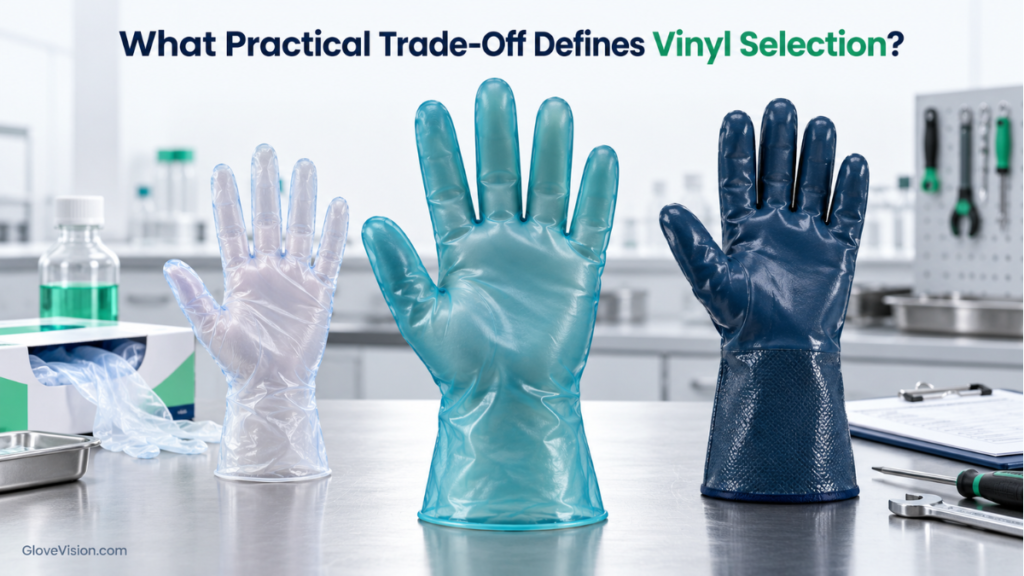
What Practical Trade-Off Defines Vinyl Selection?
The practical trade-off defining Vinyl/PVC Gloves selection is relatively low purchase cost, easy planned replacement, and useful task performance in appropriate routine exposures versus the need to verify that the exact PVC construction provides adequate chemical and physical protection for the actual task.
That does not make vinyl inherently weak or unsuitable. When an exact PVC product provides adequate protection, planned frequent replacement can be practical and economical; when chemical or physical protection is marginal, low unit cost no longer creates real value. The decision therefore moves from protection adequacy through replacement value, chemical limits, construction effects, alternative comparison, and exact-product verification.
What Practical Trade-Off Most Defines Vinyl/PVC Gloves Selection?
Vinyl/PVC Gloves provide practical value when their verified protection is sufficient and their purchase cost, planned replacement pattern, and handling characteristics fit the task.
What Practical Advantages Can Vinyl/PVC Gloves Offer?
Depending on the exact product and task, PVC can be considered alongside cost, physical performance, chemical performance, and intended conditions of use. OSHA requires chemical-protective glove selection to consider glove performance characteristics, conditions of use, duration, and the hazards present. [OSHA] For broader material context, see Vinyl/PVC glove material.
What Protection Limitations Offset Those Advantages?
The material name alone does not establish suitability for a particular chemical task. Exact chemical identity, concentration, contact duration, contact mode, temperature, mechanical requirements, and the finished glove’s performance all matter.
Why Is Low Price Not the Same as Good Value?
OSHA’s non-mandatory glove-selection guidance states that, when performance characteristics are acceptable, regularly changing cheaper gloves can in some circumstances be more cost effective than reusing more expensive types. The same guidance also says work activities should be assessed for dexterity, duration, frequency, degree of exposure, and physical stresses. [OSHA]
Why Is Maximum Protection Not Automatically the Most Practical Choice?
Selection should match the actual hazard and task rather than pursue a material label in isolation. A different barrier may be necessary for a demanding exposure, while an exact PVC product may remain appropriate where its documented performance satisfies the defined conditions.
What Question Should Control the Trade-Off?
Ask whether the exact Vinyl/PVC Glove provides the required chemical and physical protection while preserving enough replacement practicality, grip, dexterity, coverage, workflow compatibility, and lifecycle value for the task.
| Decision Dimension | Potential PVC Advantage | Limiting Condition |
|---|---|---|
| Acquisition cost | Can support economical replacement | Relevant only after adequate performance is established |
| Replacement | Frequent changes may be practical | High consumption can reduce lifecycle value |
| Thin/light construction | Can reduce bulk | Exact mechanical and chemical performance still requires verification |
| Selected routine chemical tasks | PVC may be a candidate | Exact chemical and conditions control suitability |
| Organic solvents | Product-specific | Exact permeation/degradation evidence may be necessary |
| Extended contact | Possible only where supported | Duration-specific evidence becomes important |
| Mechanical stress | Construction can be selected for the task | Abrasion, puncture, and tear requirements must be assessed |
| Higher-consequence exposure | Possible only with adequate evidence | Uncertainty should not be offset by lower price |
Why Do Cost, Replacement, and Practical Use Create Value for Vinyl/PVC Gloves?
Cost becomes a meaningful advantage only after Vinyl/PVC Gloves pass the protection requirement. At that point, planned replacement and simple deployment can contribute to practical task value.
Why Can Frequent Replacement Favor Vinyl/PVC Gloves?
Where performance characteristics are acceptable, OSHA guidance notes that regularly changing cheaper gloves may in certain circumstances be more cost effective than reusing more expensive types. [OSHA] This supports frequent replacement as a possible economic strategy, not as a substitute for chemical or physical protection.
Why Must Disposable PVC Be Kept Separate From Industrial Chemical Evidence?
FDA recognizes ASTM D5250-19(2023) as a specification for poly(vinyl chloride) gloves used in medical applications, including medical examinations, diagnostic and therapeutic procedures, and handling contaminated medical material. [FDA/ASTM] That scope establishes a medical PVC glove category; it does not by itself establish chemical breakthrough performance for an industrial exposure.
Which Tasks Can Fit Vinyl/PVC Gloves Well?
PVC can be considered when the exact product’s documented performance matches the actual chemical, physical, coverage, grip, and dexterity demands. The intended task—not the material name alone—determines whether the construction is a practical candidate.
When Does Thin Disposable Vinyl Offer Useful Handling?
A thin construction can reduce bulk and may suit tasks involving frequent glove changes, but actual dexterity, grip, tear resistance, and chemical protection should be assessed from the finished product and intended conditions of use.
When Does the Workflow Advantage Disappear?
The advantage narrows when the required change frequency, glove damage, contamination pattern, work interruption, or protection requirement makes the selected PVC product impractical for the complete task.
Why Must Lifecycle Cost Replace Unit-Price Thinking?
Lifecycle comparison can include purchase price, consumption, change frequency, work interruption, disposal, inspection, and any validated reuse or decontamination requirements. Protection adequacy remains the entry requirement.
| Task Condition | Practical PVC Value | Decision Direction |
|---|---|---|
| Brief lower-severity handling | Potential candidate | Verify exact product and task |
| Frequent planned changes | Potential workflow advantage | Use only when performance is acceptable |
| Selected chemical work | Product-specific | Verify chemical and conditions |
| Medical examination | Use appropriate medical PVC product | Apply relevant requirements |
| Long immersion | Evidence-dependent | Duration-specific chemical data required |
| Solvent exposure | Evidence-dependent | Compare exact barrier data |
| High puncture/abrasion demand | Construction-dependent | Verify physical performance |
| Fine manipulation | Construction-dependent | Confirm grip, fit, dexterity, and barrier |
Which Chemical and Exposure Limits Restrict Vinyl/PVC Gloves Selection?
Vinyl/PVC Gloves lose practical value when the actual chemical or exposure conditions exceed the documented performance of the exact PVC product.
Which Variables Must Be Defined Before Calling PVC Suitable?
OSHA identifies the type of chemical, frequency and duration of contact, nature of contact such as immersion or splash, concentration, temperature, abrasion/puncture/tear requirements, required coverage, dexterity, grip, glove features, size, comfort, and price among glove-selection factors. [OSHA] See the broader vinyl barrier limits.
Why Must Solvent Exposure Be Evaluated With Exact Data?
A broad material label cannot establish resistance to a named solvent. Chemical identity, concentration, temperature, contact mode, duration, and exact finished-glove data should control the decision. See Vinyl/PVC structure behavior.
Why Do Mixtures Require Conservative Evaluation?
Mixtures should not be assumed to behave like their largest ingredient. Where direct mixture data are unavailable, component interactions and the actual hazard profile should be considered rather than treating a single ingredient as complete evidence.
How Does Longer Contact Change the Trade-Off?
Longer chemical contact increases the importance of applicable permeation and degradation evidence. ASTM F739 evaluates permeation of liquids and gases through protective clothing materials under continuous-contact conditions, but the standard explicitly cautions that its data cannot by themselves be used to infer safe exposure levels. [ASTM] See vinyl duration limits.
Why Is a Reported Breakthrough Time Not a Safe Wear-Time Limit?
ASTM F739 states that a standardized breakthrough time greater than a stated period means the test chemical did not permeate above the specified standardized rate during that period; permeation may still have occurred at a lower rate. The result therefore should not be converted directly into a universal safe workplace wear time. [ASTM]
Why Does High Consequence Reduce the Acceptable Trade-Off?
As the consequence of barrier failure increases, selection should rely more heavily on hazard-matched performance documentation for the exact glove and less on purchase-price advantages. See vinyl high-risk limits.
When Is Vinyl/PVC Overextended?
PVC is overextended when the actual chemical, concentration, temperature, duration, contact mode, mixture, physical demand, or required protection level exceeds the evidence available for the exact product.
How Do Thickness and Construction Shift the Trade-Off of Vinyl/PVC Gloves?
Thickness and construction can change the practical performance of Vinyl/PVC Gloves, but neither thickness nor construction should be used as a substitute for chemical-specific evidence.
What Does Thin Disposable Vinyl Potentially Gain?
A thin construction can reduce bulk and material use and may support frequent-change workflows. Actual dexterity, grip, chemical resistance, and mechanical performance remain product-specific.
What Does Thin Disposable Vinyl Potentially Give Up?
Mechanical integrity should be assessed against the task’s abrasion, puncture, and tear demands rather than inferred from the material name or thickness alone.
What Can Thicker PVC Change?
A thicker construction changes the amount of material in the barrier and can change physical performance and handling, but thickness alone does not establish a chemical breakthrough time or prove suitability for a particular chemical.
How Can Supported or Coated PVC Change the Balance?
A textile-supported or coated design can change grip, flexibility, abrasion behavior, total construction, contamination handling, and task feel. Performance should therefore be assessed at the finished-product level.
Why Does Physical Integrity Matter to the Trade-Off?
Chemical-barrier selection and physical integrity are separate but interacting requirements. A glove must remain physically suitable for the stresses expected during the task. See vinyl pinhole risk.
Why Must Construction-Level Data Override Material Reputation?
FDA’s recognized ASTM D5250-19(2023) specification applies specifically to poly(vinyl chloride) gloves for medical applications and defines that product context. [FDA/ASTM] It should not be treated as evidence that every PVC glove shares the same construction, intended use, or industrial chemical performance.
How Should Vinyl/PVC Gloves Be Compared and Verified Before Selection?
Vinyl/PVC Gloves should remain the selected option only when the exact product passes the chemical, exposure, physical, and task-performance gates; economics should be compared only after those requirements are satisfied.
When Should Another Polymer Be Compared?
Compare nitrile, neoprene, butyl, PVA, fluoroelastomer, multilayer, or another construction when the available evidence for the exact PVC product does not adequately match the controlling chemical, duration, temperature, contact mode, mixture, or physical demand. No alternative material should be assumed universally superior.
How Should Cost Be Compared Fairly?
Compare cost after candidate products meet the required protection level. OSHA’s selection guidance specifically treats price as one factor alongside chemical type, duration and frequency, nature of contact, concentration, temperature, physical resistance, coverage, dexterity, grip, and other glove features. [OSHA]
| Selection Need | PVC Direction | Alternative Direction | Main Verification |
|---|---|---|---|
| Defined lower-demand exposure | Potential candidate | Compare only if useful | Exact PVC evidence |
| Frequent planned replacement | Potential practical advantage | Compare total task burden | Performance + lifecycle use |
| Oil / grease task | Product-specific | Compare another exact product if needed | Chemical + grip data |
| Named solvent | Evidence-dependent | Compare specialist exact products | Solvent-specific data |
| Complex mixture | Evidence-dependent | Compare products with stronger applicable evidence | Mixture-specific information |
| High abrasion / puncture | Construction-dependent | Compare stronger construction/system | Chemical + mechanical evidence |
| Long / elevated-temperature contact | Exact evidence essential | Compare products tested for applicable conditions | Duration / temperature match |
What Chemical Gate Must Be Passed First?
Confirm the exact chemical identity, concentration, and complete formulation or mixture information available for the task.
Which Exposure Conditions Must Be Defined?
Document duration, frequency, immersion versus splash or contaminated-surface contact, temperature, abrasion, puncture, tear, required coverage, dexterity, and grip. OSHA explicitly identifies these factors as relevant to glove selection. [OSHA]
Which Product Details Must Match?
Verify the manufacturer, exact model, thickness, construction, disposable or reusable designation, cuff, liner, surface characteristics, intended use, and any conditions attached to the available performance data.
Which Chemical-Barrier Evidence Must Be Interpreted Carefully?
ASTM F739 covers permeation testing under continuous-contact conditions and can report standardized breakthrough time, permeation rate, and cumulative permeation. ASTM cautions that these data cannot by themselves be used to infer safe exposure levels; it also explains that a breakthrough time reported as greater than a specified period does not prove that no lower-rate permeation occurred during that interval. [ASTM]
How Should Replacement Strategy Be Evaluated?
Determine expected contamination, required change frequency, intended single use or reuse, any validated decontamination requirements, expected glove consumption, and whether the resulting change pattern remains operationally practical.
When Does Vinyl Lose Its Practical Advantage?
The advantage is lost when the exact PVC product cannot demonstrate adequate protection, when physical performance does not match the task, or when the required change and handling strategy makes another adequately protective product more practical for the defined work.
Pass the protection gates first. Economics and workflow belong near the end of the decision.
Chemical Gate
- Exact chemical identified.
- CAS number confirmed where applicable.
- Concentration known.
- Complete mixture information reviewed.
- Applicable PVC compatibility evidence reviewed.
Exposure Gate
- Duration defined.
- Frequency defined.
- Splash, immersion, or contaminated-surface contact identified.
- Temperature defined.
- Physical stresses identified.
- Required coverage defined.
Product Gate
- Exact manufacturer/model confirmed.
- Thickness documented.
- PVC construction understood.
- Disposable/reusable designation known.
- Cuff, liner, and surface features considered.
- Intended use matches the task.
Performance Gate
- Applicable permeation evidence reviewed where required.
- Breakthrough endpoint interpreted correctly.
- Degradation evidence reviewed where applicable.
- Physical integrity requirements addressed.
- Abrasion/puncture/tear requirements addressed.
- Grip adequate.
- Dexterity adequate.
- Coverage adequate.
Economics / Workflow Gate
- Planned replacement interval is practical.
- Estimated glove consumption considered.
- Work interruption considered.
- Disposal burden considered.
- Validated reuse/decontamination requirements considered where applicable.
- Alternative cost compared only after protection adequacy.
What Should Readers Remember About the Practical Trade-Off of Vinyl/PVC Gloves?
Vinyl/PVC Gloves can provide practical value when the exact product provides adequate protection and the task benefits from its purchase cost, planned replacement pattern, and suitable handling characteristics. Their value is task-specific rather than simply price-driven, so protection should be established before economy becomes part of the decision.
That advantage narrows when the chemical, duration, temperature, mixture, physical stress, or required protection level exceeds the evidence for the exact PVC construction. Compare another construction or material whenever preserving vinyl’s cost or workflow advantages would require accepting inadequate or insufficiently documented protection.
Which Questions Clarify the Practical Trade-Off of Vinyl/PVC Gloves?
Are Vinyl/PVC Gloves Mainly Chosen Because They Are Cheap?
Cost is an important practical factor, but it should influence selection only after chemical and physical protection are adequate. Low price does not compensate for an unsuitable barrier.
Are Vinyl/PVC Gloves Too Weak for Chemical Work?
No. PVC can be appropriate for some chemical tasks, but suitability depends on the exact chemical, concentration, temperature, contact mode, duration, glove construction, and applicable product evidence.
Is a Thicker Vinyl/PVC Glove Always Better Than Thin Vinyl?
No. Greater thickness can change barrier and physical performance, but it can also change handling characteristics. Thickness alone does not correct chemical incompatibility or establish suitability for a particular exposure.
Can Frequent Replacement Make Vinyl/PVC Gloves More Practical Than Reusable Gloves?
It can in some circumstances when acceptable performance is maintained. Replacement economics should be considered only after the selected glove satisfies the protection requirements of the task.
When Should Another Material Replace Vinyl/PVC Gloves?
Compare another exact product when PVC lacks adequate chemical resistance, duration margin, physical durability, applicable mixture evidence, or task performance, or when another adequately protective construction provides a better complete-task fit.