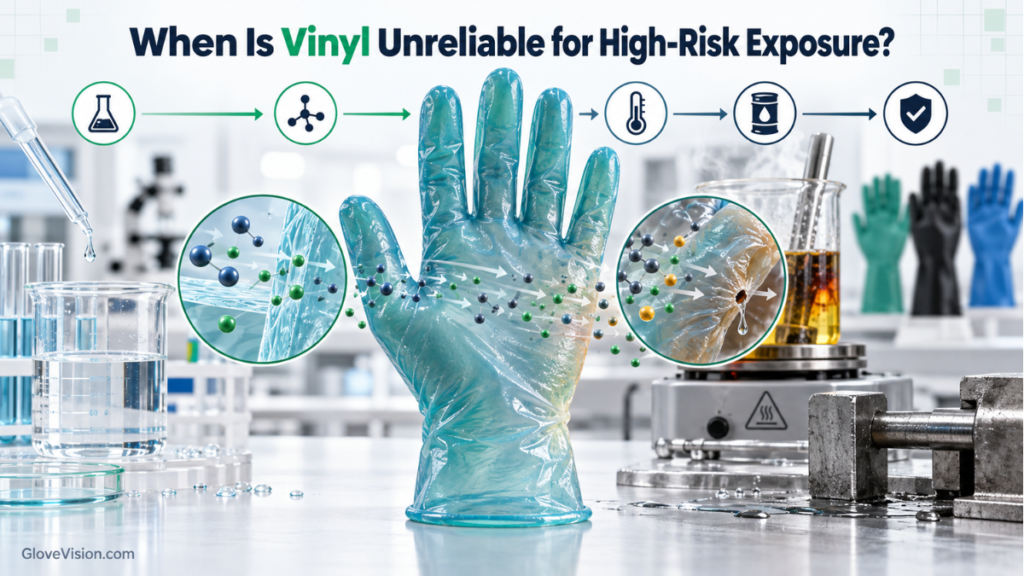
When Is Vinyl Unreliable for High-Risk Exposure?
Vinyl/PVC Gloves become unreliable for high-risk exposure when the consequences of barrier failure are serious and the exact glove lacks sufficiently applicable evidence for the chemical, concentration, temperature, contact duration, mixture, and physical task. Generic PVC resistance is therefore not enough for a high-consequence decision.
PVC remains useful for many selected acids, bases, salts, water solutions, and alcohol exposures, but the protection margin can shrink when temperature rises, contact is prolonged, mixtures are involved, the glove thins under pressure, degradation or reuse has occurred, or the exact product differs from the tested construction. The decision therefore moves from high-risk threshold to protection margin, chemical boundaries, integrity and reuse, and finally specialist comparison and exact-product verification.
What Defines the High-Risk Threshold for Vinyl/PVC Gloves?
The high-risk threshold for Vinyl/PVC Gloves is reached when the likely consequence of barrier failure and the severity of exposure demand more confidence than a generic PVC compatibility rating can provide.
Why Does Chemical Toxicity Raise the Evidence Standard?
High-risk selection is not defined by chemical family alone. The consequence of skin contact matters because a chemical may cause local injury, penetrate the skin, or contribute to systemic effects. As consequence rises, tolerance for uncertain breakthrough should fall; however, toxicity by itself does not determine which glove polymer is appropriate. [OSHA]
Why Does Prolonged Contact Raise Risk?
Incidental splash, repeated splash, contaminated-surface contact, sustained liquid contact, continuous contact, and immersion are not equivalent exposure modes. Longer contact creates more opportunity for chemical uptake and diffusion, so duration becomes increasingly important as the consequence of breakthrough rises. See vinyl duration limits.
Why Does Immersion Require More Confidence Than Splash Work?
Immersion can maintain continuous chemical challenge across exposed glove surfaces. A product or data source that supports a limited splash task should therefore not automatically be treated as evidence for continuous immersion. The intended contact mode needs to be represented by the evidence used for selection.
Why Does Elevated Temperature Increase the Evidence Requirement?
OSHA states that permeation rates are affected by temperature and that increasing temperature increases permeation rate. This makes room-temperature evidence less transferable when a process is substantially hotter: the higher-temperature task needs evidence that is sufficiently representative of the intended conditions.
Why Does Concentration Matter?
Concentration is a core glove-selection variable. A result obtained for one concentration should not automatically be transferred to a materially different concentration, particularly when the consequence of a wrong assumption is substantial.
Why Do Unknown or Complex Mixtures Increase Uncertainty?
Mixtures can create a different barrier challenge from individual components. One solvent may move through a polymer more readily or help carry another component through it, which is why complete formulation information becomes especially important in consequential work.
Why Does Mechanical Stress Belong in a High-Risk Decision?
Gripping, tools, sharp edges, abrasion, puncture, and repeated flexing can challenge physical integrity while chemical exposure challenges the polymer itself. A defensible barrier must remain both chemically and physically adequate for the complete task.
What Decision Rule Defines the High-Risk Threshold?
High consequence plus unsupported or marginal exact-product evidence means generic PVC compatibility should not be the basis for relying on the glove. OSHA’s generic material table remains useful for screening: it describes PVC as having very good physical properties and medium chemical resistance, with use areas including strong acids and bases, salts, other water solutions, and alcohols, while also warning that plasticizers can be stripped. [OSHA] For the material-level context, see Vinyl/PVC glove material.
| High-Risk Factor | Why Protection Margin Shrinks | Required Response |
|---|---|---|
| High local or systemic toxicity | Even limited barrier failure may carry significant consequence. | Require strong exact-product evidence. |
| Prolonged contact | More time is available for chemical transport through the barrier. | Use duration-relevant data. |
| Immersion | The chemical challenge is maintained continuously over exposed surfaces. | Require continuous-contact evidence. |
| Elevated temperature | Permeation may accelerate as temperature rises. | Use temperature-relevant evidence. |
| High or materially different concentration | The tested chemical challenge may no longer represent the task. | Match concentration closely. |
| Complex mixture | Component interactions can make single-chemical predictions unreliable. | Use mixture-specific or conservative assessment. |
| High mechanical stress | Local thinning or physical damage can reduce the available barrier. | Assess chemical and mechanical demands together. |
| Difficult-to-detect permeation | Visible inspection may not provide warning before molecular transport occurs. | Use conservative exact-product selection. |
Why Does a Smaller Protection Margin Make Vinyl/PVC Gloves Less Reliable?
Vinyl/PVC Gloves become less reliable as the required protection margin narrows because real workplace conditions can reduce barrier performance relative to generic compatibility labels or idealized laboratory expectations.
Why Is OSHA’s Medium Chemical Resistance Classification Important?
OSHA characterizes PVC as having medium chemical resistance rather than universal chemical resistance. That description supports PVC as a useful candidate material for defined tasks, but it does not provide a numerical resistance score or establish suitability for a high-consequence exposure.
Why Does High-Risk Work Need More Than a Compatibility Label?
Labels such as “good,” “fair,” “resistant,” or “recommended” may not tell the reader the tested concentration, temperature, glove thickness, breakthrough endpoint, permeation rate, cumulative permeation, degradation behavior, or contact mode. High-risk selection should therefore move beyond the label to the underlying test documentation.
Why Can Real Protection Be Lower Than Laboratory Expectations?
OSHA cautions that actual breakthrough can be shorter than reported values because performance is affected by temperature, glove thinning at pressure points, degradation, reuse, solvent mixtures, batch variability, manufacturer, and exact glove model. OSHA notes that model-to-model variability is particularly important for disposable gloves because formulations and fillers can differ. [OSHA]
Why Does Gripping Pressure Matter?
OSHA specifically notes that glove material can thin at pressure points where a worker grips a tool or otherwise applies pressure. The correct interpretation is qualitative: local thinning and added mechanical stress can reduce the available barrier at that location. It should not be converted into an invented percentage loss.
Why Does Model Variability Matter?
“PVC” identifies the broad material family, not one fixed barrier performance. Exact formulation, thickness, construction, manufacturer, and model can change performance, so high-risk evidence should remain tied to the finished glove that was actually tested.
Why Should High-Risk Decisions Be Conservative?
Uncertainty about breakthrough, degradation, mixture interaction, integrity, or remaining glove condition carries greater consequence when exposure is severe. For the broader material boundary behind this principle, see vinyl barrier limits.
Which Chemicals and Exposure Conditions Push Vinyl/PVC Gloves Beyond a High-Risk Boundary?
Vinyl/PVC Gloves move beyond a defensible high-risk boundary when exact evidence does not support the named chemical under the actual concentration, temperature, duration, mixture, and contact mode—even when the broader chemical family appears compatible in generic guidance.
When Can Acids or Bases Still Exceed Vinyl/PVC Gloves?
OSHA lists strong acids and bases among generic PVC use areas, but that material-family screening does not establish unlimited high-risk protection. Concentrated, heated, prolonged, immersive, or mixed acid/base exposures still require evidence applicable to the exact product and conditions.
Why Do Aromatic Solvents Require Stronger PVC Evidence?
Benzene, toluene, and xylene are distinct chemicals. High-consequence aromatic exposure should therefore be matched to chemical-specific PVC permeation and degradation evidence rather than treated as suitable or unsuitable solely because the chemical belongs to the aromatic family.
Why Do Chlorinated Solvents Require Specialist-Level Verification?
Dichloromethane, trichloroethylene, tetrachloroethylene, and chloroform should be evaluated individually. Evidence for one chlorinated solvent should not be transferred to another without supporting data. If exact PVC evidence is absent or inadequate, compare exact specialist products rather than infer protection from the polymer name.
Why Do Ketones and Esters Need Separate Review?
Acetone, MEK, ethyl acetate, and other ketones or esters can present different material interactions. Relevant concerns may include uptake, swelling, additive extraction, permeation, and material-property change, but the actual result remains chemical- and product-specific.
Why Do Plasticizer-Stripping Chemicals Create Additional Concern?
OSHA specifically identifies plasticizer stripping as a PVC limitation. If exposure removes formulation components, material properties may change and assumptions based on the original unexposed glove may no longer remain sufficiently reliable. The material mechanism is discussed further in Vinyl/PVC structure behavior.
How Does Longer Contact Increase Permeation Risk?
Greater contact time creates more opportunity for sorption and diffusion and can increase cumulative permeation potential. Splash, intermittent contact, repeated contact, continuous contact, and immersion should therefore remain separate exposure categories rather than being collapsed into one generic “chemical contact” label.
Why Does Temperature Matter So Much in High-Risk Use?
OSHA states that permeation rate increases as temperature increases. A result generated at one temperature therefore should not be treated as verified performance for a substantially hotter process without supporting evidence.
Why Are Solvent Mixtures Especially Concerning?
OSHA reports that solvent-mixture breakthrough can in many cases be considerably shorter than would be predicted from the individual components. Where specific mixture data are unavailable, OSHA’s non-mandatory hazard-assessment guidance advises selecting on the basis of the component with the shortest applicable breakthrough time because solvents can carry active ingredients through polymeric materials. This is a conservative screening approach, not a substitute for mixture testing. [OSHA]
Why Must Test Concentration and Thickness Match Closely?
A result from another concentration, thickness, construction, or glove model does not automatically establish performance for the product being selected. As the consequence of failure increases, the acceptable evidence-transfer gap should become smaller. For the dedicated contact-duration boundary, see vinyl duration limits.
When Should PVC Leave the Candidate List?
Escalate or reject the proposed product when chemical identity or mixture composition is unresolved, exact product data are absent, permeation or degradation is unacceptable, temperature or duration exceeds the evidence, immersion is unsupported, or the required protection margin cannot be demonstrated.
| Exposure Zone | Generic PVC Position | High-Risk Concern | Response |
|---|---|---|---|
| Selected aqueous acids | Common candidate zone | Concentration, heat, duration, immersion | Require exact-product evidence. |
| Selected aqueous bases | Common candidate zone | Heat and prolonged contact | Require exact-product evidence. |
| Alcohols | Generic candidate zone | Exact alcohol, concentration, duration | Verify the finished product. |
| Aromatic solvents | High-risk decision requires chemical-specific evidence | Permeation and degradation may be product-specific | Compare specialists if evidence is weak. |
| Chlorinated solvents | High verification demand | Individual solvent behavior | Require exact data or specialist evaluation. |
| Ketones / esters | Product-specific | Uptake, extraction, permeation, material change | Require exact chemical/product evidence. |
| Complex mixtures | High uncertainty | Mixture may differ from component predictions | Use mixture-specific or conservative assessment. |
| Elevated temperature | Generic data may understate challenge | Faster permeation can reduce margin | Require temperature-relevant evidence. |
| Prolonged immersion | Continuous chemical challenge | Smaller protection margin | Require continuous-contact evidence. |
Which Physical Integrity and Reuse Limits Make Vinyl/PVC Gloves Unreliable?
Vinyl/PVC Gloves become unreliable immediately when physical integrity is lost, and they can also become unreliable more subtly after chemical exposure or reuse changes the material even when no obvious hole is visible.
Direct Opening
A pinhole, puncture, tear, split, or crack creates a direct pathway through the glove.
Intact-Material Permeation
Chemical molecules can move through apparently intact material without creating a visible opening.
Previous-Use Change
Degradation, additive loss, swelling, residual chemical, and mechanical weakening can reduce confidence in future performance.
Why Are Pinholes Critical in High-Risk Exposure?
A pinhole creates a physical leakage pathway. FDA-recognized ASTM D5151-19(2023) is specifically a method for detecting holes in medical gloves that permit water leakage under the test conditions. ASTM F739, by contrast, addresses chemical permeation through protective-clothing materials. Physical hole integrity and chemical permeation are therefore separate questions. [FDA/ASTM]
Why Does Thin Disposable Construction Require More Caution?
Thin construction can support dexterity and low bulk, but severe exposure combined with puncture, abrasion, stretching, or pressure creates a smaller available material margin. Thin construction does not automatically mean unreliable; it means the exact product and task require evidence proportionate to the consequence.
Why Does Grip Pressure Matter?
OSHA identifies local thinning at pressure points during gripping or tool use as a real-world limitation that can make actual glove performance less protective than idealized laboratory assumptions.
Why Do Abrasion, Puncture, and Tears Matter More in High-Consequence Work?
Chemically adequate intact material cannot compensate for a through-film opening. A puncture, tear, or other unacceptable discontinuity defeats barrier continuity independently of the polymer’s chemical-resistance profile.
Why Is Inspection Necessary but Insufficient?
Inspection can identify punctures, tears, cracks, severe swelling, hardening, tackiness, or cuff damage, but visual appearance cannot prove that permeation has not occurred, that absorbed chemical is absent, or that remaining breakthrough performance is unchanged. See vinyl pinhole risk.
Why Can Previous Chemical Exposure Reduce Future Protection?
Previous exposure can involve degradation, plasticizer extraction, swelling, residual absorbed chemical, or physical weakening. The magnitude and significance of those changes depend on the exact chemical, glove formulation, construction, exposure, and subsequent handling.
Why Does Reuse Raise a High-Risk Concern?
OSHA specifically cautions that glove degradation and reuse can dramatically reduce impermeability to chemicals. A previously exposed glove should therefore not automatically be assumed to retain its original barrier performance.
Why Is Decontamination Not Automatic Restoration?
Surface cleaning may remove external contamination without reversing chemical permeation, absorbed solvent, additive loss, swelling, polymer degradation, or mechanical damage. A reuse or decontamination procedure should therefore be supported by the manufacturer and workplace assessment rather than improvised from appearance alone.
Why Does Unknown Exposure History Matter?
If the previous chemical, concentration, temperature, duration, or decontamination history is unknown, the remaining barrier condition is also less certain. That uncertainty carries more weight when the consequence of failure is high.
When Can Reuse Be Considered?
Reuse should be considered only where the product is intended for reuse, the previous chemical exposure is known, applicable decontamination and inspection procedures exist, replacement criteria are defined, and continued barrier performance is supported for the intended task.
When Should the Exact Glove Be Replaced Immediately?
Replace or reject the glove when there is an unacceptable hole, puncture, tear, split, crack, major degradation, loss of structural integrity, unresolved damaging exposure, or a manufacturer-defined end-of-use condition.
How Should Vinyl/PVC Gloves Be Compared and Verified Before High-Risk Use?
Vinyl/PVC Gloves should be used for high-risk exposure only when the exact product has sufficiently applicable chemical and physical evidence for the task; otherwise, specialist products should be compared under the same exposure conditions.
When Can Nitrile Be a Candidate?
OSHA’s generic table describes nitrile as having excellent physical properties and dexterity while also identifying chemical weak zones. Nitrile may therefore be a practical candidate for some tasks, but it is not a universal high-risk replacement for PVC.
When Can Neoprene Be a Candidate?
OSHA’s generic table lists neoprene use areas that include oxidizing acids, anilines, phenol, glycol ethers, and toluene. Those broad material-level categories can help identify a candidate, but the exact chemical, concentration, temperature, duration, and finished-product evidence still control the decision.
When Can Butyl Be a Candidate?
OSHA positions Butyl as a specialty glove material for selected polar organics and lists glycol ethers, ketones, and esters among its use areas. That specialist profile should not be generalized to every chemical or every Butyl glove.
When Can PVA or Fluoroelastomer Be Considered?
OSHA describes PVA as a specialty organic-solvent material with water-related limitations and fluoroelastomer as an organic-solvent specialist with its own physical and chemical limitations. Exact finished-product evidence remains necessary before either becomes a high-risk selection.
When Should a Multilayer Barrier Be Evaluated?
A multilayer product may warrant evaluation when mixture composition is complex, breakthrough consequences are severe, extended contact is expected, or conventional single-material products lack sufficiently applicable evidence. Multilayer construction should not be described as universally superior; the exact product still needs relevant evidence.
Why Must Alternatives Be Compared Under Equivalent Conditions?
Compare exact chemical or formulation, concentration, temperature, contact mode, duration, tested thickness and construction, test standard and endpoint, degradation behavior, mechanical task, and required coverage. Only after those variables are aligned should usability or operational practicality be compared. See vinyl selection tradeoff.
| High-Risk Condition | PVC Direction | Alternative Direction | Required Evidence |
|---|---|---|---|
| Concentrated aqueous acid/base | Exact PVC may remain a candidate. | Compare when heat or contact severity exceeds available PVC data. | Exact chemical and product testing. |
| Aromatic solvent | Generic PVC evidence is insufficient for a high-risk decision. | Evaluate exact neoprene, fluoroelastomer, multilayer, or other tested products. | Chemical-specific data. |
| Chlorinated solvent | High verification demand. | Evaluate exact PVA, fluoroelastomer, multilayer, or another supported specialist. | Exact solvent/product evidence. |
| Ketone / ester | Conditional and product-specific. | Butyl or another specialist may warrant comparison. | Exact product testing. |
| Complex mixture | Generic assumption is weak. | Evaluate mixture-tested or broader multilayer products where appropriate. | Complete formulation evidence. |
| High puncture / abrasion | PVC chemistry alone is insufficient. | Compare chemically compatible systems that also address mechanical hazards. | Whole-task assessment. |
| Unknown high-toxicity chemical | Do not rely on generic PVC. | Identify the hazard before selecting any specialist material. | Chemical identity first. |
| Long, hot immersion | Generic PVC data are insufficient. | Evaluate an exact continuous-contact product with relevant data. | Temperature and duration evidence. |
What Hazard Information Must Be Confirmed?
Record the exact chemical, CAS number where applicable, relevant local skin hazard, systemic dermal hazard, concentration, complete mixture information, and relevant safety-data information. Hazard consequence and exposure potential should be understood before the glove is selected.
Which Exposure Conditions Must Be Defined?
Define temperature, splash or intermittent or continuous or immersion contact, duration, frequency, pressure and gripping, contaminated-surface contact, mechanical stress, and required coverage. These variables determine whether laboratory or manufacturer evidence is sufficiently representative of real use.
Which Product Details Must Match the Evidence?
Confirm manufacturer, exact model, relevant PVC formulation where disclosed, thickness, disposable or reusable status, supported or unsupported construction, liner, cuff, surface or grip design, and relevant product certification. Polymer name alone is not an exact product specification.
Which Chemical-Barrier Measurements Matter?
ASTM F739-20 identifies breakthrough detection time, standardized breakthrough time, permeation rate, and cumulative permeation as key measures of chemical-barrier effectiveness. ASTM also states that its data cannot by themselves be used to infer safe dermal exposure levels and clarifies that standardized breakthrough beyond a stated period does not necessarily mean zero lower-rate permeation occurred during that period. [ASTM F739]
Why Can’t Breakthrough Time Be Used as an Automatic Safe-Wear Time?
Breakthrough is a laboratory barrier measurement under defined test conditions, not an automatic workplace change-out schedule. Actual workplace exposure can differ in temperature, pressure, contact mode, mechanical stress, contamination pattern, and other variables. The safe-use decision therefore requires a broader hazard and task assessment.
Which Physical-Integrity Evidence Matters?
Depending on product category and task, relevant evidence can include holes or leak integrity, puncture, tear, abrasion, tensile or elongation properties, and current physical condition. Medical-glove standards such as ASTM D5151 and ASTM D5250 must remain in their medical-product context and should not be converted into universal industrial chemical-glove acceptance criteria.
When Is Evidence Too Weak for High-Risk Use?
Escalate or reject the proposed use when a generic PVC chart is the main evidence; chemical identity, toxicity, or mixture composition is unresolved; the exact model is unknown; tested thickness, concentration, temperature, duration, or contact mode does not sufficiently represent use; degradation is significant; previous exposure history is uncertain; or physical integrity cannot be assured.
Complete each evidence layer before relying on the exact glove for consequential exposure.
Hazard Information
- Exact chemical identified.
- CAS number confirmed where applicable.
- Local skin hazard understood.
- Systemic dermal hazard understood.
- Concentration confirmed.
- Complete mixture composition reviewed where relevant.
Exposure Conditions
- Temperature defined.
- Splash, intermittent, continuous, or immersion contact defined.
- Duration documented.
- Frequency documented.
- Pressure and gripping requirements understood.
- Mechanical stress identified.
- Required coverage defined.
Exact Glove Product
- Manufacturer and exact model confirmed.
- PVC formulation or construction identified where available.
- Relevant thickness matches the evidence.
- Disposable or reusable status known.
- Supported or unsupported design identified.
- Cuff, liner, and grip are appropriate for the task.
Chemical-Barrier Evidence
- Chemical-specific data reviewed.
- Test concentration is sufficiently relevant.
- Test temperature is sufficiently relevant.
- Breakthrough endpoint is understood.
- Permeation rate reviewed where reported.
- Cumulative permeation reviewed where relevant.
- Degradation information reviewed separately.
- No safe-wear schedule inferred automatically from breakthrough time.
Integrity and Previous Use
- No unacceptable holes or tears are present.
- Pinhole control is appropriate to the product category.
- Puncture and abrasion demands are addressed.
- No unacceptable degradation is present.
- Previous chemical exposure is known.
- Reuse is permitted where applicable.
- Decontamination and replacement procedures are supported.
Alternative Comparison
- Only chemically adequate alternative products are compared.
- Alternative data represent equivalent exposure conditions.
- Physical task and required coverage are compared separately.
- A multilayer product is evaluated where its evidence better fits the hazard.
What Should Readers Remember About High-Risk Use of Vinyl/PVC Gloves?
Vinyl/PVC Gloves are not automatically unreliable in high-risk work, but generic PVC compatibility becomes insufficient as chemical toxicity, concentration, temperature, duration, immersion, mixture complexity, or the consequence of breakthrough increases. High-risk use requires evidence for the actual glove and exposure rather than confidence in the material name alone: the higher the consequence of breakthrough, the more exact the glove evidence must be.
Reliability must also account for real-use losses in protection, including pressure-related thinning, degradation, previous exposure, reuse, physical damage, and mixture effects. When the required protection margin cannot be demonstrated with chemical-specific and product-specific evidence, compare a more appropriate verified specialist barrier or redesign the exposure rather than relying on generic PVC resistance.
Which Questions Clarify When Vinyl/PVC Gloves Become Unreliable?
Are Vinyl/PVC Gloves Suitable for High-Risk Chemical Exposure?
Sometimes, but only when the exact PVC glove has sufficiently applicable chemical-specific, exposure-specific, and physical-integrity evidence. Generic PVC compatibility alone is not enough for a high-consequence task.
Does a Long Breakthrough Time Automatically Make Vinyl/PVC Gloves Safe?
No. Laboratory breakthrough does not itself establish safe wear time, and actual performance can change with temperature, local thinning, degradation, reuse, mixtures, formulation, and glove model.
Are Vinyl/PVC Gloves Reliable for Chemical Mixtures?
Not automatically. Mixture breakthrough can differ from the behavior of individual components. Use mixture-specific evidence where available; where specific mixture data are unavailable, OSHA provides a conservative screening approach based on the component with the shortest applicable breakthrough time.
Does Passing Pinhole Testing Prove Vinyl/PVC Gloves Are Chemically Protective?
No. Hole testing evaluates physical leakage pathways, while chemical permeation evaluates molecular transport through material. Both questions can matter, but one test cannot substitute for the other.
When Should Another Glove Replace Vinyl/PVC Gloves for High-Risk Work?
Compare another exact product when PVC lacks applicable permeation or degradation evidence, the actual exposure exceeds tested conditions, mixture or reuse uncertainty is substantial, physical integrity cannot be maintained, or another verified barrier provides stronger applicable evidence for the complete high-risk task.