
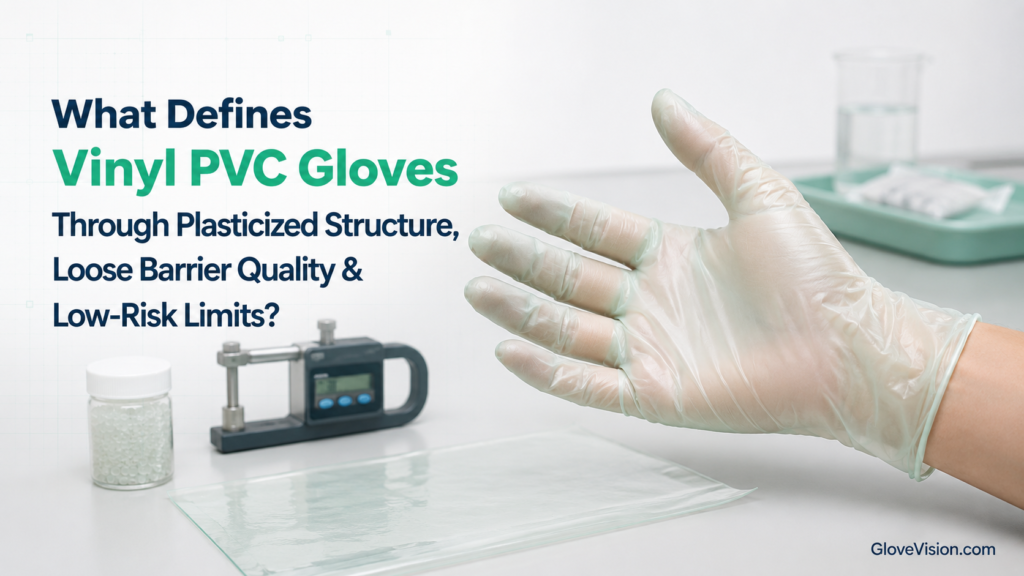
What Defines Vinyl PVC Gloves Through Plasticized Structure, Loose Barrier Quality & Low-Risk Limits?
Vinyl/PVC Gloves are made by adding flexibility-producing ingredients to polyvinyl chloride, creating economical disposable or reusable hand coverings that can support basic contamination separation and easy donning but have limited elastic recovery, construction-dependent fit, and variable barrier reliability.
Thin disposable vinyl gloves, regulated vinyl examination gloves, authorized food-contact products, general-purpose gloves, thicker reusable PVC chemical gloves, and PVC-coated work gloves are separate constructions whose intended uses, evidence, fit, and protection limits must not be treated as interchangeable.
What Are Vinyl/PVC Gloves, and How Does Their Plasticized Structure Shape Performance?
Vinyl/PVC Gloves are made from PVC resin combined with plasticizers and other formulation ingredients that convert a comparatively rigid polymer into a flexible glove film.
What Is the PVC Polymer Inside Vinyl Gloves?
Polyvinyl chloride provides the structural polymer base of Vinyl/PVC Gloves but requires formulation before it can function as flexible glove material. PVC resin, flexible compound, formed film, and finished glove represent separate stages. PubChem identifies PVC and its flexible plasticized forms at the material level. [PVC]
Why Do Vinyl/PVC Gloves Need Plasticizers?
Plasticizers make PVC softer and more flexible by increasing polymer-chain mobility and reducing rigidity. This supports film formation, donning, movement, and feel, but plasticizer presence alone proves neither regulatory status nor task suitability. The plasticized PVC structure of vinyl gloves explains the mechanism in greater depth.
Which Other Ingredients Can Change Vinyl/PVC Gloves?
Stabilizers, lubricants, pigments, processing aids, surface treatments, and other additives can change manufacture, feel, appearance, and aging. Products do not necessarily share the same additives or concentrations.
How Can Plasticizer Systems Affect Vinyl/PVC Gloves?
Plasticizer type and concentration can change softness, stretch behavior, grip feel, migration, extraction, and exposure response. No formulation can be ranked as universally safer or better without exact evidence.
Why Do Vinyl/PVC Gloves Have Limited Elastic Recovery?
Flexible PVC can stretch and deform during use without returning as closely to its original shape as highly elastic rubber materials. Hand heat, repeated movement, thickness, formulation, and sizing can contribute to relaxation and fit change.
Why Does the Vinyl/PVC Gloves Label Not Prove Performance?
The Vinyl/PVC Gloves label identifies a broad material category rather than one fit, grade, barrier, or protection level. Formulation, thickness, sizing, cuff, finish, intended use, defect control, and regulatory status vary. The relationship between vinyl and PVC glove categories helps separate disposable film from reusable and supported constructions.
| Material Factor | Possible Physical Effect | Practical Contribution | What It Does Not Guarantee |
|---|---|---|---|
| PVC resin | Structural polymer base | Forms glove film | Flexibility by itself |
| Plasticizer system | Increases flexibility | Supports donning and movement | Medical or food status |
| Film thickness | Changes feel and physical margin | Influences durability and tactility | Chemical suitability |
| Additives | Modify processing and aging | Product-specific characteristics | Equal safety across formulations |
| Surface treatment | Changes donning and friction | Easier handling | Barrier integrity |
| Manufacturing control | Influences defects and consistency | More predictable quality | Suitability for every task |
How Do Vinyl/PVC Gloves Construction and Fit Affect Barrier Reliability?
Vinyl/PVC Gloves can provide a useful intact barrier, but limited elastic recovery, variable fit, film defects, hand movement, and physical stress can reduce reliability during use.
Why Can Vinyl/PVC Gloves Fit More Loosely?
Vinyl/PVC Gloves may fit less closely when limited elastic recovery combines with broad sizing, hand-shape mismatch, glove relaxation, and excess material. Fingertip space, palm-width mismatch, hand heat, movement, product size, and glove shape can contribute; not every product fits loosely.
How Can Loose Fit Affect Performance?
Loose fit can interfere with handling by increasing bunching, internal movement, snagging, fingertip folds, and localized stress. It is a functional warning, not automatic proof that an intact glove is already leaking.
Which Defects Can Interrupt the Barrier?
Pinholes, punctures, tears, thin spots, split finger areas, damaged cuffs, and donning damage can interrupt the barrier. ISO 374-2 treats penetration resistance as a distinct test property rather than a conclusion inferred from appearance. [ISO 374-2]
How Do Movement and Duration Affect Vinyl/PVC Gloves?
Repeated flexion, gripping, friction, fingernail pressure, stretching, and longer wear increase opportunities for material stress and failure. No universal safe duration follows from the material name; the duration-related limits of vinyl gloves remain task- and product-specific.
How Does Product Grade Affect Barrier Claims?
Product grade controls the intended-use claims that can reasonably be made. Medical examination, food-contact, general-purpose, industrial disposable, reusable PVC, and PVC-coated work products carry different evidence and boundaries.
Why Should Failure Rates Not Be Universalized?
Vinyl-glove failure rates cannot be universalized because studies differ in products, thicknesses, sample sizes, stretching, duration, tasks, and defect definitions. CDC/NIOSH barrier findings under stretching apply to the exact products and test conditions studied, not the entire material family. [NIOSH Barrier]
| Factor | Possible Benefit | Possible Barrier Weakness | Required Verification |
|---|---|---|---|
| Thin disposable film | Low bulk and cost | Limited physical margin | Exact specifications |
| Limited elastic recovery | Relaxed donning | Loosening or bunching | Functional fit check |
| Correct size | Stable hand position | Sizing varies | Model-specific fit |
| Medical classification | Defined intended use | Not every medical hazard | Regulatory status and policy |
| Food-contact classification | Defined food role | Not medical by default | Exact authorization |
| Thicker reusable PVC | Greater chemical potential | More bulk | Chemical-specific data |
| Repeated movement | Task completion | Accumulating stress | Inspection and change |
Where Do Vinyl/PVC Gloves Provide a Useful Barrier, and Where Does Protection End?
Vinyl/PVC Gloves can provide basic separation from dirt, contamination, food, body fluids, or selected compatible liquids when the exact product is approved for the task, but they are not universal biological, chemical, or mechanical protection.
When Can Medical-Grade Vinyl/PVC Gloves Provide a Biological Barrier?
Medical-grade Vinyl/PVC Gloves may provide an examination barrier in procedures permitted by their regulatory status and facility policy. FDA classification identifies disposable PVC patient examination gloves as medical devices for a defined barrier role, not universal clinical approval. [FDA] CDC guidance recognizes intact medical-glove barrier value while noting product- and study-specific performance differences. [CDC]
Why Are Food-Contact Vinyl/PVC Gloves Not Medical Gloves?
Food-contact Vinyl/PVC Gloves are not automatically medical gloves because the classifications serve different intended uses and evidence requirements. CDC guidance for high-consequence infectious-disease PPE explicitly separates food-grade vinyl products from medical-grade gloves. [CDC PPE]
How Can Vinyl/PVC Gloves Support Food Handling?
Authorized food-contact Vinyl/PVC Gloves may separate hands from food during defined short tasks when local rules and change procedures are followed. Handwashing remains required, and authorization belongs to the exact formulation and conditions of use.
Which Chemicals May Suit Reusable PVC Gloves?
Thicker reusable PVC gloves may resist selected acids, alkalis, salts, alcohols, water-based solutions, or cleaning solutions when exact product data support the exposure. OSHA’s broad material guidance supports hazard-led evaluation but does not authorize an unspecified model. [OSHA] These possibilities must never be transferred to thin disposable vinyl film.
Which Chemicals Can Exceed the Protection Boundary?
Aggressive solvents, ketones, aromatic or chlorinated solvents, heated chemicals, concentrated formulations, and prolonged immersion can exceed many products’ limits. Verify chemical identity, concentration, temperature, contact, thickness, permeation, and degradation. The vinyl glove barrier limitations remain model-specific.
Which Physical Hazards Require Separate Protection?
Vinyl/PVC Gloves do not automatically protect against cuts, needlesticks, punctures, abrasion, impact, heat, flame, cryogenic liquids, or electrical hazards. Separate testing is required, particularly where the high-consequence exposure limits of vinyl gloves are reached.
Why Does Double-Gloving Not Correct an Unsuitable Product?
Double-gloving does not convert an incompatible product into a validated chemical, infection-control, or mechanical-protection system. Both layers may remain unsuitable, both can be damaged, cuffs remain entry points, and lost dexterity can create new task risk.
Which Vinyl/PVC Gloves Match Defined Low-Exposure Tasks, and Which Tasks Require Another Glove?
Vinyl/PVC Gloves are most defensible when an approved product matches a short, low-stress task and the consequence of barrier failure is limited and promptly controllable.
How Should a Low-Exposure Task Be Defined?
A low-exposure task must be defined through the hazard, contact amount, duration, hand movement, physical stress, and consequence of failure. “Low-risk” alone is meaningless; evaluate splash potential, tear or puncture exposure, replacement access, and required classification through defined low-exposure tasks for vinyl gloves.
Which General Tasks May Suit Vinyl/PVC Gloves?
General-purpose Vinyl/PVC Gloves may suit short, light tasks involving nonhazardous dirt or basic contamination separation when the exact product is intended for that use. Light housekeeping, short surface contact, nonsharp items, and frequent-change workflows are examples to assess—not automatic approvals.
Which Food Tasks May Suit Vinyl/PVC Gloves?
Food-contact Vinyl/PVC Gloves may suit defined food tasks when the exact product, food-contact conditions, local requirements, and change frequency align. Authorization, food composition, ready-to-eat rules, cross-contamination control, duration, and hand hygiene still govern use.
Which Medical Tasks May Suit Vinyl/PVC Gloves?
Medical-grade Vinyl/PVC Gloves may suit selected routine nonsurgical examination tasks when facility policy and procedure-specific risk permit. Medical-device status, limited physical stress, appropriate barrier expectation, and immediate replacement after damage remain necessary.
Which Tasks Should Not Rely on Thin Disposable Vinyl/PVC Gloves?
Thin disposable Vinyl/PVC Gloves should not be relied on when exposure, mechanical stress, or failure consequence exceeds product-level evidence. Hazardous immersion, aggressive solvents, untested chemotherapy agents, high-consequence infection, surgery, sharps, heavy abrasion, heat, flame, cryogenic exposure, and electrical work require other verified protection.
When Might Reusable Vinyl/PVC Gloves Be Appropriate?
Reusable Vinyl/PVC Gloves may be appropriate when thickness, coating coverage, cuff, grip, chemical compatibility, and reuse instructions match the task. Supported or unsupported construction, coating continuity, liner, cuff length, decontamination, and retirement criteria require separate evaluation.
Which Evidence Should Support Selection?
A Vinyl/PVC Gloves decision should be supported by evidence for the exact model, grade, intended use, fit, and exposure. Verify manufacturer, model, construction, thickness, sizing, regulatory status, food authorization, chemical compatibility, physical data, and change instructions. ISO 374-1 provides chemical-glove terminology and requirements but does not prove an unspecified glove complies. [ISO 374-1] These practical vinyl glove selection trade-offs must be resolved before use.
| Task Context | Required Product Evidence | Possible Vinyl/PVC Role | Main Warning |
|---|---|---|---|
| Short general task | General-purpose intended use | Basic separation | Not medical or chemical approval |
| Food handling | Exact authorization | Single-task separation | Change gloves and wash hands |
| Routine examination | Medical examination status | Barrier where permitted | Not every procedure |
| Chemical handling | Tested reusable PVC | Product-specific role | Disposable data are insufficient |
| High hand movement | Stable functional fit | Short controlled use | Loosening and stress |
| Sharp-object handling | Separate cut/puncture proof | No primary protective role | No needlestick protection |
| High-consequence exposure | Procedure-specific PPE | Only if explicitly approved | Generic selection is insufficient |
How Should Vinyl/PVC Gloves Be Selected, Used, Inspected, and Replaced?
Vinyl/PVC Gloves should be selected by product grade and task, checked for functional fit and defects, used for one controlled activity, and replaced after contamination, damage, task completion, or loss of reliable function.
What Should Be Verified Before Selection?
Selection must begin by verifying the exact task, exposure, construction, grade, size, intended use, and required evidence. Confirm disposable or reusable status, medical, food-contact, industrial, or general-purpose grade, thickness, authorization, compatibility, and change frequency.
How Should Fit Be Checked?
Vinyl/PVC Gloves should fit securely enough to preserve hand movement and grip without excessive bunching or internal slipping. Verify finger alignment, fingertip space, palm fit, thumb position, opening, closure, cuff stability, grip, and internal movement.
What Should Be Inspected Before Donning?
Pre-use inspection should reject gloves with visible defects, contamination, deterioration, damaged packaging, or uncertain identity. Check holes, tears, punctures, thin spots, split cuffs, incomplete fingers, discoloration, tackiness, hardening, contamination, and size.
How Should Disposable Vinyl/PVC Gloves Be Used?
Disposable Vinyl/PVC Gloves should be assigned to one defined task and replaced instead of washed or reused. Minimize unnecessary contact, change between contamination zones, replace after damage, control wear duration, and perform hand hygiene after removal.
When Should Vinyl/PVC Gloves Be Changed?
Disposable Vinyl/PVC Gloves should be changed whenever the task, contamination zone, barrier condition, fit, grip, or approved use period changes. Task or patient changes where applicable, incompatible contact, visible contamination, tears, punctures, and fit or grip deterioration are change points.
How Should Vinyl/PVC Gloves Be Removed?
Vinyl/PVC Gloves should be removed without touching the contaminated exterior with bare skin or transferring contamination to clothing and surfaces. Control cuffs, contain the exterior, use the correct waste stream, and perform hand hygiene.
How Should Reusable PVC Gloves Be Maintained?
Reusable Vinyl/PVC Gloves require product-specific cleaning, decontamination, drying, storage, inspection, and retirement procedures. Reusable care instructions must never be transferred to disposable vinyl gloves.
When Should Vinyl/PVC Gloves Be Rejected or Retired?
Vinyl/PVC Gloves must be rejected or retired when intended use, fit, integrity, compatibility, contamination status, or identity cannot be verified. Unstable fit, interfering bunching, damage, hardness, softness, stickiness, discoloration, unknown compatibility, uncontrolled contamination, and lost traceability stop use.
What Final Decision Determines Suitability?
Final suitability requires the task, product grade, intended use, fit, barrier demand, condition, and change procedure to align. Task and hazard → required grade → exact model → intended use and evidence → fit and movement → barrier and physical demand → change frequency → inspection → final use or rejection.
- Task, exposure, duration, movement, consequence, and separate hazard types are defined.
- Model, disposable/reusable status, grade, intended use, authorization, and chemical data are confirmed.
- Fingers, palm, thumb, closure, grip, cuff, bunching, and internal movement are acceptable.
- No holes, punctures, tears, thin spots, tackiness, hardness, contamination, package damage, or lost identity exists.
- One task, defined change points, no disposable reuse, correct removal, disposal, and hand hygiene are established.
- Use, resize, change, select another glove, retire, or do not use according to the first failed check.
Conclusion
Vinyl/PVC Gloves are economical plasticized-PVC hand coverings whose usefulness depends on matching an exact disposable or reusable product to a defined task, exposure, fit requirement, and consequence of failure. Formulations vary, limited elastic recovery can affect fit, loose fit is not universal, and medical, food-contact, general-purpose, and reusable PVC products are not interchangeable.
Begin with the task and hazard, verify product grade, confirm fit and barrier requirements, and keep thin disposable vinyl separate from reusable chemical PVC construction. Replace disposable gloves promptly, maintain hand hygiene, and select another tested glove whenever the exposure exceeds the exact product’s evidence.
Frequently Asked Questions
Are Vinyl Gloves and PVC Gloves the Same?
Generally, disposable vinyl gloves are made from flexible plasticized PVC. They still differ from reusable PVC gauntlets, PVC-coated work gloves, and supported PVC constructions.
Why Can Vinyl/PVC Gloves Become Loose During Use?
Flexible PVC has limited elastic recovery, while hand heat, movement, sizing, formulation, and hand shape can alter fit. Not every product fits loosely.
Are Food-Contact Vinyl/PVC Gloves Medical-Grade?
No—not automatically. Food-contact and medical-device classifications have different intended uses and evidence requirements.
Can Vinyl/PVC Gloves Protect Against Chemicals?
Some thicker, tested PVC gloves may resist selected chemicals, but thin disposable vinyl gloves should not be presumed chemically protective. Exact compatibility data are required.
When Should Vinyl/PVC Gloves Be Replaced?
Replace disposable gloves after task completion, contamination, tearing, puncture, fit deterioration, incompatible contact, or a zone change. Retire reusable products when compatibility, integrity, or contamination control cannot be verified.