
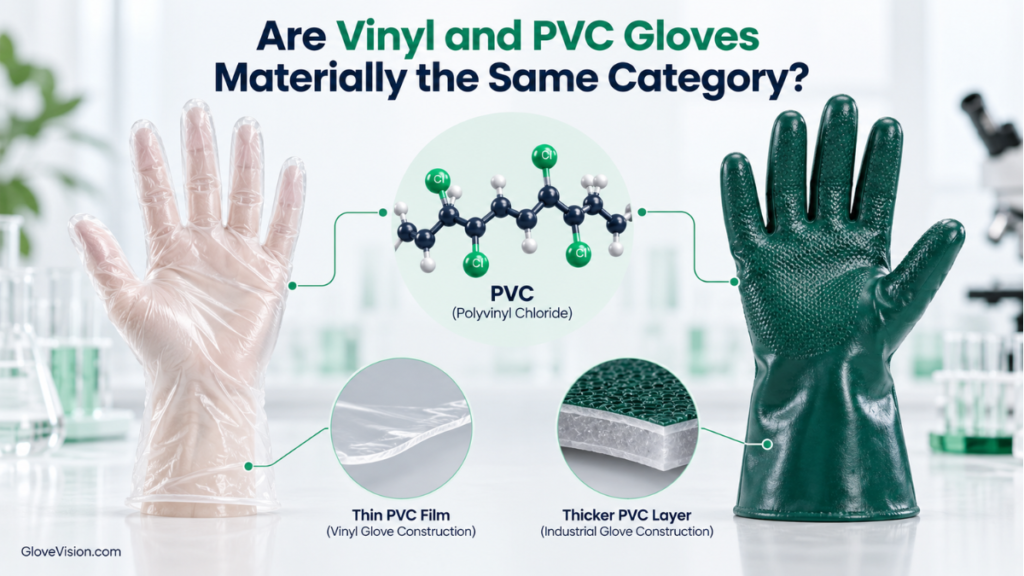
Are Vinyl and PVC Gloves Materially the Same Category?
Yes—at the base-material level, ordinary vinyl gloves are PVC gloves. “Vinyl” is the familiar commercial category name, while polyvinyl chloride, or PVC, is the chemically precise material designation. FDA defines a vinyl patient examination glove as a disposable device made from polyvinyl chloride.
That equivalence stops at material classification. Thin disposable vinyl gloves, medical PVC examination gloves, unsupported PVC chemical gloves, and PVC-coated industrial gloves can differ in formulation, thickness, support structure, grip, standards, barrier integrity, and chemical performance. The useful sequence is material identity → formulation → construction → terminology boundaries → exact-product verification.
What Material Identity Makes Vinyl/PVC Gloves the Same Basic Category?
Vinyl/PVC Gloves belong to the same basic material category because ordinary vinyl gloves use polyvinyl chloride as their principal synthetic glove material. “Vinyl” usually identifies the familiar disposable product category, whereas PVC identifies the polymer more precisely. Neither term by itself establishes the complete construction or performance of a finished glove.
What Does PVC Mean in Vinyl/PVC Gloves?
PVC means polyvinyl chloride. It is the chemically precise polymer designation. When a technical data sheet identifies a glove material as polyvinyl chloride or PVC, it is naming the underlying polymer family rather than a specific thickness, formulation, standard, or protection level.
The broader material characteristics belong to the dedicated vinyl PVC glove material discussion.
Why Are PVC Gloves Commonly Called Vinyl Gloves?
“Vinyl” is a conventional commercial term, especially in the thin disposable-glove market. FDA provides a direct regulatory example: its classification for a vinyl patient examination glove defines that medical device as a disposable glove made from polyvinyl chloride. [FDA]
The definition is strong evidence for the vinyl-to-PVC relationship within the medical examination-glove category, but it should not be expanded into a claim that every PVC-containing product is a disposable medical glove.
Does FDA Treat Vinyl and PVC as Separate Examination-Glove Materials?
No. Within the defined medical category, the vinyl examination-glove name and the PVC material identity refer to the same underlying polymer family. FDA also recognizes ASTM D5250-19(2023), Standard Specification for Poly(vinyl chloride) Gloves for Medical Application. [FDA/ASTM]
ASTM D5250’s scope is specifically medical PVC gloves. It does not establish performance for industrial PVC coatings, unsupported chemical gloves, or every disposable vinyl product.
Do Manufacturers Use Both Terms for the Same Product?
Yes. Commercial glove documentation can use “vinyl” as the product-category term while identifying polyvinyl chloride as the technical material. This is why the commercial name and technical material field should be read together rather than treated as competing material descriptions.
What Is the Correct Classification Rule for Vinyl/PVC Gloves?
Ordinary disposable vinyl glove = PVC-based glove at the material-classification level.
The next question is not whether the polymer family is the same, but how that polymer was formulated and constructed. This distinction also applies across the wider categories covered in glove materials explained.
Vinyl/PVC Gloves Terminology Equivalence Table
| Product Label | Base Material | Typical Product Meaning | Same PVC Family? |
|---|---|---|---|
| Vinyl glove | PVC | Usually flexible disposable glove | Yes |
| PVC glove | PVC | Broad PVC-based glove category | Yes |
| Vinyl examination glove | PVC | Medical disposable construction | Yes |
| PVC medical glove | PVC | Medical glove under applicable PVC specification | Yes |
| Unsupported PVC chemical glove | PVC | More substantial PVC barrier construction | Yes, different product type |
| PVC-coated work glove | PVC coating + support | Supported industrial construction | PVC present; complete glove differs |
| Vinyl-coated glove | Often PVC-based coating | Commercial term requiring specification check | Verify exact material |
Why Can Vinyl/PVC Gloves Share One Polymer but Behave Differently?
Vinyl/PVC Gloves can share the same PVC polymer family yet feel and perform differently because flexible glove behavior comes from the complete formulation and finished construction rather than PVC resin alone. Material identity is only the first layer of the finished product.
Why Is “Vinyl” Less Precise for Material Science?
Vinyl is an established commercial glove term. PVC or polyvinyl chloride is the chemically specific polymer term.
When discussing polymer structure, plasticization, chemical interaction, degradation, or formulation, PVC is the more precise description because it identifies the actual polymer rather than the commercial glove category.
Why Does Flexible PVC Require Formulation?
Flexible glove material is produced from a compounded system rather than being described adequately by PVC resin alone. At a controlled level, the relationship is:
PVC base polymer → plasticizer + stabilizers + other formulation components → flexible PVC compound.
Plasticization increases the molecular mobility needed for flexible film products. The detailed polymer mechanism belongs to the dedicated vinyl structure behavior page.
Why Can Plasticizer Systems Make Products Different?
Different plasticizer systems and overall formulations can affect softness, flexibility, elongation, aging behavior, chemical interaction, and extraction or migration behavior. Those effects should remain product-specific.
A specific plasticizer such as DEHP, DINP, or another compound should never be attributed to a glove merely because the glove is called vinyl. Manufacturer formulation evidence is required.
Why Can Two Vinyl/PVC Gloves Feel Different?
Two PVC-based disposable gloves can differ in plasticizer system, polymer formulation, thickness, surface finish, cuff design, processing, fit, and dimensions. Those variables can change tactility, stretch, grip, softness, and the user’s perception of flexibility even though both products remain within the same base polymer family.
Why Can Formulation Affect More Than Comfort?
Formulation can influence mechanical properties, flexibility, barrier behavior, chemical interaction, aging, and durability. It is therefore unsafe to treat formulation differences as merely cosmetic or comfort-related.
Same PVC family + different formulation ≠ same glove performance.
Which Construction Differences Separate Vinyl/PVC Gloves Into Distinct Product Types?
Construction is the main reason two Vinyl/PVC Gloves with the same base polymer can belong to very different practical product classes. Thin unsupported disposable film, medical examination gloves, more substantial unsupported PVC barriers, and supported PVC coatings cannot be treated as interchangeable merely because they contain the same polymer.
What Defines a Disposable Vinyl/PVC Glove?
A disposable vinyl glove is typically made as a thin flexible PVC film without a textile support structure. It commonly has a relatively short cuff and is intended for single-use or light-duty tasks defined by the exact product.
The word “vinyl” does not establish one universal thickness, hole specification, grip level, food-contact status, or medical status.
What Defines a Medical Vinyl/PVC Examination Glove?
A medical examination glove adds a defined medical intended use and applicable medical-product requirements to the PVC material identity. FDA’s classification defines the vinyl patient examination glove as a disposable PVC device intended for medical barrier use. [FDA]
FDA’s recognition of ASTM D5250 further demonstrates that medical PVC gloves form a defined specification category. Medical status should not be inferred merely because another product is made from PVC.
What Defines an Unsupported PVC Chemical Glove?
An unsupported PVC chemical glove uses PVC as the primary glove body without relying on a textile support substrate. Such products may use a more substantial construction than thin disposable vinyl gloves and can be designed for different contact conditions.
Selection requires the exact product’s chemical-resistance evidence, thickness, cuff length, construction details, applicable chemical standard, and intended-use limitations. Disposable-vinyl data should not be transferred to this category.
What Defines a PVC-Coated Work Glove?
A PVC-coated work glove combines PVC with another structural layer, commonly a textile or support substrate. The coating and support work together as a complete glove system rather than behaving like a thin unsupported vinyl film.
This difference is central to the vinyl practical tradeoff between disposable film and more substantial constructions.
Why Does the Support Substrate Matter?
A support substrate can alter abrasion resistance, tear behavior, flexibility, grip, thermal behavior, total thickness, and moisture handling. Complete-glove performance therefore cannot be assigned solely to the PVC coating.
Why Can Construction Matter More Than the Material Name?
PVC tells you what polymer is present; construction tells you how that polymer is used in the glove.
Two products can therefore be correctly classified within the same PVC family while requiring entirely different evidence for chemical contact, mechanical tasks, barrier integrity, reuse, or intended use.
Vinyl/PVC Gloves Construction Comparison Matrix
| Construction | Base Material Arrangement | Typical Structure | Main Verification Need |
|---|---|---|---|
| Disposable vinyl | Flexible PVC | Thin unsupported film | Fit, barrier integrity, intended use |
| Medical vinyl examination | Flexible PVC | Thin medical construction | Applicable standard + integrity |
| Unsupported chemical PVC | PVC | More substantial unsupported barrier | Exact chemical resistance |
| PVC-coated work glove | PVC + support textile | Supported/dipped coating | Coating + substrate + mechanical task |
| Specialized flexible vinyl | Modified PVC formulation | Thin unsupported film | Product-specific formulation/performance |
Which Terminology Boundaries Prevent Misreading Vinyl/PVC Gloves?
Vinyl/PVC Gloves terminology becomes misleading when a material name is treated as though it describes the entire construction, performance level, certification, or intended use of the finished glove. Material classification and finished-product selection are separate decisions.
Is “Vinyl” a Different Polymer From PVC?
For ordinary disposable gloves, no. FDA’s classification directly defines a vinyl patient examination glove as a disposable device made from polyvinyl chloride. [FDA]
This equivalence applies to the established glove-market meaning of “vinyl glove.” It should not be generalized to every polymer or material that happens to use “vinyl” elsewhere in its chemical or commercial name.
Does “PVC Glove” Always Mean Disposable Vinyl?
No. PVC is a broader material description. It can refer to thin disposable film, medical examination gloves, unsupported chemical gloves, supported or dipped industrial gloves, and PVC coating systems.
The phrase “PVC glove” therefore does not establish thickness, disposable or reusable status, support structure, medical status, or chemical-protective certification.
Can a Vinyl Chemical Rating Be Applied to Every PVC Glove?
No. Generic material compatibility can be useful for screening, but the final decision must move from the material family to the exact model and construction. Differences in formulation, thickness, temperature, concentration, contact duration, and glove architecture can prevent direct transfer of chemical-resistance data.
The separate vinyl resistance boundary page addresses those chemical-selection limits in greater detail.
Are “Vinyl-Free” and “PVC-Free” Always Identical Claims?
No universal equivalence should be assumed from marketing language alone. Where a manufacturer clearly uses “vinyl” to mean PVC, the two claims may refer to exclusion of the same polymer, but the manufacturer’s composition definition and claim scope should be checked.
A marketing label should not override the technical composition field.
Is Every Polymer Described as “Vinyl” Chemically PVC?
No. “Vinyl” is broader terminology outside this specific glove-market convention. This page’s equivalence applies specifically to the ordinary use of vinyl glove as a PVC-based glove category.
Can Polymer Identity Establish AQL, Thickness, or Intended Use?
No. PVC identity does not establish an AQL value, nominal thickness, food-contact status, medical-device status, disposable or reusable status, or chemical-protection certification.
Those characteristics belong to the exact finished product, its applicable standard, manufacturer documentation, and intended-use evidence.
Why Is Technical Material Disclosure Better Than Product Naming?
When terminology is unclear, prioritize the technical material specification, product data sheet, regulatory classification, construction description, applicable standards, and then the marketing name.
The commercial name is useful for identifying how a product is sold, but the technical data determine what it actually is and which evidence applies.
Vinyl/PVC Gloves Naming-vs-Performance Decision Matrix
| Label Seen | Likely Material Meaning | Can Performance Be Transferred? | Required Next Step |
|---|---|---|---|
| Vinyl glove | Usually flexible PVC | No | Confirm exact product |
| PVC glove | PVC-based product | No | Identify construction |
| Vinyl examination glove | PVC medical examination glove | Only within applicable product evidence | Verify standard/model |
| PVC-coated glove | PVC coating over substrate | No | Verify coating + support |
| Industrial PVC glove | Broad PVC category | No | Review exact chemical/task data |
| Vinyl-free claim | Marketing/composition claim | No | Read manufacturer’s definition |
| PVC-free claim | PVC excluded by claim | No | Confirm composition scope |
How Should Vinyl/PVC Gloves Be Verified Before the Terms Are Treated as Equivalent?
Vinyl and PVC should be treated as equivalent only for identifying the base material. As soon as suitability is being decided, the exact model, formulation, construction, standard, thickness, intended use, and performance evidence must replace generic terminology.
What Material Field Should Be Checked First?
Look for polyvinyl chloride, PVC, or a vinyl designation accompanied by technical confirmation of PVC composition.
A manufacturer technical specification is more reliable than marketplace shorthand. If a commercial name says “vinyl” but the technical material field identifies something different, the technical documentation should control the material classification.
Which Construction Details Must Be Confirmed?
Record whether the product is disposable or reusable, supported or unsupported, all-film or coated. Then verify thickness, cuff length, lining, support substrate, and surface or grip finish.
These details determine how the PVC is arranged and prevent a thin disposable film from being confused with a more substantial unsupported barrier or supported coating.
Which Formulation Details Matter?
Where disclosed, review the plasticizer system, DEHP/DINP or other formulation claims, powder status, specialized flexible formulation, relevant additives, and medical or food-contact formulation information.
Do not assume a particular plasticizer from the word “vinyl,” and do not transfer one manufacturer’s formulation statement to another PVC product.
Why Do Exact Product Examples Matter?
Exact-product examples are useful because products within the same PVC family can have different dimensions, formulations, quality specifications, and intended uses. A vinyl medical examination glove and a vinyl product intended for food-processing or light-duty tasks can both identify PVC as the material while remaining different finished products.
The comparison should be used to demonstrate variation, not to rank one PVC product over another.
Which Intended-Use Standards Must Be Checked?
Determine whether the product belongs to a medical, food-contact, chemical-protection, mechanical-protection, or another task-specific category. The applicable standard should match that category rather than being inferred from PVC composition alone.
FDA recognizes ASTM D5250-19(2023) for polyvinyl chloride gloves used in medical applications. Its scope includes PVC gloves used for medical examinations, diagnostic and therapeutic procedures, and handling contaminated medical material; FDA lists the standard with partial recognition. [FDA/ASTM]
That medical specification should not be transferred to industrial PVC-coated or unsupported chemical gloves.
Which Performance Evidence Must Match the Actual Task?
Depending on the task, review freedom from holes or other barrier-integrity requirements, chemical permeation, degradation, thickness, tensile and elongation properties, abrasion resistance, grip, coverage, relevant certification, and stated intended-use limitations.
Each metric answers a different question. An applicable hole specification does not automatically establish chemical resistance, while a chemical-resistance result does not automatically establish mechanical suitability or medical-device status.
Why Must Chemical Resistance Remain Product-Specific?
A thin disposable PVC examination glove and a more substantial industrial PVC glove share a polymer family but do not automatically share breakthrough times, degradation behavior, acceptable chemical-contact duration, reuse criteria, or mechanical protection.
Chemical identity, concentration, temperature, contact duration, glove thickness, construction, and exact manufacturer test evidence must match the intended task before chemical performance is transferred.
When Should “Vinyl = PVC” Stop Driving the Decision?
Immediately after base-material classification.
Vinyl label → PVC confirmed → classification complete → exact finished-product evidence takes over.
This prevents a correct terminology shortcut from becoming an incorrect performance shortcut.
Vinyl/PVC Gloves Product-Identity Verification Checklist
Material Identity
- Product label identified.
- Technical data sheet reviewed.
- PVC or polyvinyl chloride confirmed where “vinyl” is used.
- No performance assumption made from the commercial name.
Construction
- Disposable or reusable status known.
- Supported or unsupported status known.
- Coated versus all-film construction known.
- Thickness recorded.
- Cuff and coverage known.
- Grip or surface finish identified.
Formulation
- Relevant formulation information reviewed where disclosed.
- Plasticizer claims interpreted only from manufacturer evidence.
- Powder or formulation status checked where relevant.
- Product-specific formulation distinguished from generic PVC.
Applicable Standard / Intended Use
- Medical, food, industrial, chemical, or other category identified.
- Applicable standard or certification confirmed.
- Regulatory requirements are not transferred between product categories.
Performance
- Barrier-integrity requirement checked.
- Chemical resistance reviewed where relevant.
- Mechanical and task performance checked.
- Exact model data used rather than generic material reputation.
Final Classification
What Should Readers Remember About the Material Category of Vinyl/PVC Gloves?
Vinyl gloves and PVC gloves are materially the same basic category when “vinyl” refers to the ordinary disposable-glove material. PVC is polyvinyl chloride, and regulatory terminology directly defines a vinyl patient examination glove as a PVC device. Use “vinyl = PVC” to classify the base material, while remembering that the term “PVC glove” can cover a broader range of constructions than the familiar thin disposable vinyl glove.
Material equivalence does not create product equivalence. Flexible disposable vinyl film, medical examination gloves, unsupported chemical PVC gloves, and PVC-coated work gloves can differ substantially in formulation, plasticization, thickness, support, grip, standards, and barrier performance, so exact finished-product evidence must govern selection. Never use shared PVC identity alone to transfer chemical, mechanical, regulatory, or barrier performance between different glove constructions.
Which Questions Clarify Whether Vinyl/PVC Gloves Are the Same Category?
Are Vinyl/PVC Gloves Made From the Same Base Material?
Yes, in ordinary disposable-glove terminology. Vinyl gloves are made from polyvinyl chloride, so they belong to the PVC glove material family.
Are Vinyl/PVC Gloves the Same Finished Product?
Not necessarily. “Vinyl” commonly refers to thin disposable PVC gloves, while PVC can also describe thicker unsupported, supported, dipped, or coated industrial constructions. Exact product architecture determines performance.
Do All Vinyl/PVC Gloves Have the Same Chemical Resistance?
No. Formulation, plasticizer system, thickness, construction, temperature, chemical concentration, and manufacturer-specific performance data can change chemical resistance substantially.
Why Can Two Vinyl/PVC Gloves Feel Different if Both Are PVC?
Flexible PVC is a compounded material. Differences in formulation, plasticization, thickness, surface finish, fit, support construction, and manufacturing can change flexibility, grip, tactility, and durability.
Which Term Is Best When Discussing Vinyl/PVC Gloves Scientifically?
PVC or polyvinyl chloride is the more chemically precise material term. “Vinyl glove” remains appropriate for the established commercial product category, particularly thin disposable PVC gloves.