
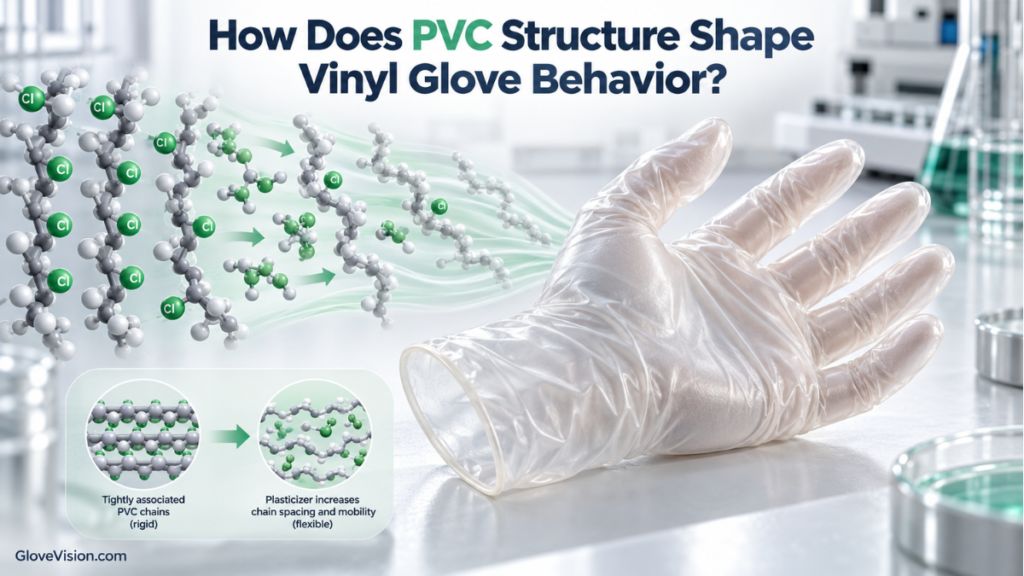
How Does PVC Structure Shape Vinyl Glove Behavior?
PVC structure shapes vinyl glove behavior by combining a relatively rigid chlorine-containing polymer with plasticizers that increase chain mobility and make flexible glove manufacture possible. The resulting compound can provide useful physical durability and chemical resistance for selected aqueous chemicals while remaining highly formulation-dependent.
The finished glove cannot be predicted from the PVC repeat unit alone. Plasticizer chemistry and loading, fillers, stabilizers, thickness, lining, surface treatment, processing, aging, temperature, and chemical contact all influence flexibility, permeation, degradation, grip, and serviceability, so this page moves from PVC molecular structure through plasticization, chemical response, aging boundaries, and exact-product verification.
What Molecular Features of PVC Gloves Control Their Basic Material Behavior?
PVC Gloves begin with a PVC polymer whose chlorine-containing repeat units contribute significant intermolecular interactions and comparatively restricted chain mobility. Flexible glove behavior therefore depends heavily on the complete compound, especially plasticization, rather than on the PVC repeat unit alone.
How Does the PVC Backbone Influence PVC Gloves?
PVC has a carbon–carbon polymer backbone with chlorine-containing repeat units. The chlorine contributes polar character and stronger interchain interactions than occur in simple nonpolar hydrocarbon polymers, helping make the unmodified material comparatively rigid.
PVC structure → comparatively restricted chain mobility → relatively rigid base polymer.
Why Is Unplasticized PVC Too Rigid for Typical Flexible Glove Construction?
Flexible PVC products depend on formulation changes that reduce stiffness and increase segmental movement. Peer-reviewed PVC literature describes plasticization through reduced effective polymer-chain interactions, chain slippage, and increased free volume, all of which support greater molecular mobility and flexible PVC behavior. [PVC Review]
Rigid base PVC → plasticization → increased segmental mobility → flexible compound.
How Does Chlorine Affect PVC Gloves Chemical Character?
The chlorine-containing repeat structure gives PVC a different polarity and intermolecular character from simple hydrocarbon polymers. That chemistry contributes to how chemicals interact with the material, but chlorine content alone cannot predict sorption, degradation, compatibility, or breakthrough time.
Why Does PVC Gloves Behavior Depend on More Than the Repeat Unit?
Finished behavior can change with polymer grade, molecular weight, plasticizer chemistry and loading, stabilizers, fillers, pigments, processing, surface finish, thickness, and manufacturing quality.
Same polymer label ≠ same finished-glove performance.
Why Must Material-Level Properties Be Separated From Finished PVC Gloves Performance?
Chemical-protective-glove performance must be evaluated at the finished-product level because formulation, thickness, test conditions, degradation, temperature, and actual exposure can affect barrier behavior. Generic material identity is therefore not a substitute for applicable chemical-resistance evidence for the selected glove. [OSHA]
This distinction is central to understanding glove materials explained: molecular structure helps explain behavior, but the finished protective product determines actual performance.
PVC Gloves Structure-to-Behavior Factors Table
| Structural / Formulation Factor | Material Effect | Practical Glove Consequence |
|---|---|---|
| PVC backbone + chlorine-containing repeat units | Comparatively restricted chain mobility | Rigid starting polymer |
| Plasticizer chemistry | Modifies chain interactions and free volume | Flexible PVC behavior |
| Plasticizer loading | Changes softness and mobility | Product-specific tactility and flexibility |
| Molecular weight / polymer grade | Changes processing and material behavior | Formulation-specific properties |
| Stabilizers / fillers | Modify processing and physical properties | Product-specific durability |
| Thickness | Changes barrier path and physical bulk | Chemical/usability trade-off |
| Surface finish | Changes surface traction | Grip differences |
| Processing / manufacturing | Influences final structure and quality | Finished-product variability |
Why Do PVC Gloves Depend on Plasticization for Flexible Performance?
PVC Gloves depend on plasticizers because these additives increase molecular mobility and lower the effective stiffness of PVC enough to create flexible, hand-conforming products. The same formulation change also means flexibility, chemical transport, migration, and extraction behavior can vary among products.
How Do Plasticizers Increase PVC Gloves Flexibility?
Peer-reviewed PVC literature describes several complementary plasticization mechanisms: reduced interaction between polymer chains, lubrication that allows chains to slip, and increased free volume that gives chains more room to move. These mechanisms support the conversion of comparatively rigid PVC into flexible formulations. [PVC Review]
Plasticizer incorporation → more molecular mobility → lower stiffness → greater flexibility.
Why Does Plasticizer Loading Change PVC Gloves Hand Feel?
Changing the complete formulation can alter softness, elongation, bending resistance, flexibility, and conformability. Plasticizer loading alone, however, does not establish tactility, grip, chemical resistance, or durability because polymer grade, additive package, thickness, construction, and processing also contribute.
Why Can Plasticization Affect PVC Gloves Barrier Behavior?
Plasticizer changes the composition and molecular environment of the PVC matrix. It can alter chain spacing and free-volume behavior, while the plasticizer itself may interact with contacting chemicals. Sorption and diffusion can therefore depend on the exact formulation rather than on PVC chemistry alone.
Plasticized PVC matrix ≠ chemically identical to unplasticized PVC.
Why Can Plasticizers Be Stripped From PVC Gloves?
OSHA specifically identifies “plasticizers can be stripped” as a generic PVC glove limitation. This means removal of formulation components must be considered where the contacting medium can extract the plasticizer, but the OSHA screening table does not identify every chemical capable of doing so or establish the behavior of an exact glove formulation. [OSHA]
Why Is Plasticizer Migration Different From Chemical Extraction in PVC Gloves?
Migration broadly concerns movement or loss of plasticizer from flexible PVC, while liquid extraction is one route by which plasticizer can leave the material when it contacts an external medium. Peer-reviewed flexible-PVC literature documents plasticizer migration and distinguishes mechanisms that include volatilization, liquid extraction, and movement into contacting phases. That material-level evidence does not establish a migration rate or service life for an exact glove. [PVC Migration Review]
How Do PVC Gloves Structure and Formulation Shape Chemical-Barrier Behavior?
PVC Gloves can provide useful resistance to selected aqueous chemicals because their polymer and formulation chemistry creates a practical medium-resistance barrier, but chemical transport and degradation remain specific to the exact compound, chemical, concentration, temperature, and finished construction.
What Must a Chemical Do to Permeate PVC Gloves?
Permeation is molecular transport through otherwise intact protective material, whereas penetration occurs through physical discontinuities such as holes or defects. Chemical-protective-clothing selection must also account for degradation because a material can change physically or chemically during exposure. [OSHA]
Chemical contact → sorption into material → diffusion through plasticized PVC → arrival at the inner surface.
Why Is Polymer Polarity Relevant but Insufficient for PVC Gloves?
The chlorine-containing polymer has polar character, so its interaction pattern differs from that of nonpolar hydrocarbon polymers. Polarity is only one part of chemical interaction, however, and cannot replace measured compatibility, degradation, or permeation evidence.
How Can Plasticizer Chemistry Change PVC Gloves Chemical Response?
Different formulations can change chemical affinity, matrix free volume, plasticizer extraction behavior, swelling, softening, hardening, and diffusion. These mechanisms help explain why two PVC products need not provide identical chemical performance.
Why Are Strong Acids and Bases Important PVC Gloves Candidate Zones?
OSHA characterizes PVC gloves as having very good physical properties and medium chemical resistance and lists strong acids and bases, salts, other water solutions, and alcohols among generic PVC use areas. This is material-family screening guidance rather than approval for an exact chemical, concentration, temperature, duration, or glove model. [OSHA]
Why Are Salts and Water Solutions Common PVC Gloves Applications?
Salts and other water solutions fall within OSHA’s generic PVC use guidance. The complete exposure still matters because dissolved additives, co-solvents, concentration, temperature, and contact pattern can change the challenge.
When Can Alcohol Exposure Suit PVC Gloves?
Alcohols also appear in OSHA’s generic PVC screening guidance, but the actual alcohol, concentration, mixture composition, temperature, contact duration, and finished glove must be checked before selection.
Why Does Useful Aqueous Resistance Not Mean Universal Solvent Resistance for PVC Gloves?
Useful acid/base/water screening performance ≠ universal organic-solvent resistance. Organic solvents can interact differently with the PVC matrix, plasticizer, and other additives. Some exposures may increase permeation, produce degradation, or remove formulation components.
Where PVC evidence is insufficient, chemically appropriate specialist materials can be investigated through Butyl selection trade-offs, Neoprene specialization trade-offs, PVA selection trade-offs, or Fluoroelastomer adoption limits. These are candidate comparisons, not universal rankings.
Why Does Thickness Matter Without Guaranteeing PVC Gloves Protection?
Thickness is one barrier variable, but it does not establish protection by itself. Chemical identity and concentration, temperature, material formulation, degradation, glove model, exposure pattern, and applicable test conditions must also be considered before translating laboratory data to actual use.
PVC Gloves Chemical-Response Matrix
| Exposure Zone | Generic PVC Screening Position | Main Qualification | Editorial Decision |
|---|---|---|---|
| Strong aqueous acids | Common candidate | Identity, concentration, and temperature matter | Verify exact glove |
| Strong bases | Common candidate | Hot or concentrated contact requires exact evidence | Verify exact glove |
| Salts | Common candidate | Complete formulation matters | Usually favorable screening zone |
| Water solutions | Common candidate | Dissolved additives may alter challenge | Product-specific |
| Alcohols | Common candidate | Individual alcohol, concentration, and duration matter | Verify |
| Mixed aqueous / organic formulations | Conditional | Co-solvents or additives may control failure | Complete-formulation assessment |
| Aggressive organic solvents | More conditional | Permeation or extraction may dominate | Exact-product data required |
| Unknown mixtures | No defensible family approval | Chemical challenge unresolved | Escalate |
How Do Plasticizer Stability, Aging, Temperature, and Task Demands Set PVC Gloves Boundaries?
PVC Gloves performance can change after manufacture or during use because plasticizers may migrate or be extracted, chemicals can degrade the compound, temperature can change molecular transport and mobility, and physical tasks can damage the finished barrier.
How Can Plasticizer Migration Affect PVC Gloves Over Time?
Peer-reviewed flexible-PVC literature establishes plasticizer migration as a material phenomenon and describes loss of plasticizer as a cause of deterioration in flexible-PVC material performance. That evidence supports the mechanism but does not establish the migration rate, remaining barrier performance, or service life of a particular glove. [PVC Migration Review]
How Can Chemical Extraction Accelerate Change in PVC Gloves?
Liquid extraction is one documented route of plasticizer loss from flexible PVC. OSHA separately identifies plasticizer stripping as a generic PVC glove limitation. Whether meaningful extraction occurs in a specific glove still depends on the actual formulation, contacting chemical, exposure conditions, and product evidence.
Extracting medium → possible plasticizer loss → composition changes → altered material behavior → reassessment.
Why Does Repeated Exposure Matter for PVC Gloves?
Repeated use can combine chemical uptake, extraction, degradation, abrasion, flexing, and physical damage. A reusable lifetime should therefore come from applicable manufacturer and workplace criteria rather than from the generic PVC material category.
How Does Higher Temperature Affect PVC Gloves?
Temperature is a relevant chemical-glove selection variable and can change barrier performance. Because workplace conditions may differ from laboratory test conditions, demanding service should be matched to product evidence that reflects the actual temperature, concentration, contact pattern, and glove construction. [OSHA]
How Can Cold Affect PVC Gloves Flexibility?
Lower temperature can reduce segmental mobility in a plasticized polymer and potentially increase apparent stiffness. The magnitude depends on the exact formulation, so a universal cold-use temperature should not be assigned without product-specific evidence.
Why Do Grip and Surface Finish Matter for PVC Gloves?
Smooth, textured, roughened, or patterned surfaces can provide different handling behavior. OSHA specifically includes dry, wet, and oily grip, dexterity, glove features, size and comfort, chemical identity, concentration, temperature, contact duration, and mechanical resistance among glove-selection factors. Grip is therefore a finished-product feature rather than a property that can be predicted from the PVC repeat unit. [OSHA]
Why Do Abrasion, Puncture, and Repeated Flexing Matter for PVC Gloves?
Chemical compatibility cannot compensate for a physical penetration route. OSHA’s glove-selection framework specifically requires abrasion, puncture, and tear resistance to be considered according to the job or task.
When Should PVC Gloves Be Removed From Service?
For reusable products, follow applicable manufacturer and workplace criteria and reassess gloves showing cracks, tears, punctures, excessive hardening, severe softening, swelling, tackiness, loss of grip, delamination where applicable, or an unresolved contamination history. Visual appearance alone cannot establish zero permeation or remaining chemical protection.
PVC Gloves Plasticizer-and-Aging Boundary Matrix
| Change / Condition | Possible Material Effect | Practical Consequence | Required Response |
|---|---|---|---|
| Plasticizer migration | Composition or property shift | Flexibility or surface behavior may change | Inspect / reassess |
| Solvent extraction | Plasticizer depletion | Hardening or altered physical/barrier behavior | Replace / reassess |
| Repeated chemical exposure | Cumulative degradation possible | Reduced confidence in continued performance | Follow reuse/replacement criteria |
| Higher temperature | Barrier behavior may change | Actual service may differ from reference test conditions | Use temperature-relevant data |
| Low temperature | Reduced molecular mobility | Increased stiffness possible | Product-specific cold assessment |
| Abrasion / puncture | Physical barrier damage | Penetration pathway | Remove damaged product |
| Poor task grip | Reduced object control | Handling difficulty | Compare grip construction |
| Unknown prior exposure | Uncertain remaining condition | Unverified continued performance | Escalate / replace |
How Should PVC Gloves Be Verified Before Final Selection?
PVC Gloves should be selected from exact-product evidence rather than generic PVC reputation. The chemical, concentration, temperature, contact pattern, construction, chemical test data, grip, physical durability, and glove condition must all match the intended task.
What Chemical Information Must Be Confirmed for PVC Gloves?
Record the exact chemical name, CAS number, concentration, complete commercial formulation, relevant co-solvents or other active ingredients, and applicable SDS information. Generic family names are not enough when formulation components can change the challenge.
Which Exposure Conditions Must Be Defined for PVC Gloves?
Document temperature, splash or immersion, repeated contact, duration, frequency, mechanical stresses, and required hand or forearm coverage. OSHA identifies chemical type, frequency and duration, nature of contact, concentration, temperature, abrasion/puncture/tear resistance, required coverage, dexterity, grip, glove features, size, and comfort as glove-selection factors. [OSHA]
Which PVC Gloves Product Details Must Match?
Verify the manufacturer, exact model, reusable or disposable design, thickness, lining, surface and grip finish, cuff length, supported or unsupported construction where relevant, disclosed plasticizer information where available, and applicable chemical-protection documentation.
A proprietary plasticizer formulation is not by itself a reason to reject a product when adequate finished-glove evidence supports the intended exposure.
Which Chemical-Resistance Measurements Matter for PVC Gloves?
Review the exact test chemical, concentration, temperature, tested thickness, test method, breakthrough detection time, standardized breakthrough time where applicable, permeation rate, cumulative permeation where available, and degradation information from applicable sources.
ASTM F739-20 addresses permeation of liquids and gases through protective clothing materials under continuous-contact conditions and includes standardized breakthrough and cumulative-permeation reporting. ASTM also states that data from this test method cannot by themselves be used to infer safe exposure levels. [ASTM]
Why Must Mixtures Be Treated Conservatively for PVC Gloves?
Mixture behavior should not be assumed from a generic PVC label or from one component alone. Where applicable mixture-specific finished-glove data are unavailable, assess the complete formulation conservatively rather than assuming the principal ingredient determines barrier performance.
Why Must Work Activities Be Included When Selecting PVC Gloves?
Assess dexterity, dry/wet/oily grip, abrasion, puncture, tear, fit, coverage, duration, frequency, and safe removal. A chemically adequate PVC material can still be the wrong finished glove if the physical construction does not suit the task.
When Should PVC Gloves Be Rejected or Escalated?
Reject, replace, compare, or escalate when the chemical identity or complete formulation is unresolved, exact-product evidence is unavailable or inadequate, actual temperature or contact exceeds the supporting evidence, serious degradation or plasticizer loss is suspected, grip or mechanical performance is inadequate, physical damage creates a penetration route, or generic “PVC resistance” remains the main basis for selection.
PVC Gloves Product-Verification Checklist
Chemical Identity
- Exact chemical is confirmed.
- CAS number is recorded.
- Concentration is known.
- Complete mixture is reviewed.
- Relevant SDS information is checked.
Exposure Conditions
- Temperature is defined.
- Splash, repeated contact, or immersion is established.
- Contact duration is known.
- Frequency is documented.
- Mechanical demands are identified.
- Coverage requirement is defined.
Exact PVC Product
- Manufacturer and model are confirmed.
- Thickness is documented.
- Reusable or disposable construction is identified.
- Lining or support construction is known.
- Surface and grip design are understood.
- Cuff and coverage are appropriate.
Chemical Evidence
- Exact chemical-specific data are reviewed.
- Breakthrough endpoint is understood.
- Permeation rate is reviewed where available.
- Degradation is reviewed.
- Test temperature and concentration are compared with actual use.
- Mixture limitations are assessed.
- No safe-wear time is inferred automatically from laboratory breakthrough.
Physical Condition and Task
- Flexibility is acceptable.
- Grip is adequate.
- Dexterity is adequate.
- No cracks, tears, or punctures are present.
- No unacceptable swelling, hardening, softening, or tackiness is present.
- Safe removal is possible.
Final Decision
What Should Readers Remember About How PVC Structure Shapes PVC Gloves?
PVC Gloves behave as flexible protective products because a comparatively rigid PVC polymer is compounded with plasticizers and other additives that modify chain mobility and finished material properties. That formulation controls much of the flexibility, hand feel, chemical interaction, and physical behavior associated with vinyl gloves. Use molecular structure to understand why the glove behaves as it does—not to approve an exact product.
The same formulation dependence creates important boundaries. Plasticizers can migrate or be extracted, chemical transport depends on the exact compound and exposure, and temperature, thickness, aging, construction, and physical damage can change performance. PVC structure explains the mechanism, but suitability belongs to the exact chemical, formulation, finished product, test evidence, condition, and task.
Which Questions Clarify How PVC Structure Affects PVC Gloves?
Why Are PVC Gloves Flexible if PVC Is Naturally Rigid?
Flexible PVC Gloves contain plasticizers and other formulation ingredients that increase polymer-chain mobility and lower material stiffness. The final degree of flexibility depends on the complete compound and finished glove construction rather than on the PVC repeat unit alone.
Do More Plasticizers Always Make PVC Gloves Better?
No. Plasticization can increase softness and flexibility, but formulation changes can also alter physical properties, migration behavior, chemical interaction, and barrier performance. More plasticizer is not a universal measure of glove quality.
Which Chemicals Commonly Suit PVC Gloves?
Strong acids and bases, salts, water solutions, and alcohols are common generic PVC screening areas. Exact chemical identity, concentration, mixture composition, temperature, contact duration, and finished-glove evidence still determine whether a particular PVC Glove is suitable.
Why Can PVC Gloves Become Harder After Chemical Exposure?
Some chemicals can extract or strip compatible plasticizer from flexible PVC. A change in plasticizer content can alter flexibility and other physical properties. Significant hardening should therefore trigger product-specific inspection and reassessment rather than being treated as a quantitative measure of protection loss.
When Should PVC Gloves Be Replaced?
Replace or reassess an exact glove according to manufacturer and workplace criteria when cracking, puncture, severe hardening, swelling, tackiness, loss of grip, other unacceptable degradation, or an uncertain chemical-exposure history makes continued performance unreliable. Visual integrity alone does not prove that chemical protection remains adequate.