Where Does Vinyl Barrier Protection Become Limited?
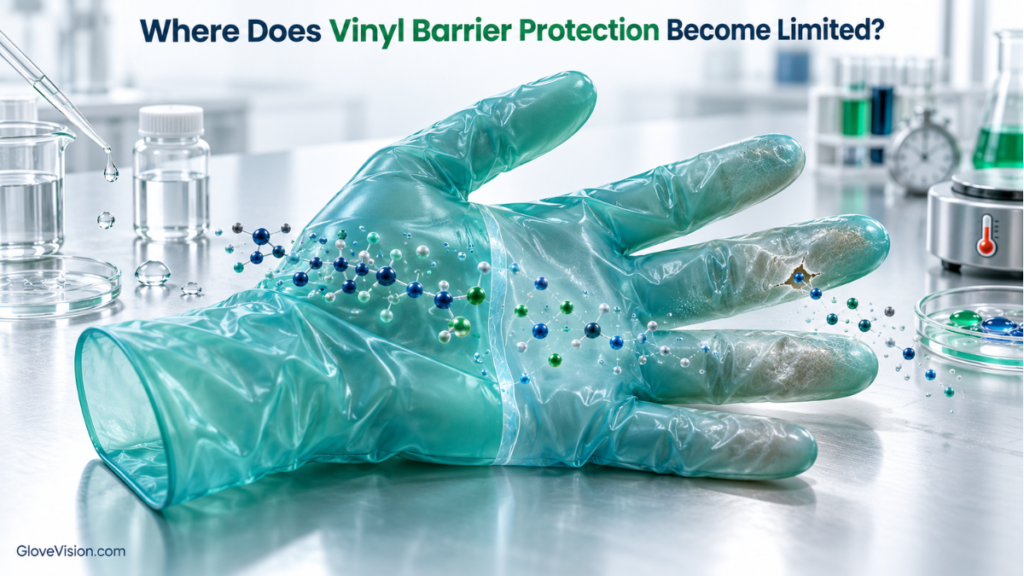
Vinyl/PVC Gloves become limited when the exact chemical, concentration, temperature, contact duration, mixture, or physical task exceeds the evidence available for the finished PVC glove. PVC is commonly useful as a candidate for selected aqueous acids, bases, salts, other water solutions, and alcohols, but its chemical resistance is conditional rather than universal.
Barrier loss can follow different routes: chemicals can permeate intact PVC or degrade the material, while pinholes, punctures, tears, or cracks can create direct physical pathways. Disposable vinyl and heavier industrial PVC constructions also should not be assumed equivalent. Selection therefore has to connect the chemical and exposure conditions to evidence for the actual finished glove.
What Defines the Useful Barrier Scope of Vinyl/PVC Gloves?
Vinyl/PVC Gloves are reasonable candidate barriers for selected aqueous acids and bases, salts, other water solutions, and alcohol exposures, but OSHA’s material-level guidance should be treated as a screening boundary rather than approval of an exact glove for an exact chemical task.
Which Chemical Groups Does OSHA Place Within the Generic PVC Candidate Zone?
OSHA’s chemical-resistant glove selection table describes PVC as low-cost, with very good physical properties and medium chemical resistance. Its listed use areas are strong acids and bases, salts, other water solutions, and alcohols. The same OSHA table also warns that PVC plasticizers can be stripped. These statements define a useful material-level starting point, not universal compatibility. [OSHA]
Why Must the Exact Exposure Still Be Defined for Vinyl/PVC Gloves?
OSHA identifies the chemical being handled, frequency and duration of contact, nature of contact, concentration, temperature, abrasion, puncture and tear requirements, required protection length, dexterity, grip, and glove features among factors affecting glove selection. Consequently, a broad PVC compatibility category is only the beginning of the selection process. [OSHA]
Why Is the Useful Scope of Vinyl/PVC Gloves a Screening Boundary?
Material-family guidance cannot establish that every PVC formulation, thickness, glove construction, or model performs identically. The intended use should therefore move from generic PVC candidate → exact chemical and exposure → exact finished-product evidence. For the broader material context, see Vinyl/PVC glove material.
| Selection Factor | Why It Matters | Boundary Effect |
|---|---|---|
| Exact chemical | Material response is chemical-specific. | Can move a product from candidate to unsupported. |
| Concentration | OSHA identifies concentration as a glove-selection factor. | Evidence should represent the intended concentration. |
| Temperature | Temperature affects selection and permeation behavior. | Room-temperature evidence may not represent hotter use. |
| Contact duration | Frequency and duration are OSHA selection factors. | Longer contact increases the evidence requirement. |
| Contact mode | OSHA distinguishes immersion, splash, mist, and contaminated surfaces. | Exposure mode must match the protective decision. |
| Thickness / construction | Material thickness and finished construction affect barrier performance. | Do not transfer results automatically between products. |
| Mixture composition | Mixtures can behave differently from individual components. | Complete-formulation evidence may be needed. |
| Physical condition | Holes, tears, and punctures create direct pathways. | Barrier continuity can be lost regardless of chemical compatibility. |
Why Do Permeation, Degradation, and Plasticizer Loss Narrow Vinyl/PVC Gloves Protection?
Vinyl/PVC Gloves can lose protective value through molecular permeation, chemical degradation, or both. These mechanisms are different from a visible hole and must be evaluated separately from ordinary physical inspection.
What Is Permeation Through Vinyl/PVC Gloves?
OSHA defines permeation as the process by which a chemical dissolves in or moves through a protective material on a molecular basis. OSHA also notes that in most cases there is no visible evidence that a chemical is permeating the material. An intact-looking glove therefore does not by itself demonstrate absence of permeation. [OSHA]
How Is Degradation Different From Permeation in Vinyl/PVC Gloves?
OSHA’s protective-clothing guidance treats permeation, degradation, and penetration as separate chemical-resistance considerations. Permeation concerns molecular movement through material; degradation concerns damaging changes in the material caused by exposure; penetration concerns passage through physical openings or discontinuities. A sound assessment therefore should not use one of these mechanisms as a proxy for the others.
Why Does Plasticizer Loss Matter for Vinyl/PVC Gloves?
OSHA’s PVC glove-selection entry specifically identifies plasticizers can be stripped as a PVC disadvantage. This supports treating plasticizer extraction as a genuine material limitation rather than assuming that flexible PVC will retain the same properties after every chemical exposure. [OSHA]
Which Variables Can Change Permeation Through Vinyl/PVC Gloves?
OSHA states that permeation rate is a function of factors including chemical concentration, material thickness, humidity, temperature, and pressure. This is why a breakthrough result obtained under one set of test conditions should not be treated as a universal property of every PVC glove or every workplace exposure. [OSHA]
What Does ASTM F739 Actually Establish for Vinyl/PVC Gloves?
ASTM F739-20 identifies breakthrough detection time, standardized breakthrough time, permeation rate, and cumulative permeation as key measures of chemical-barrier effectiveness. ASTM also states that the test data cannot by themselves be used to infer safe dermal exposure levels. A standardized breakthrough time reported beyond a specified period means the defined permeation-rate threshold was not exceeded during that period; ASTM explicitly notes that permeation may still have occurred at a lower rate. [ASTM F739]
Why Must Finished-Product Evidence Remain Specific for Vinyl/PVC Gloves?
ASTM F739 expressly applies to protective-clothing materials and includes specimens from finished items such as gloves. OSHA also identifies material thickness and other exposure variables as factors affecting permeation. For that reason, evidence should remain tied to the tested construction rather than being transferred automatically between thin disposable vinyl and heavier PVC glove designs. For more on the construction mechanism, see Vinyl/PVC structure behavior.
Which Chemicals and Exposure Conditions Push Vinyl/PVC Gloves Beyond Their Barrier Boundary?
Vinyl/PVC Gloves move beyond a defensible generic selection boundary when the chemical or formulation falls outside supported evidence, when contact becomes more demanding, or when concentration, temperature, duration, or mixture conditions are not represented by the available finished-product data.
Why Do Organic Solvents Require Product-Specific Evidence for Vinyl/PVC Gloves?
OSHA’s generic PVC entry lists strong acids and bases, salts, other water solutions, and alcohols as PVC use areas; it does not provide a blanket approval for organic solvents. The same entry warns that plasticizers can be stripped. Organic-solvent selection should therefore rely on applicable chemical-specific data rather than extrapolation from PVC’s aqueous candidate zone.
Why Should Aromatics, Chlorinated Solvents, Ketones, and Esters Be Verified Individually for Vinyl/PVC Gloves?
These labels describe broad chemical families, not one exposure. Benzene is not toluene; dichloromethane is not trichloroethylene; acetone is not MEK; and one ester result does not establish another. The exact chemical or complete formulation should therefore be matched to evidence for the actual glove rather than inferred from family membership.
Why Do Mixtures Raise the Evidence Requirement for Vinyl/PVC Gloves?
OSHA’s protective-clothing guidance notes that mixtures can present chemical-resistance problems that are not resolved simply by knowing performance against individual chemicals. When the workplace product is a formulation, selection should account for the complete relevant composition rather than only the principal ingredient. [OSHA]
Why Do Duration and Contact Mode Matter for Vinyl/PVC Gloves?
OSHA identifies frequency and duration of chemical contact and the nature of contact—including total immersion, splash, mist, and contaminated surfaces—as glove-selection factors. Incidental splash and prolonged continuous contact therefore should not be treated as equivalent tasks. See vinyl duration limits.
Why Does Temperature Matter for Vinyl/PVC Gloves?
OSHA identifies chemical temperature as a glove-selection factor and separately states that permeation rate is affected by temperature. Consequently, test data generated under one thermal condition should not automatically be assumed representative of substantially hotter use.
When Should Vinyl/PVC Gloves Move From Generic Screening to Specialist Verification?
Escalate when chemical identity is uncertain, a mixture is unresolved, exposure concentration or temperature is not represented, contact becomes prolonged or immersive, or the consequence of failure is high. See vinyl high-risk limits for the high-consequence boundary and vinyl selection tradeoff when another verified barrier must be compared.
| Exposure Zone | Screening Position | Main Boundary Concern | Required Response |
|---|---|---|---|
| Strong acids / bases | Listed by OSHA as generic PVC use areas | Exact concentration, temperature, contact pattern | Verify the finished glove. |
| Salts / water solutions | Listed by OSHA as generic PVC use areas | Formulation and additives | Review the complete exposure. |
| Alcohols | Listed by OSHA as a generic PVC use area | Exact alcohol and exposure conditions | Verify chemical-specific product data. |
| Other organic solvents | Do not infer suitability from the generic PVC table | Permeation, degradation, plasticizer extraction | Require applicable chemical-specific evidence. |
| Mixtures | Higher uncertainty | Combined formulation challenge | Seek formulation-relevant evidence. |
| Elevated temperature | Test conditions may not represent use | Temperature-dependent permeation | Match evidence to relevant conditions. |
| Prolonged / continuous contact | Higher evidence requirement | Duration and nature of contact | Require evidence appropriate to the task. |
Which Physical Integrity Limits Can Defeat Vinyl/PVC Gloves Barrier Protection?
Vinyl/PVC Gloves can lose barrier continuity through holes, pinholes, punctures, tears, splits, cracks, or other discontinuities even when the underlying PVC material would otherwise be chemically suitable for the exposure.
Chemical Permeation
Molecular movement through material that may remain visibly intact.
Physical Penetration
Passage through an opening or discontinuity such as a hole, tear, or puncture.
Why Are Pinholes Different From Permeation in Vinyl/PVC Gloves?
FDA’s recognition record for ASTM D5151-19(2023) identifies it as the Standard Test Method for Detection of Holes in Medical Gloves. FDA states that its scope is detection of holes that permit water leakage under the conditions of that test and that safe and proper use of medical gloves is outside the method’s scope. ASTM F739, by contrast, measures chemical permeation through protective-clothing materials. Hole detection and chemical permeation therefore answer different barrier questions. [FDA/ASTM D5151]
Why Can Mechanical Demands Defeat Vinyl/PVC Gloves?
OSHA explicitly includes abrasion, puncture, and tear resistance requirements among glove-selection factors. A glove that is chemically compatible but physically inadequate for sharp, rough, or abrasive work may therefore be the wrong finished product for the complete task.
Why Must Physical and Chemical Evidence Be Considered Together for Vinyl/PVC Gloves?
Chemical compatibility does not repair a physical opening, while the absence of a visible hole does not prove that molecular permeation is absent. Selection and continued use therefore require separate attention to chemical resistance and physical integrity.
When Should Physically Damaged Vinyl/PVC Gloves Be Removed From Service?
A glove should not continue to be relied upon as an intact barrier when unacceptable holes, punctures, tears, splits, cracks, or other discontinuities are identified under the applicable product and workplace procedure. For the dedicated integrity issue, see vinyl pinhole risk.
How Should Vinyl/PVC Gloves Be Compared and Verified Before Their Barrier Is Relied On?
Vinyl/PVC Gloves should be relied upon only when the exact exposure and physical task are supported by applicable evidence for the finished product. If that evidence is incomplete, compare another verified glove under equivalent chemical and task conditions rather than ranking materials by polymer reputation alone.
How Should Alternative Materials Be Screened Against Vinyl/PVC Gloves?
OSHA’s generic glove-selection table assigns different broad use areas and limitations to PVC, nitrile, neoprene, Butyl, PVA, fluoroelastomer, and other glove materials. That table is useful for identifying candidates, but it does not replace finished-product evidence for the actual exposure. [OSHA]
Why Must Alternatives to Vinyl/PVC Gloves Be Compared Under Equivalent Conditions?
A meaningful comparison should hold the controlling exposure variables as constant as possible: exact chemical or formulation, concentration, temperature, nature and duration of contact, relevant construction, chemical test endpoint, and physical task. An ASTM F739 permeation result for one finished product should not be treated as directly equivalent to a generic compatibility statement for another polymer.
| Controlling Exposure | PVC Direction | Comparison Direction | Evidence Requirement |
|---|---|---|---|
| Strong acid / base | Generic PVC candidate area | Retain or compare according to exact-product data | Exact chemical and exposure evidence |
| Salt / water solution | Generic PVC candidate area | Compare when another task variable controls | Complete formulation and product evidence |
| Alcohol | Generic PVC candidate area | Compare when exact PVC evidence is inadequate | Exact alcohol and product evidence |
| Organic solvent outside generic PVC use guidance | Do not infer suitability | Compare products with applicable solvent data | Chemical-specific permeation/degradation evidence |
| Complex mixture | Higher uncertainty | Compare only evidence-supported products | Formulation-relevant evidence |
| High puncture / abrasion demand | Chemical adequacy alone is insufficient | Compare compatible constructions that also meet physical needs | Chemical + physical task evidence |
Which Exposure Variables Must Be Defined for Vinyl/PVC Gloves?
OSHA’s glove-selection guidance identifies chemical type, frequency and duration of contact, nature of contact, concentration, temperature, abrasion, puncture and tear resistance, required length of protection, dexterity, grip, glove features, thermal protection, size, comfort, and price as relevant factors. The chemical-barrier decision should therefore be connected to the whole task rather than chemical name alone. [OSHA]
Which Product Details Must Match the Evidence for Vinyl/PVC Gloves?
Record the exact product, construction, relevant thickness, and intended use. For medical PVC gloves specifically, FDA recognizes ASTM D5250-19(2023), titled Standard Specification for Poly(vinyl chloride) Gloves for Medical Application. FDA’s scope states that it covers certain requirements for PVC gloves used in medical examinations, diagnostic and therapeutic procedures, and handling contaminated medical material. That medical scope should not be generalized into chemical approval for every industrial PVC glove. [FDA/ASTM D5250]
Which Chemical-Barrier Measurements Matter for Vinyl/PVC Gloves?
ASTM F739 identifies breakthrough detection time, standardized breakthrough time, permeation rate, and cumulative permeation as key barrier measures. ASTM also cautions that F739 data cannot by themselves establish safe dermal exposure levels. Use the reported test conditions and endpoint rather than converting a breakthrough number automatically into workplace wear time.
Why Must Medical Integrity Standards Stay in Context for Vinyl/PVC Gloves?
FDA recognizes ASTM D5151-19(2023) for detecting holes in medical gloves and ASTM D5250-19(2023) for PVC gloves used in medical applications. FDA also lists ASTM F739-20 as a recognized standard for permeation of liquids and gases through protective-clothing materials under continuous contact. Because their scopes and endpoints differ, satisfying one type of test should not be presented as satisfying the others.
When Is the Evidence Insufficient to Rely on Vinyl/PVC Gloves?
Escalate when the exact chemical or formulation is unresolved, exposure conditions do not match available evidence, the tested construction is not the selected glove, physical demands exceed the product’s capability, or the only basis for selection is a generic polymer-family statement.
Before relying on the barrier, confirm that the chemical, exposure, finished glove, evidence, and physical condition all describe the same real-world task.
Chemical Information
- Identify the exact chemical rather than only its broad family.
- Confirm the CAS number where applicable.
- Record the concentration used in the actual task.
- Review the relevant formulation when a mixture or commercial product is involved.
- Identify co-solvents or other components that may alter the barrier challenge.
Exposure Conditions
- Define the actual exposure temperature.
- Distinguish splash, intermittent contact, continuous contact, and immersion.
- Record expected contact duration and frequency.
- Consider pressure where relevant to the process or test comparison.
- Assess abrasion, puncture, tear, grip, dexterity, and coverage requirements.
Exact Glove Product
- Confirm the manufacturer and exact glove model.
- Match relevant thickness and construction to the evidence.
- Distinguish disposable from reusable construction.
- Confirm support, lining, cuff, and other task-relevant features where applicable.
Chemical-Resistance Evidence
- Review chemical-specific permeation evidence applicable to the finished product.
- Identify whether the value is breakthrough detection time or standardized breakthrough time.
- Review permeation rate and cumulative permeation where reported.
- Review degradation information separately from permeation evidence.
- Confirm that concentration and temperature represent intended use closely enough for the decision.
- Do not convert ASTM F739 breakthrough information automatically into a safe workplace wear time.
Physical Condition
- Check the glove using the applicable manufacturer and workplace inspection procedure.
- Reject unacceptable holes, tears, punctures, splits, or cracks.
- Look for evidence of material degradation or loss of physical integrity.
- Confirm that the glove remains mechanically adequate for the actual task.
Alternative Comparison
- Compare only alternative products with evidence relevant to the actual chemical.
- Use equivalent concentration, temperature, duration, and contact conditions when comparing products.
- Evaluate chemical-barrier performance and physical-task performance separately.
- Escalate when neither PVC nor an alternative has adequate applicable evidence.
What Should Readers Remember About the Barrier Limits of Vinyl/PVC Gloves?
Vinyl/PVC Gloves can be useful candidate barriers for selected chemical tasks, and OSHA’s generic guidance specifically lists strong acids and bases, salts, other water solutions, and alcohols among PVC use areas. That broad material guidance does not establish compatibility for every formulation, concentration, temperature, duration, construction, or finished glove.
Reliable selection therefore requires two separate questions: does applicable chemical-resistance evidence support the exact finished glove under the intended exposure, and does the glove remain physically intact and adequate for the task? Permeation, degradation, and physical penetration are distinct failure mechanisms, so none should be used as a substitute for evidence about the others.
Which Questions Clarify the Barrier Limits of Vinyl/PVC Gloves?
Are Vinyl/PVC Gloves Good Chemical Barriers?
For selected chemicals, Vinyl/PVC Gloves can be useful candidate barriers. OSHA lists strong acids and bases, salts, other water solutions, and alcohols among generic PVC use areas while describing PVC as having medium chemical resistance. Exact finished-product and exposure evidence determines suitability.
Are Vinyl/PVC Gloves Suitable for Organic Solvents?
Not universally. Generic PVC guidance does not establish compatibility with a specific organic solvent. Chemical-specific permeation and degradation evidence applicable to the exact finished glove and exposure conditions should guide the decision.
Does an Intact Vinyl/PVC Glove Mean Chemicals Cannot Pass Through It?
No. OSHA describes permeation as molecular movement through a material and notes that visible evidence is often absent. A glove can therefore look intact while permeation is occurring.
Do Pinholes Mean Vinyl/PVC Gloves Are Chemically Weak?
No. A pinhole is a physical discontinuity, whereas chemical resistance concerns how the material responds to the chemical exposure. Hole integrity and chemical permeation answer different barrier questions.
When Should Vinyl/PVC Gloves Be Replaced or Rejected?
Replace, reject, or escalate an exact glove when unacceptable physical damage or degradation is present, applicable integrity requirements are not met, exposure exceeds conditions supported by available evidence, or chemical-resistance data do not support the intended task.