
Which Lower-Risk Tasks Fit Vinyl Best?
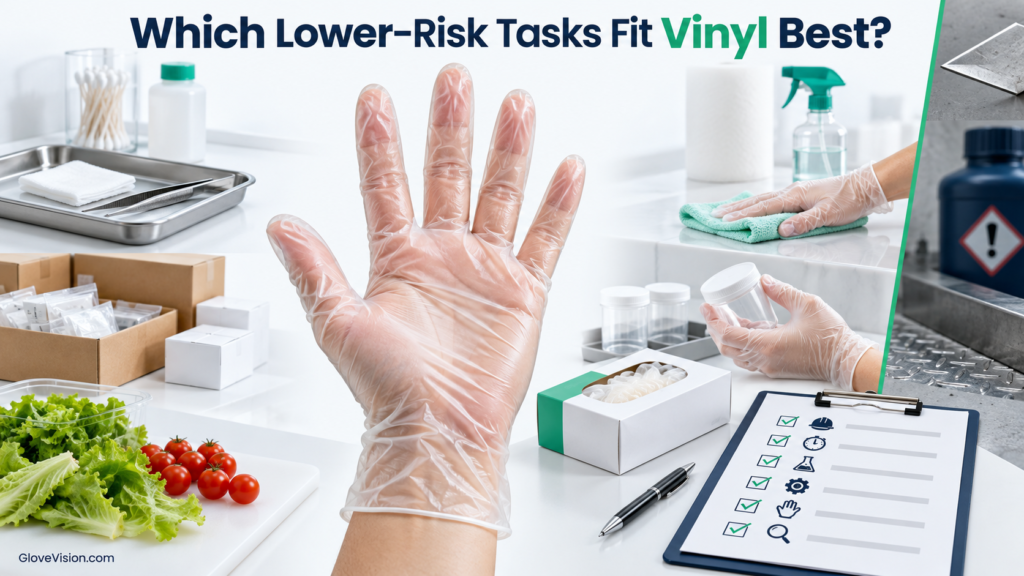
Vinyl/PVC Gloves fit best in lower-risk work when the hazard is clearly defined, contact is brief or intermittent, puncture and abrasion demand are low, the exact PVC glove provides adequate protection, and frequent replacement is practical. Candidate tasks can include routine examination with an appropriate medical glove, light general handling, selected food-contact work, mild cleaning, and brief compatible aqueous contact.
“Lower-risk” describes the complete task rather than PVC itself. Aggressive chemicals, prolonged immersion, high puncture or cut demand, high-consequence contamination, poor fit, or uncertain compatibility can move apparently routine work outside vinyl’s practical range; the decision therefore moves from lower-risk criteria to task fit, chemical and mechanical boundaries, replacement value, and final product verification.
What Lower-Risk Criteria Make Vinyl/PVC Gloves a Practical Choice?
Vinyl/PVC Gloves become strong candidates when exposure is short or intermittent, mechanical demand is modest, failure consequences are limited, exact chemical compatibility is adequate, and glove replacement is practical enough to maintain an appropriate barrier condition.
Why Does Short Exposure Duration Favor Vinyl/PVC Gloves?
Brief or intermittent contact can reduce total chemical dwell time, cumulative exposure opportunity, prolonged contamination, and the time over which mechanical fatigue can develop. It does not make an incompatible chemical acceptable. OSHA identifies frequency, duration, and nature of contact—including immersion, splash, mist, and contaminated surfaces—as factors that should influence glove selection. [OSHA]
Why Does Low Mechanical Stress Matter?
A strong lower-risk candidate should generally involve limited puncture, cut, abrasion, sharp-edge exposure, and repetitive heavy gripping. OSHA specifically includes abrasion, puncture, and tear resistance requirements among glove-selection factors, so a chemically mild task can still be a poor vinyl assignment when physical stress is high. [OSHA]
Why Does Consequence of Barrier Failure Matter?
The simpler a task appears, the easier it can be to overlook the consequence of glove failure. If a small defect could result in serious chemical, biological, or contamination exposure, the evidence requirement rises and a generic light-duty assumption becomes less defensible.
Why Must Chemical Compatibility Still Be Confirmed?
Confirm the exact chemical or contaminant, concentration where relevant, temperature, contact mode, and duration. OSHA notes that glove selection depends on the type of chemical, concentration, temperature, and nature and duration of contact. “Lower-risk” therefore cannot override an unsupported or incompatible chemical exposure. [OSHA]
Why Does Easy Replacement Strengthen the Case?
Planned replacement can add practical value where the exact glove is already adequately protective, tasks are short, contamination transitions matter, reuse is unnecessary, and glove changes are operationally manageable. OSHA’s PPE-selection guidance notes that regular replacement of lower-cost gloves can sometimes be economical when their performance characteristics are acceptable. [OSHA]
What Is the Correct Lower-Risk Rule?
The useful sequence is: known hazard + manageable consequence + short contact + low mechanical stress + verified PVC compatibility + practical replacement. For the broader polymer and construction context, see Vinyl/PVC glove material.
| Task Factor | Stronger Vinyl Fit | Weaker Vinyl Fit |
|---|---|---|
| Contact duration | Brief or intermittent | Prolonged, continuous, or immersed |
| Mechanical stress | Low | High puncture, cut, or abrasion demand |
| Chemical severity | Mild and verified compatible | Aggressive, complex, or uncertain |
| Consequence of failure | Manageable | High consequence |
| Temperature | Within supported conditions | Elevated or unsupported |
| Replacement | Easy and planned | Difficult or extended use expected |
| Contamination | Manageable | Persistent or high-consequence |
| Fit and handling | Adequate control | Snagging, slippage, or overstretching |
Which Routine Tasks Best Fit Vinyl/PVC Gloves?
Vinyl/PVC Gloves are most practical in routine work that needs a temporary hand barrier rather than specialist chemical, cut, puncture, or prolonged-contact protection, provided the exact product is appropriate for the intended use.
When Can Routine Medical Examination Fit Vinyl/PVC Gloves?
An appropriately regulated vinyl patient-examination glove can fit medical examination work within its intended role. FDA defines a vinyl patient examination glove as a disposable PVC device intended to be worn for medical purposes as a barrier against potentially infectious materials and other contaminants, while FDA-recognized ASTM D5250-19(2023) covers specified PVC gloves for medical examinations and related medical applications. [FDA] [ASTM]
When Can Light General Handling Fit Vinyl/PVC Gloves?
Sorting, simple packaging, handling clean or light components, brief non-sharp item handling, and low-contamination maintenance can be candidates when sharp-edge exposure, abrasion, chemical severity, and consequences of barrier failure remain appropriately controlled.
When Can Selected Food Handling Fit Vinyl/PVC Gloves?
Selected food handling can be a candidate only when the exact glove is suitable for its intended food-contact use, puncture demand is modest, glove changes are appropriate, and any cleaning chemicals encountered in the workflow are compatible. PVC material identity alone does not establish food-contact authorization.
When Can Light Cleaning Fit Vinyl/PVC Gloves?
Selected water-based cleaning, mild detergent work, or brief contact with compatible dilute aqueous solutions can fall within a lower-risk zone when exact chemical compatibility, duration, temperature, and mechanical demands support the glove. “Cleaning” by itself is too broad to establish suitability.
When Can Brief Contamination Control Favor Vinyl/PVC Gloves?
PVC can be practical where the principal requirement is a temporary disposable barrier, contact is brief, physical stress is low, and routine glove changes help control contamination transitions rather than compensate for weak chemical protection.
When Does Routine Work Stop Being Lower-Risk?
The task should be reassessed when sharp objects, toxic or systemically important chemicals, aggressive solvent exposure, prolonged wet contact, unsupported immersion, or high-consequence contamination enters the workflow.
| Task | Typical Vinyl Fit | Main Qualification |
|---|---|---|
| Routine low-stress medical examination | Often appropriate | Regulated/intended medical product |
| Light packaging or sorting | Often practical | No significant sharp or mechanical hazard |
| Selected food handling | Potentially practical | Exact food-contact suitability |
| Mild water-based cleaning | Potentially practical | Exact chemical compatibility |
| Brief contamination control | Often practical | Barrier integrity and appropriate changes |
| Short compatible aqueous contact | Candidate | Exact chemical and product evidence |
| Repetitive sharp handling | Weak | Mechanical upgrade needed |
| Aggressive solvent handling | Weak or conditional | Chemical-specific specialist evidence |
| Long immersion | High evidence demand | Continuous-contact evidence required |
Which Chemical and Mechanical Boundaries Push Vinyl/PVC Gloves Beyond Lower-Risk Use?
A task leaves the lower-risk Vinyl/PVC Gloves zone when either its chemical challenge or its mechanical challenge exceeds the exact product’s demonstrated capability—even when the other side of the task appears mild.
Which Chemical Zones Can Be Initial PVC Candidates?
OSHA’s generic chemical-resistant glove chart describes PVC as low cost, with very good physical properties and medium chemical resistance, and lists strong acids and bases, salts, other water solutions, and alcohols as generic use areas. These are screening categories, not approvals for every chemical, concentration, temperature, duration, or PVC construction. [OSHA] For the broader boundary, see vinyl barrier limits.
Why Can Aggressive Solvent Exposure Leave the Routine Vinyl Zone?
Solvent exposure can require closer evaluation of permeation and material degradation rather than reliance on the label “light-duty.” The exact chemical or mixture and exact product evidence control the decision; an entire solvent family should not be accepted or rejected solely by a generic material assumption.
Why Does Prolonged Contact Change the Decision?
Brief compatible contact and continuous or immersed contact are different exposure conditions. OSHA notes that breakthrough can occur sooner than expected depending on multiple factors and specifically requires consideration of frequency, duration, contact mode, concentration, and temperature. [OSHA] See vinyl duration limits for the duration-specific boundary.
Why Does Puncture Risk Change the Decision?
Needles, splinters, sharp metal, broken materials, and exposed edges can move a task beyond a thin disposable glove’s practical mechanical role. Low chemical severity plus high puncture severity is not a lower-risk task.
Why Does Abrasion Matter?
Repeated rubbing and surface contact can progressively challenge glove integrity. Where abrasion is substantial, evaluate whether the exact construction is sufficiently durable rather than assuming a disposable PVC film will remain intact.
Why Do Heavy Gripping and Repetition Matter?
Repeated gripping can increase local stretch, pressure, fatigue, fit loss, and stress around weak regions. OSHA includes dexterity and grip requirements as explicit glove-selection factors, reinforcing that mechanical usability belongs in the protective decision rather than being treated as a secondary comfort issue.
Why Does Fit Matter?
Poor fit can create excess fingertip material, snagging, slippage, overstretching, reduced tool control, or tearing. The glove must allow the actual task to be performed safely rather than merely covering the hand.
Why Does High Consequence of Failure Override “Routine” Appearance?
A physically simple task may still involve toxic contamination, serious exposure consequences, or barrier failure that is difficult to detect. In those situations, generic material assumptions are insufficient. Review vinyl pinhole risk and vinyl high-risk limits when integrity or consequence becomes the controlling issue.
Why Does Frequent Replacement Strengthen Vinyl/PVC Gloves Selection?
Frequent replacement strengthens Vinyl/PVC Gloves selection only when the exact glove already provides adequate protection and planned short-use replacement helps maintain a clean, known barrier condition.
When Is Frequent Changing Useful?
Planned changes can support workflows that move between clean and contaminated tasks, repeated short procedures, selected food-handling transitions, routine contamination-control stages, or tasks that require a fresh glove between items, subjects, or work zones.
Why Can Planned Replacement Be Better Than Reuse?
Where the exact product is intended for disposable use, a fresh glove begins with a known use history and can reduce dependence on decontamination or uncertain previous exposure. This does not mean every PVC construction is disposable; reusable and task-specific PVC gloves also exist.
Why Doesn’t Frequent Replacement Fix a Poor Material Match?
An incompatible chemical plus frequently replaced vinyl is still an incompatible glove. Replacement can control contamination history, physical condition, and workflow transitions, but it cannot create chemical compatibility that the material or exact product does not have.
Why Must Replacement Frequency Be Defined?
A disposable glove should not drift into uncontrolled extended wear merely because it still appears clean, has not visibly torn, or changing it is inconvenient. Replacement criteria should follow the task, contamination pathway, glove condition, product instructions, and applicable workplace requirements.
When Does Frequent Replacement Lose Its Practical Advantage?
The advantage declines when gloves fail too often, changing disrupts the work, chemical contact requires impractically short intervals, consumption becomes excessive, or another verified product provides longer adequate service with better complete-task performance.
What Is the Correct Economics Rule?
OSHA’s PPE guidance allows economics to enter glove selection only where performance characteristics are already acceptable. The practical sequence is therefore adequate protection first, replacement strategy second, and lifecycle cost third—not lowest unit cost first. [OSHA]
How Should Vinyl/PVC Gloves Be Upgraded, Compared, and Verified for Lower-Risk Tasks?
Vinyl/PVC Gloves should remain the choice only when the exact product matches the complete lower-risk task. If one requirement exceeds the disposable product’s capabilities, determine whether a better PVC construction solves the problem before comparing another verified material where necessary.
When Can Thicker PVC Be More Appropriate Than Disposable Vinyl?
A thicker, longer-cuff, supported, or otherwise task-specific PVC product can be considered for longer wet handling, greater abrasion demand, additional coverage, selected chemical work, or reusable applications—but only when evidence for that exact construction supports the task. Performance should not be scaled from a thin disposable product by thickness alone.
When Can Nitrile Be More Practical?
An exact nitrile product can be compared when greater elasticity, closer fit, different puncture performance, different chemical resistance, or different handling characteristics are needed. The comparison should be product-to-product rather than a universal nitrile-versus-PVC ranking.
When Can Neoprene Be More Appropriate?
An exact neoprene or polychloroprene product can be considered when the chemical exposure exceeds the selected PVC product, reusable construction is needed, or exact neoprene evidence better matches the task. Polymer name alone does not prove superiority.
When Is a Specialist Barrier Unnecessary?
When the hazard is genuinely modest, the exact PVC glove provides adequate protection, mechanical stress is low, duration is short, and replacement is practical, a more specialized material may add little useful value to that particular task.
Why Must Alternatives Be Compared as Exact Products?
Compare manufacturer and model, material, thickness, construction, intended use, exact hazard, duration, temperature, mechanical requirements, and applicable test evidence. OSHA likewise advises employers to consider the glove’s performance characteristics relative to the specific anticipated hazard and to obtain appropriate manufacturer documentation. [OSHA] See the vinyl selection tradeoff for the broader comparison framework.
| Escalating Condition | PVC Direction | Upgrade / Comparison Direction |
|---|---|---|
| Longer but compatible wet handling | Evaluate thicker or task-specific PVC | Compare another barrier if duration evidence remains weak |
| More forearm coverage needed | Longer-cuff PVC may help | Verify the exact construction |
| High puncture demand | Thin vinyl becomes a weaker fit | Compare a mechanically stronger exact product |
| Higher abrasion | Disposable film may be inadequate | Evaluate supported or reinforced construction |
| Aggressive solvent exposure | Generic PVC evidence is insufficient | Use chemical-specific product evidence |
| High dexterity or close-fit need | Product-dependent | Compare a fitted synthetic product |
| Complex mixture | Generic chart is insufficient | Seek mixture-relevant exact-product evidence |
| High consequence of failure | Stronger evidence required | Escalate to a suitably verified exact product |
What Hazard Must Be Identified First?
Identify whether the controlling hazard is chemical, biological, contamination-related, or physical. Record concentration where relevant, potential consequences of exposure, and sharp or mechanical hazards before assigning a glove.
Which Exposure Variables Must Be Defined?
Record contact duration, frequency, splash versus sustained contact, temperature, contamination level, and immersion where relevant. These variables can move the same nominal chemical or task into a different protection category.
Which Exact Product Details Matter?
Verify manufacturer, model, PVC/vinyl material, thickness, construction, intended use, disposable or reusable status, support or lining where relevant, cuff, size, and applicable certification or regulatory category.
Why Does Intended Use Matter?
A vinyl medical examination glove, food-contact glove, general-purpose disposable glove, and industrial PVC glove can share PVC material identity while carrying different intended uses and supporting evidence. FDA’s definition of a vinyl patient-examination glove is explicitly medical, so that classification should not be transferred to nonmedical PVC products. [FDA]
Which Physical Requirements Must Be Checked?
Assess puncture, cut, abrasion, tear, grip, dexterity, fit, and coverage. A glove that is chemically compatible can still be unsuitable when its physical construction does not match the work.
Which Chemical Requirements Must Be Checked?
Where chemicals are involved, verify the exact substance or mixture, concentration, temperature, duration, contact mode, and relevant degradation or permeation evidence. Generic material-level guidance is only a screening step.
When Is Vinyl Evidence Insufficient?
Escalate when the hazard is poorly defined, the exact product is unknown, chemical compatibility is unclear, duration or immersion is unsupported, puncture/cut/abrasion risk is significant, consequences of failure are high, or the intended-use category does not match the task.
Use the complete task—not the word “routine”—to determine whether the exact Vinyl/PVC Glove belongs in the lower-risk zone.
Hazard Gate
- Hazard identified.
- Consequence of exposure understood.
- Chemical identity and concentration confirmed where relevant.
- Chemical compatibility established.
- Sharp and mechanical hazards identified.
Exposure Gate
- Contact is short or intermittent where lower-risk classification depends on it.
- Exposure frequency documented.
- Temperature is within supported conditions.
- No unsupported immersion is expected.
- Contamination level is understood.
Mechanical Gate
- Puncture risk is acceptably low.
- Cut risk is acceptably low.
- Abrasion risk is acceptably low.
- Grip is adequate.
- Dexterity is adequate.
- Fit is adequate.
Product Gate
- Exact manufacturer and model identified.
- Correct PVC/vinyl product category confirmed.
- Intended use matches the task.
- Thickness and construction are appropriate.
- Size and cuff are appropriate.
- Barrier and integrity requirements are met.
- Applicable certification or regulatory requirement is confirmed.
Workflow Gate
- Planned replacement is practical.
- Task transitions requiring fresh gloves are defined.
- Damaged gloves are replaced.
- Disposable gloves are not treated as uncontrolled extended-wear PPE.
- Cost is considered only after protection adequacy.
What Should Readers Remember About Lower-Risk Tasks for Vinyl/PVC Gloves?
Vinyl/PVC Gloves fit lower-risk work best when the hazard is clearly defined, chemical or contamination contact is brief or intermittent, puncture and abrasion demands are low, the exact product provides adequate barrier performance, and planned replacement is practical. Affordability and workflow simplicity are useful only after those protection conditions are satisfied, so choose vinyl because the complete lower-risk task fits the exact glove—not merely because the glove is inexpensive, disposable, or convenient.
Their practical fit declines when aggressive chemicals, prolonged immersion, sharp objects, heavy abrasion, complex mixtures, poor fit, or high consequences of barrier failure become controlling factors. In those conditions, the appropriate response is to upgrade the exact PVC construction or compare another verified glove rather than stretch a lower-risk vinyl application beyond its supporting evidence.
Which Questions Clarify Lower-Risk Tasks for Vinyl/PVC Gloves?
What Types of Lower-Risk Tasks Best Fit Vinyl/PVC Gloves?
Vinyl/PVC Gloves generally fit clearly defined short-duration or intermittent tasks where the hazard is compatible with the exact glove, puncture and abrasion demand are low, consequences of barrier failure are manageable, and planned glove changes are practical.
Can Vinyl/PVC Gloves Be Used for Routine Medical Examination?
Appropriately regulated vinyl patient-examination gloves can be used within their intended medical role. A generic food-service or industrial vinyl glove should not be treated as a medical examination glove simply because both products use PVC.
Can Vinyl/PVC Gloves Be Used for Cleaning?
They can fit selected lower-risk cleaning tasks when the exact cleaner is compatible with the exact PVC glove, exposure is limited, and puncture, abrasion, temperature, and duration remain within the product’s supported conditions.
Are Vinyl/PVC Gloves Suitable for Tasks With Sharp Objects?
They become a weaker choice as puncture, cut, abrasion, or snagging risk increases. A chemically mild task can still fall outside the lower-risk vinyl zone when mechanical failure is the controlling hazard.
When Should Another Glove Replace Vinyl/PVC Gloves?
Compare another exact product when it provides the chemical resistance, puncture durability, fit, dexterity, duration margin, coverage, or high-consequence protection that the selected PVC glove cannot adequately demonstrate.