
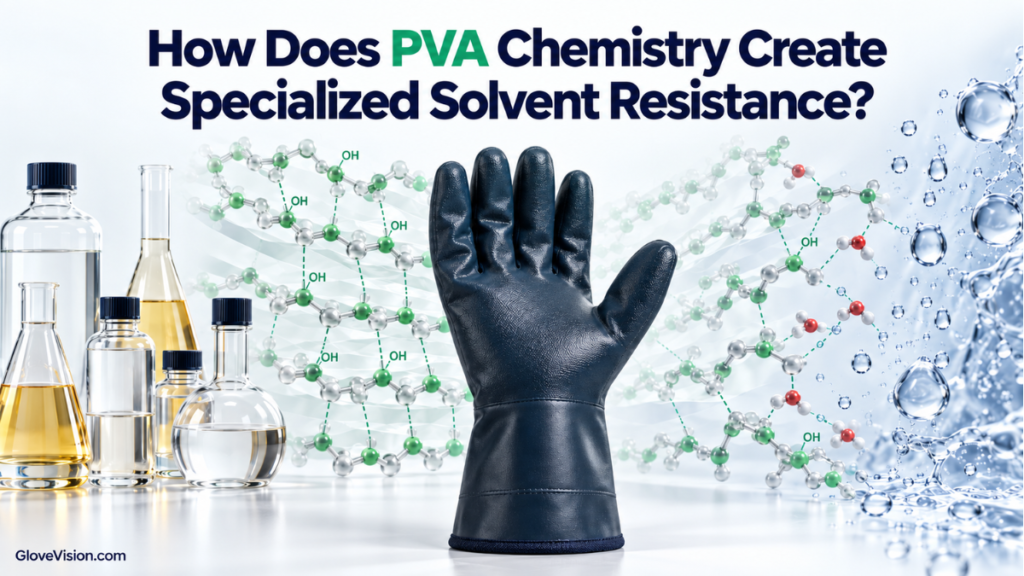
How Does PVA Chemistry Create Specialized Solvent Resistance?
PVA Gloves gain specialized organic-solvent resistance from hydroxyl-rich polymer chains that form strong interchain hydrogen bonds and semicrystalline regions. These interactions restrict chain mobility and can make many dry organic solvents less able to swell or move rapidly through the material.
That same hydroxyl chemistry creates PVA’s defining limitation: water interacts strongly with the polymer and can alter its structure and barrier behavior. PVA should therefore be treated as a specialist dry-solvent material rather than a universal chemical glove, with selection moving from molecular chemistry and barrier mechanism to solvent zones, water and mixture limits, and exact-product verification.
What Molecular Chemistry Gives PVA Gloves Their Specialized Barrier Behavior?
PVA Gloves derive their distinctive chemistry from a polymer backbone bearing abundant hydroxyl groups, which support strong chain-to-chain hydrogen bonding and semicrystalline organization.
Why Are Hydroxyl Groups Central to PVA Gloves?
Polyvinyl alcohol is a linear, semicrystalline polymer containing abundant hydroxyl groups along its backbone. These groups enable strong intra- and intermolecular hydrogen bonding and materially influence solubility, mechanical integrity, crystallinity, and water interaction. [PVA Review]
How Does Hydrogen Bonding Affect Polymer Mobility?
Strong interactions between neighboring PVA chains increase polymer cohesion and can make chain segments more resistant to separation and rearrangement. Under favorable dry-solvent conditions, this more restricted structure can help limit solvent-induced expansion. Hydrogen bonding contributes to the mechanism but does not independently determine resistance to every chemical.
Why Does Degree of Hydrolysis Matter?
PVA is produced through hydrolysis of polyvinyl-acetate-derived material, so degree of hydrolysis changes the balance between hydroxyl and residual acetate groups. Published PVA literature shows that hydrolysis level affects hydrogen bonding, crystallinity, mechanical properties, water solubility, and organic-solvent resistance; fully hydrolyzed grades can require much hotter water for complete dissolution than lower-hydrolysis grades. [PVA Review]
Why Does Crystallinity Matter?
More ordered polymer regions restrict segmental movement and provide a more tightly organized environment than less-ordered regions. Greater order can therefore contribute to more restricted molecular transport, but no single crystallinity value should be assumed for every PVA grade or finished glove.
Why Is PVA Chemistry Only the Starting Point?
Finished PVA Gloves also depend on polymer grade, degree of hydrolysis, molecular weight, coating thickness, support construction, processing, modification, temperature, solvent purity, and exposure duration. Polymer chemistry explains why specialization is plausible; it does not establish finished-glove performance. See glove materials explained for the broader material-versus-product distinction.
The molecular illustration and factor table below form one chemistry-to-resistance asset: the visual shows the structural mechanism, while the table connects each structural or product factor to its practical barrier consequence.
| Structural / Product Factor | Material Effect | Practical Barrier Consequence |
|---|---|---|
| Hydroxyl groups | Strong polarity and hydrogen bonding | High chain interaction |
| Interchain hydrogen bonding | Increased cohesion | Restricted segmental mobility |
| Degree of hydrolysis | Changes hydroxyl / acetate balance | Alters crystallinity, water, and solvent behavior |
| Crystallinity | Creates more ordered regions | More restricted transport pathways |
| Molecular weight | Changes chain and processing behavior | Product-specific mechanical and barrier effects |
| Coating thickness | Changes diffusion-path length | Barrier margin remains product-specific |
| Support construction | Changes physical performance | Finished-glove task behavior differs |
| Water / moisture | Strong interaction with PVA | Specialist barrier advantage can decline |
Why Does Hydrogen-Bonded Structure Strengthen the Organic-Solvent Barrier of PVA Gloves?
PVA Gloves become effective specialist barriers when the contacting solvent has limited ability to disrupt the cohesive, semicrystalline PVA matrix and therefore has limited ability to swell and mobilize the polymer.
What Must a Solvent Do to Permeate PVA Gloves?
At a simplified level, a solvent contacts the outer surface, partitions or sorbs into the coating, diffuses through the polymer matrix, and eventually reaches the inner surface. How readily those stages occur depends on solvent–polymer interaction and the exact finished construction.
How Can Strong Chain Cohesion Reduce Swelling?
A solvent entering PVA encounters a matrix stabilized by polymer–polymer hydrogen bonding, semicrystalline organization, and other cohesive interactions. Where the solvent interacts less favorably with that matrix, sorption and swelling can remain more restricted.
Why Does Limited Swelling Support Barrier Performance?
Swelling can increase chain separation, segmental mobility, and accessible transport pathways. Limiting that expansion can help preserve a more restricted transport environment, although swelling alone does not determine breakthrough.
Why Does Low Swelling Not Mean Zero Permeation?
A glove can look unchanged, remain dimensionally stable, and show little obvious swelling while still allowing measurable molecular permeation. Visual appearance therefore cannot establish chemical barrier performance.
Why Does PVA Chemistry Create Specialization Instead of Universal Resistance?
Solvents differ in polarity, hydrogen-bonding behavior, molecular size, affinity for PVA, and ability to plasticize or swell the polymer. One liquid can therefore be strongly resisted while another challenges the same PVA structure.
Which Organic Solvents Best Match the Specialized Resistance of PVA Gloves?
PVA Gloves are most valuable where a dry organic solvent falls within PVA’s verified specialty range—particularly selected aliphatic, aromatic, chlorinated, ketone, ester, or ether exposures—but generic family guidance must be followed by exact chemical and product verification.
Which Generic Solvent Families Enter the PVA Candidate Zone?
OSHA identifies PVA as a specialty glove for organic solvents and lists aliphatics, aromatics, chlorinated solvents, ketones except acetone, esters, and ethers among its generic use areas. The same OSHA chart identifies PVA as water-sensitive and poor versus light alcohols. These are material-family screening categories rather than exact-product approvals. [OSHA]
Why Do Aromatic Hydrocarbons Often Favor PVA Gloves?
Aromatics occupy one of PVA’s generic specialty zones. Chemicals within that family may justify evaluating an exact PVA product, but family-level guidance does not establish a universal breakthrough time, thickness, concentration, temperature, or safe wear period.
Why Are Chlorinated Solvents Important PVA Targets?
Chlorinated solvents are another generic PVA specialty zone. At the exact-product level, Ansell describes AlphaTec 15-554 as a PVA-coated glove providing advanced resistance to aromatic and chlorinated solvents. That positioning and the glove’s supported construction belong specifically to AlphaTec 15-554 and should not be transferred automatically to another PVA glove. [Ansell]
Can Ketones Fit PVA Gloves?
Selectively. OSHA lists ketones except acetone among generic PVA use areas. The explicit acetone exception demonstrates why membership in the same solvent family does not guarantee the same glove response.
Can Esters and Ethers Fit PVA Gloves?
Both are generic PVA candidate classes in OSHA’s chart. Exact ester or ether identity, concentration, temperature, contact duration, exposure mode, and glove product still require verification.
Why Must Each Solvent Still Be Verified?
Generic family guidance does not establish breakthrough detection time, standardized breakthrough time, permeation rate, cumulative permeation, degradation, tested coating thickness, test temperature, or safe task duration. Those details require evidence relevant to the exact product and conditions.
The radial map and matrix are two views of the same solvent-specialization decision asset: the map shows the family-level pattern, while the matrix adds the qualification needed before selection.
| Solvent Zone | Generic PVA Position | Main Qualification | Decision Direction |
|---|---|---|---|
| Aliphatic hydrocarbons | Strong candidate | Exact chemical and product data | Verify |
| Aromatic hydrocarbons | Strong candidate | Exact solvent and permeation data | Verify |
| Chlorinated solvents | Strong candidate | Individual solvents and products still differ | Verify |
| Ketones | Selective candidate | OSHA excludes acetone generically | Chemical-specific |
| Acetone | Generic exception / weak zone | Do not transfer other ketone results | Compare alternative |
| Esters | Candidate | Exact ester and conditions matter | Verify |
| Ethers | Candidate | Exact chemical and exposure matter | Verify |
| Light alcohols | Weak / conditional | OSHA identifies generic limitation | Compare |
| Water / aqueous exposure | Major boundary | Water sensitivity | Usually poor without exact support |
Where Do Water, Light Alcohols, and Mixtures Break the Specialization of PVA Gloves?
Water is the defining boundary of PVA Gloves because the polymer’s hydroxyl groups interact strongly with water, allowing moisture to alter molecular interactions and, depending on grade and conditions, contribute to plasticization, swelling, or dissolution behavior.
Why Does Water Interact Strongly With PVA?
PVA’s abundant hydroxyl groups make the polymer strongly hydrophilic. Water can interact with those groups and alter the balance of polymer–polymer interactions, increasing molecular mobility and changing material properties. Published PVA literature also shows that moisture can act as a plasticizer, so barrier and mechanical behavior can change as moisture conditions change.
Why Is “PVA Is Water Soluble” Too Simple as a Universal Polymer Statement?
Degree of hydrolysis, molecular weight, crystallinity, temperature, modification, and product construction affect water response. Peer-reviewed literature reports substantially different dissolution conditions across hydrolysis grades, with fully hydrolyzed PVA requiring much hotter water for complete dissolution than lower-hydrolysis grades. [PVA Review]
Why Can Exact PVA Gloves Still Carry Strong Water Warnings?
Ansell’s current AlphaTec 15-554 documentation identifies the glove as PVA-coated and states that its PVA is water soluble; it also warns that contact with water or use in high-humidity environments will greatly decrease chemical protection. This is important exact-model evidence and should remain attributed specifically to AlphaTec 15-554 rather than being transferred automatically to every PVA glove. [Ansell]
Why Can Wet Handling Matter Without Full Immersion?
Relevant moisture can come from wet surfaces, water-contaminated solvent, condensation, splash, or high humidity where the exact manufacturer identifies it as a limitation. Dry-solvent evidence should not automatically be transferred into those conditions.
Why Are Light Alcohols a Separate PVA Limitation?
OSHA’s current glove-selection chart identifies PVA as water-sensitive and poor versus light alcohols while simultaneously classifying it as a specialty glove for organic solvents. This is why “good against organic solvents” is too broad a PVA selection rule. [OSHA]
Why Are Alcohol–Water Mixtures Especially Important?
When a light alcohol and water occur together, both can conflict with PVA’s generic specialist profile. A dry-solvent result therefore cannot be assumed to remain applicable to an alcohol–water formulation without relevant exact-mixture and exact-product evidence.
Why Do Mixed Solvents Require More Caution?
OSHA’s hand-protection guidance states that for mixtures and formulated products without specific test data, glove selection should consider the component with the shortest applicable breakthrough time because solvents may carry other ingredients through polymeric materials. This is a conservative selection framework rather than proof of the mixture’s actual breakthrough performance. [OSHA]
Why Can Small Water Content Matter?
For PVA, water is not simply another unrelated co-solvent: it interacts with the hydroxyl-rich polymer itself. Dry-solvent compatibility therefore should not be transferred automatically to a water-containing formulation when exact mixture evidence is unavailable.
Why Must Acetone Remain a Named Exception?
OSHA explicitly lists PVA for ketones except acetone. Acetone therefore provides a direct warning against assuming that every chemical within a nominal solvent family produces the same PVA response.
When Should PVA Leave the Candidate List?
Compare or escalate when water exposure is unavoidable without supporting exact-product evidence, light alcohol is a controlling component, acetone lacks favorable exact-product data, mixture composition or water content is unresolved, or actual temperature, duration, and physical conditions exceed the glove’s evidence. See PVA selection trade-offs for the broader material-selection boundary.
The dry-versus-wet illustration and decision matrix form one water-sensitivity asset: the visual explains why moisture changes the selection problem, while the matrix converts that mechanism into exposure-specific decision directions.
| Exposure Condition | PVA Direction | Main Concern |
|---|---|---|
| Dry aromatic solvent | Strong candidate zone | Exact permeation evidence |
| Dry chlorinated solvent | Strong candidate zone | Exact product required |
| Dry aliphatic solvent | Strong candidate zone | Exact chemical required |
| Dry supported ketone | Conditional | Acetone must be separated |
| Acetone | Weak generic position | Compare exact alternative |
| Light alcohol | Weak generic position | OSHA limitation |
| Water-contaminated solvent | High concern | Water interaction with PVA |
| Aqueous mixture | Generally poor generic fit | Water sensitivity |
| Wet work | Weak candidate | Direct moisture exposure |
| High-humidity environment | Product-specific concern | Check exact manufacturer guidance |
How Should PVA Gloves Be Compared and Verified Before Solvent Use?
PVA Gloves should be used when the exact dry-solvent exposure matches the exact PVA product’s tested specialization; when water, light alcohols, unsupported mixtures, or physical task requirements undermine that advantage, compare another barrier under the same conditions.
When Can Fluoroelastomer Be More Appropriate?
An exact fluoroelastomer product may warrant comparison where aromatic or chlorinated solvent resistance remains important but water exposure makes the proposed PVA product unsuitable, provided the alternative’s own chemical and physical limitations are acceptable. Review fluoroelastomer adoption limits.
When Can Butyl Be More Appropriate?
Butyl may warrant comparison for selected ketones, esters, glycol ethers, or conditions where PVA’s water sensitivity is problematic and an exact Butyl product has stronger evidence for the complete exposure. See Butyl selection trade-offs.
When Can Neoprene Be More Appropriate?
An exact neoprene product may become relevant when aqueous and chemical conditions coexist and PVA’s wet-environment limitation is unacceptable. The alternative must still be verified against the exact chemical and task. See the neoprene specialization trade-off.
When Can Nitrile Be More Practical?
Nitrile can be compared when exact resistance is adequate, PVA’s specialist dry-solvent advantage is unnecessary, or different handling characteristics are required. Familiarity with nitrile is not evidence that it suits the solvent.
When Should a Multilayer Barrier Be Evaluated?
A verified multilayer product may deserve evaluation for complex mixtures, water plus aggressive-solvent combinations, high-consequence exposure, or broad resistance requirements poorly addressed by one polymer. Multilayer construction should not be treated as universally superior.
Why Must Alternatives Be Compared Under the Same Conditions?
Match the exact chemical and CAS number, complete mixture, concentration, water content, temperature, splash or immersion mode, contact duration, glove thickness and construction, test standard and endpoint, and mechanical task. Changing those conditions changes the comparison.
What Chemical Information Must Be Confirmed?
Record the exact solvent, CAS number, concentration, complete formulation, water content, and relevant co-solvents or additives. An incomplete formulation leaves PVA suitability unresolved.
Why Should Water Content Be Checked Early?
Water directly targets the defining limitation of the PVA material family. A strong dry-solvent rating combined with unknown water content therefore remains an unresolved PVA exposure rather than a confirmed match.
Which Exact Product Details Must Match?
Verify manufacturer, model, PVA coating or material, thickness, supported or unsupported construction, liner, cuff, certifications, intended use, and relevant contact designation. AlphaTec 15-554, for example, is specifically documented as a PVA-coated glove with an interlock cotton liner; that construction should not be treated as the generic physical template for every PVA glove.
Which Chemical-Barrier Results Matter?
Review the exact test chemical, concentration, temperature, breakthrough detection time, standardized breakthrough time, permeation rate, cumulative permeation where relevant, degradation, tested thickness, and test method. ASTM F739 identifies breakthrough and permeation measures as barrier-performance metrics but states that the resulting data cannot by themselves be used to infer safe exposure levels; it also notes that a reported standardized breakthrough beyond a stated period does not prove that no lower-rate permeation occurred beforehand. [ASTM]
Which Physical and Task Conditions Matter?
Assess wet surfaces, humidity where the exact manufacturer identifies it as relevant, abrasion, puncture, grip, dexterity, cuff and coverage, splash versus immersion, and expected wear duration. Chemical barrier data cannot compensate for a construction that fails the physical task.
When Is PVA Evidence Insufficient?
Escalate when exact solvent data are absent, water content is unknown, mixture composition is incomplete, the exact model is unidentified, the proposed construction differs from the tested construction, temperature or duration exceeds the evidence, wet conditions conflict with manufacturer guidance, or physical task performance is inadequate.
Chemical Gate
- Exact solvent identified.
- CAS number confirmed.
- Concentration known.
- Complete formulation reviewed.
- Co-solvents and additives identified.
Water Gate
- Water content known.
- Aqueous contamination assessed.
- Wet surfaces considered.
- Humidity limitation checked where product-specific.
- Dry-solvent assumptions not transferred into wet conditions.
Product Gate
- Manufacturer and model confirmed.
- Exact PVA construction confirmed.
- Thickness or coating matches relevant evidence.
- Supported or unsupported design known.
- Liner and cuff documented.
- Intended use and certification checked.
Barrier-Performance Gate
- Exact chemical permeation data reviewed.
- Breakthrough endpoint understood.
- Permeation rate reviewed.
- Cumulative permeation reviewed where relevant.
- Degradation reviewed.
- Test temperature relevant.
- Contact duration relevant.
- No automatic safe-wear time inferred.
Task Gate
- Splash or immersion mode matched.
- Grip adequate.
- Abrasion resistance adequate.
- Puncture resistance adequate.
- Dexterity acceptable.
- Moisture conditions acceptable.
Alternative Gate
- Butyl compared where selected polar organics or wet conditions justify it.
- Fluoroelastomer compared where aromatic or chlorinated resistance remains necessary.
- Neoprene compared where aqueous conditions matter.
- Multilayer product considered for complex mixed exposures.
- Exact-product evidence used for every alternative.
Final Decision
What Should Readers Remember About Specialized Solvent Resistance in PVA Gloves?
PVA Gloves gain their specialist solvent behavior from a hydroxyl-rich, strongly hydrogen-bonded, semicrystalline polymer structure that can restrict molecular mobility and resist swelling by many dry organic solvents. This helps explain why PVA occupies a valuable specialty zone for selected aliphatic, aromatic, chlorinated, ketone, ester, and ether exposures. Use PVA when the exact dry organic solvent matches verified PVA specialization rather than relying on polymer reputation alone.
The same hydroxyl chemistry also creates PVA’s defining weakness: strong interaction with water and moisture. Water content, light alcohols, acetone, mixtures, product construction, temperature, and exact permeation and degradation evidence therefore determine whether the specialist advantage remains valid for the actual task; do not transfer dry-solvent strength into water-containing, light-alcohol, unsupported ketone, or unresolved mixture exposures.
Which Questions Clarify Specialized Solvent Resistance in PVA Gloves?
Why Do PVA Gloves Resist Many Organic Solvents?
Their hydroxyl-rich polymer chains form strong interchain hydrogen bonds and semicrystalline regions that restrict chain mobility and can limit swelling and transport by many dry organic solvents. Exact performance still depends on the solvent and finished glove.
Are PVA Gloves Resistant to Water?
Water is a major PVA limitation. The exact swelling or dissolution response varies with PVA grade and product conditions, but OSHA classifies PVA gloves as water sensitive, and some commercial PVA gloves specifically warn that water or high humidity greatly reduces chemical protection.
Are PVA Gloves Good for Aromatic and Chlorinated Solvents?
They are strong generic candidate zones. OSHA lists aromatic and chlorinated solvents among PVA’s specialty applications, and exact commercial PVA products are specifically positioned for those solvent classes. Chemical-specific product data remain necessary.
Are PVA Gloves Suitable for Ketones?
Selectively. OSHA lists ketones as a PVA candidate class but explicitly excludes acetone in its generic guidance. Resistance from one ketone should not be transferred to another without exact product evidence.
When Should Another Barrier Replace PVA Gloves?
Compare another exact product when water, light alcohols, acetone, a complex mixture, unsuitable mechanical conditions, or missing product-specific permeation data eliminate PVA’s specialist dry-solvent advantage.