
Why Does PVA Resist Chlorinated Solvents Effectively?
PVA Gloves are specialty organic-solvent gloves that can be strong candidates for many chlorinated-solvent exposures. Their hydroxyl-rich, hydrogen-bonded, semicrystalline polymer structure helps explain why PVA can maintain useful barrier behavior against selected dry organic solvents.
That specialization is not universal chlorinated-solvent immunity. TCE, PCE, dichloromethane, chloroform, chlorobenzene, mixtures, water contamination, temperature, contact duration, and exact glove construction must be evaluated separately as selection moves from generic material compatibility to a finished-glove decision.
What Molecular Chemistry Makes PVA Gloves Resist Chlorinated Solvents?
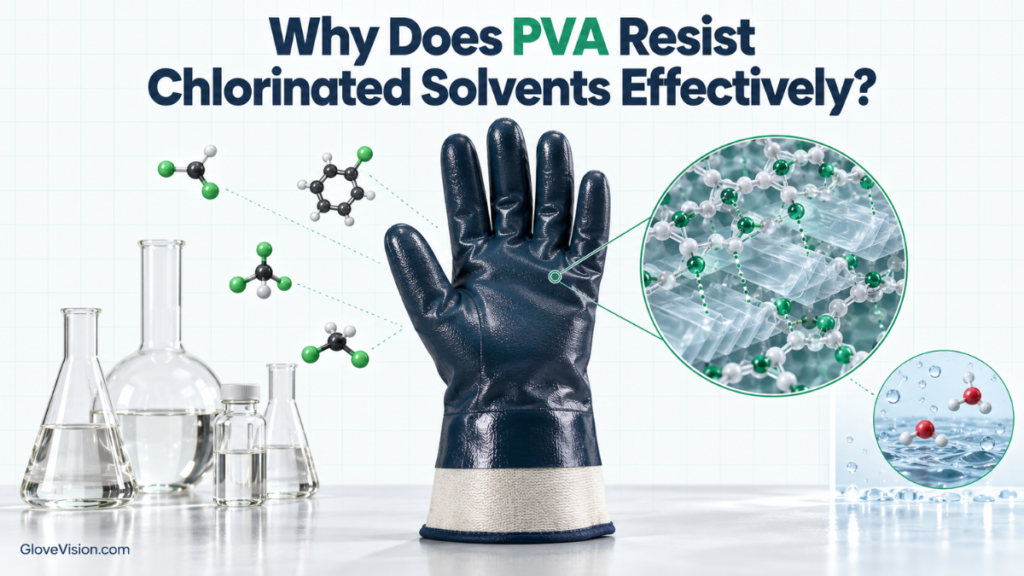
PVA Gloves derive their specialist barrier behavior from a hydroxyl-rich, semicrystalline polymer structure with extensive hydrogen bonding. Those structural features can increase polymer cohesion and restrict chain mobility, but molecular chemistry explains candidacy rather than proving an exact glove’s breakthrough performance.
Why Are Hydroxyl Groups Important?
Polyvinyl alcohol is a linear, semicrystalline polymer containing abundant hydroxyl groups along its backbone. Peer-reviewed PVA literature describes those hydroxyl groups as enabling strong intra- and intermolecular hydrogen bonding and identifies degree of hydrolysis and molecular weight as important influences on material properties. [PVA Review]
How Does Hydrogen Bonding Affect the Polymer Network?
Hydrogen bonding strengthens association among PVA chains and contributes to a cohesive polymer network. In barrier interpretation, that supports a mechanism in which molecular transport must occur through a relatively strongly associated polymer rather than through freely mobile chains; it does not by itself establish chemical-specific glove performance. [PVA Review]
Why Does Semicrystallinity Matter?
PVA contains both ordered and less-ordered polymer regions. Its semicrystalline character contributes to restricted chain organization, while the actual transport of a solvent through a finished PVA glove still depends on the particular polymer grade, construction, thickness, chemical, concentration, temperature, and test conditions.
Why Does Degree of Hydrolysis Matter?
Degree of hydrolysis changes the balance of hydroxyl and residual acetate functionality and can alter crystallinity, water behavior, mechanical properties, and solvent resistance. Published PVA literature therefore supports treating PVA grade as a relevant material variable rather than assuming every PVA formulation behaves identically. [PVA Review]
What Must Happen Before a Solvent Permeates PVA?
At a simplified mechanism level, a solvent contacts the barrier, interacts with and sorbs into the polymer, diffuses through the material, and may eventually emerge at the inner surface. The rate and extent of that transport depend on the chemical–polymer system and exposure conditions, so visible glove appearance cannot substitute for permeation evidence.
Why Is Swelling Only Part of the Barrier Story?
Strong swelling can indicate important polymer–solvent interaction and can alter polymer structure, but low visible swelling does not establish zero molecular transport. Degradation observations and permeation measurements answer different questions and should be reviewed together.
This table separates defensible molecular mechanisms from finished-glove conclusions so that chemistry is not converted into an unsupported breakthrough claim.
| Structural / Product Factor | Relevant Effect | Selection Meaning |
|---|---|---|
| Hydroxyl groups | Support strong hydrogen bonding | Contribute to PVA chain association |
| Hydrogen bonding | Strengthens polymer cohesion | Supports restricted chain mobility |
| Semicrystallinity | Creates ordered polymer regions | Contributes to restricted transport structure |
| Degree of hydrolysis | Changes chemistry and crystallinity | Grade-specific behavior matters |
| Solvent interaction | Controls sorption and possible swelling | Chemical-specific behavior matters |
| Thickness | Changes transport path | Exact specimen matters |
| Finished construction | Changes whole-glove performance | Exact model matters |
| Water exposure | Targets a known PVA weakness | Major selection boundary |
Which Chlorinated Solvents Are Strong Candidates for PVA Gloves?
PVA Gloves are generic screening candidates for chlorinated solvents, but the generic material classification does not establish identical performance for TCE, PCE, chlorobenzene, chloroform, dichloromethane, or mixed formulations. Each named chemical remains a separate exact-product decision.
What Does OSHA Support at the Material-Family Level?
OSHA’s Chemical Resistant Glove Selection chart identifies PVA as a specialty glove for organic solvents and lists chlorinated solvents among its generic “Use Against” categories. The same chart identifies water sensitivity as a PVA disadvantage. This supports PVA as a chlorinated-solvent screening material, not a chemical-specific breakthrough claim. [OSHA]
What Does a Finished PVA Glove Manufacturer Support?
Ansell states that its AlphaTec 15-554 uses a PVA coating and provides advanced resistance to aromatic and chlorinated solvents. Because this is evidence for one named finished glove, it strengthens the case that commercial PVA glove constructions can be designed for chlorinated-solvent service without proving identical performance for every PVA glove or every chlorinated chemical. [Ansell]
How Should Trichloroethylene Be Treated?
Trichloroethylene (TCE) belongs within the chlorinated-solvent family for which OSHA identifies PVA as a generic screening material. A final TCE decision should nevertheless be based on TCE-specific data for the exact glove construction and relevant concentration, temperature, duration, and contact mode rather than on the family classification alone.
How Should Tetrachloroethylene Be Treated?
Tetrachloroethylene, also called perchloroethylene or PCE, should be evaluated as its own chemical case. TCE and PCE belong to the same broad solvent family, but evidence for one should not be silently transferred to the other.
How Should Chlorobenzene and Chloroform Be Treated?
Both can be screened within the broader chlorinated-solvent question, but neither should receive a breakthrough value or task approval from generic PVA guidance. Exact chemical-specific finished-glove evidence remains the decision standard.
How Should Dichloromethane Be Treated?
Dichloromethane (DCM), also called methylene chloride, should be treated as a high-evidence case rather than approved from generic PVA compatibility. Require chemical-specific permeation and degradation evidence for the exact proposed glove and compare other specialist barriers where the available PVA evidence does not adequately match the task.
Why Must Each Named Solvent Remain Separate?
A shared family label does not make different chemicals interchangeable in permeation testing. Exact solvent identity, concentration, specimen construction, thickness, temperature, analytical method, and contact conditions determine how applicable a test result is to the workplace task.
This candidate map intentionally separates generic family-level support from chemical-specific approval. No named solvent below receives an invented breakthrough time or universal compatibility rating.
| Chlorinated Solvent | Generic PVA Basis | Evidence Needed for Final Use | Decision Status |
|---|---|---|---|
| Trichloroethylene (TCE) | Chlorinated-solvent family screening | TCE + exact glove + relevant conditions | Verify |
| Tetrachloroethylene (PCE) | Chlorinated-solvent family screening | PCE + exact glove + relevant conditions | Verify |
| Chlorobenzene | Chlorinated-solvent family screening | Chlorobenzene + exact glove data | Verify |
| Chloroform | Chlorinated-solvent family screening | Chloroform + exact glove data | Verify |
| Dichloromethane (DCM) | Generic family screening only | Strong chemical-specific exact-product evidence | Escalate / verify |
| Mixed chlorinated solvents | No single-solvent transfer | Complete formulation + applicable product data | Mixture-specific |
Which Solvent and Exposure Boundaries Limit Chlorinated-Solvent Use of PVA Gloves?
PVA Gloves require greater caution when water or high humidity is relevant, the chlorinated solvent is part of a mixture, temperature rises, contact becomes prolonged, or continuous exposure exceeds the conditions represented by the available product evidence.
Why Can’t TCE, PCE, DCM, and Chloroform Share One Result?
They are different test chemicals. ASTM F739 evaluates protective clothing material against a test chemical under defined continuous-contact conditions, so results belong to the tested chemical, specimen, procedure, and analytical conditions rather than automatically to an entire solvent family. [ASTM]
Why Is Water a Major PVA Boundary?
OSHA’s current glove-selection chart explicitly identifies PVA as water sensitive while listing chlorinated solvents among its generic use areas. The useful interpretation is therefore conditional: dry chlorinated-solvent candidacy does not erase PVA’s water limitation. [OSHA]
Why Can High Humidity Matter?
For AlphaTec 15-554 specifically, Ansell states that contact with water or use in high-humidity environments will greatly decrease chemical protection. This is strong evidence for that exact PVA-coated model, but it should not be converted into an invented universal humidity threshold for every PVA glove. [Ansell]
Why Are Aqueous Chlorinated Mixtures Problematic?
An aqueous formulation combines a chlorinated-solvent question with a known PVA water limitation. Do not transfer dry-solvent compatibility to that formulation unless the exact glove has evidence applicable to the complete mixture and exposure conditions.
Why Must Commercial Mixtures Be Treated as Formulations?
A commercial cleaner can contain multiple solvents, water, alcohols, ketones, surfactants, or other additives. Selection should therefore start from the complete formulation and available mixture-specific evidence rather than from one ingredient selected from the safety data sheet.
Why Do Temperature and Contact Duration Matter?
Chemical permeation evidence is condition-dependent. If workplace temperature, exposure duration, specimen thickness, or contact mode differs materially from the available data, the evidence should be treated as less directly transferable and the decision escalated rather than extrapolated confidently.
Why Is Continuous Contact a Distinct Evidence Case?
ASTM F739 is specifically a continuous-contact permeation test. It identifies breakthrough detection time, standardized breakthrough time, permeation rate, and cumulative permeation as important barrier-comparison measures and cautions that the resulting data cannot by themselves be used to infer safe exposure levels. [ASTM]
When Should PVA Use Be Escalated?
Escalate when water content is unresolved, mixture composition is incomplete, the exact chlorinated solvent is unclear, only generic material guidance exists, temperature or duration differs materially from testing, continuous contact is unsupported, or the exact glove construction differs from the available evidence. The broader material-level limits are explained in PVA selection trade-offs.
The boundary landscape and matrix form one proof asset. They distinguish generic dry-solvent candidacy from conditions that require stronger exact-condition evidence.
| Exposure Condition | Evidence Position | Required Response |
|---|---|---|
| Defined dry chlorinated solvent | Generic PVA candidacy exists | Verify exact chemical + glove |
| Named solvent without product data | Family guidance only | Do not invent performance |
| Chlorinated solvent + water | Known PVA boundary involved | Require applicable wet-condition evidence |
| High humidity | Can be product-relevant | Check exact manufacturer guidance |
| Mixed formulation | Single-solvent transfer unreliable | Review complete formulation |
| Higher temperature | Evidence may be less transferable | Match test and use conditions |
| Prolonged / continuous contact | Greater permeation evidence demand | Use applicable contact-mode data |
How Should PVA Gloves Be Compared With Other Chlorinated-Solvent Barriers?
PVA Gloves should be compared with another barrier when the complete task falls outside the conditions supported by the proposed PVA glove. The comparison should be based on exact chemical and finished-product evidence rather than a universal ranking of glove materials.
When Can Fluoroelastomer Enter the Comparison?
OSHA’s generic glove chart also lists chlorinated solvents among fluoroelastomer use areas. That makes an exact fluoroelastomer glove a reasonable comparison candidate where the task requires it, but it does not prove that fluoroelastomer universally outperforms PVA for every chlorinated solvent. [OSHA] For the practical limitations of that material family, see fluoroelastomer adoption limits.
When Can a Multilayer Barrier Enter the Comparison?
A verified multilayer glove can be considered when the exact chemical, mixture complexity, moisture conditions, or required coverage make the proposed PVA product unsuitable or insufficiently documented. Its suitability must still be established from its own applicable test data.
Why Must Nitrile Be Evaluated Chemical-by-Chemical?
OSHA’s generic chart itself shows different nitrile positions for different chlorinated chemicals, including poor performance versus methylene chloride and TCE while listing perchloroethylene and trichloroethane among use areas. That variation demonstrates why “nitrile” alone is not an adequate chlorinated-solvent selection conclusion. [OSHA]
Why Is Butyl Not a Generic Chlorinated-Solvent Substitute?
OSHA identifies chlorinated solvents as a generic weakness for butyl. That makes butyl a poor default substitution based on material name alone, while an exact product should still be judged from chemical-specific evidence rather than from a family-wide prohibition. See Butyl selection trade-offs.
When Can Neoprene Enter the Comparison?
An exact neoprene product can be considered when its documented chemical resistance and physical construction better fit the actual task. Broad neoprene reputation should not replace chemical-specific permeation evidence. See the neoprene specialization trade-off.
Why Must Physical Performance Also Be Compared?
Chemical barrier performance is only one selection dimension. Grip, dexterity, abrasion, puncture, cuff length, liner construction, wet handling, removal, and required body coverage must also match the actual work.
How Should PVA Gloves Be Verified Before Chlorinated-Solvent Use?
PVA Gloves should be selected for chlorinated-solvent work only after the exact chemical, exposure conditions, and finished glove have been matched to sufficiently relevant permeation, degradation, construction, and task-performance evidence.
What Chemical Information Must Be Confirmed?
Record the exact chlorinated solvent, CAS number, concentration, complete formulation, other chlorinated components, and relevant co-solvents or additives. A trade name or the phrase “chlorinated cleaner” is not sufficient for evidence matching.
Why Must Water Be Checked Early?
Water should be checked before generic dry-solvent compatibility is relied upon because OSHA identifies PVA as water sensitive, and manufacturer guidance for at least one commercial PVA-coated glove specifically warns against water and high-humidity conditions.
Which Exposure Conditions Must Be Defined?
Document temperature, splash versus intermittent or continuous contact, immersion, contact duration, frequency, pressure, and mechanical stress. Evidence should be matched as closely as possible to the actual contact mode rather than transferred without qualification.
Which Exact Product Details Must Match?
Verify manufacturer, model, PVA coating or formulation, thickness, support material, liner, cuff, certification, and intended use. Ansell documents AlphaTec 15-554 specifically as a PVA-coated glove with a two-piece knit liner and resistance positioning for aromatic and chlorinated solvents; those claims belong to that product. [Ansell]
Which Permeation Measures Matter?
ASTM F739 identifies breakthrough detection time, standardized breakthrough time, permeation rate, and cumulative permeation as key measures for comparing protective clothing materials against a test chemical. It also states that comparisons require specific information about test procedures and analytical techniques. [ASTM]
Why Must Breakthrough Time Be Interpreted Carefully?
ASTM F739 explains that a reported standardized breakthrough time means the specified permeation-rate threshold was not exceeded before that time; it does not establish that no chemical permeated at a lower rate. ASTM also cautions that its test data cannot by themselves be used to infer safe exposure levels. [ASTM]
When Is Evidence Insufficient?
Escalate when only generic material guidance exists, the tested chemical differs from the workplace chemical, mixture composition is incomplete, water exposure is unresolved, actual temperature or duration exceeds the evidence, construction differs from the tested specimen, or physical task demands exceed the glove. General material-comparison principles are covered in glove materials explained.
Chemical Gate
- Exact chlorinated solvent identified.
- CAS number confirmed.
- Concentration known.
- Complete mixture reviewed.
- Co-solvents and additives identified.
Water Gate
- Water content confirmed.
- Aqueous phase assessed.
- Humidity considered where relevant to the exact product.
- Wet surfaces and equipment considered.
- Cleaning residues and condensation considered.
Exposure Gate
- Temperature defined.
- Splash, intermittent, continuous, or immersion contact defined.
- Duration known.
- Frequency known.
- Pressure and mechanical stress assessed.
Product Gate
- Exact PVA glove confirmed.
- Coating and construction match the evidence.
- Thickness known where available.
- Support and liner identified.
- Cuff and coverage appropriate.
- Applicable certification and manufacturer guidance checked.
Performance Gate
- Exact test chemical confirmed.
- Breakthrough information reviewed.
- Permeation rate reviewed where available.
- Cumulative permeation reviewed where relevant.
- Degradation reviewed.
- Test concentration and temperature checked.
- Test duration and contact mode checked.
- No automatic safe-wear time inferred.
Alternative Gate
- Alternative exact barriers compared where PVA conditions are unsupported.
- Multilayer construction considered where appropriate.
- Nitrile evaluated chemical-by-chemical rather than generically.
- Physical task performance compared.
- Every alternative supported by its own applicable evidence.
Final Decision
What Should Readers Remember About Chlorinated-Solvent Resistance in PVA Gloves?
PVA Gloves are legitimate specialist candidates for chlorinated-solvent work: OSHA places chlorinated solvents within PVA’s generic use zone, and commercial PVA-coated gloves exist with manufacturer positioning for aromatic and chlorinated solvents. The polymer’s hydroxyl-rich, hydrogen-bonded, semicrystalline structure provides a useful molecular explanation for that specialization, but molecular mechanism and family-level compatibility are screening evidence rather than chemical-specific approval.
Final selection must therefore move from the exact chlorinated chemical and complete formulation to water or humidity conditions, temperature, contact mode, duration, exact glove construction, and applicable permeation and degradation data. Water sensitivity, mixture complexity, unsupported extrapolation, and differences between test and workplace conditions should trigger limitation, comparison, or escalation rather than an assumption that all PVA gloves resist all chlorinated solvents equally.
Which Questions Clarify Chlorinated-Solvent Resistance in PVA Gloves?
Are PVA Gloves Good for Chlorinated Solvents?
PVA Gloves are strong generic screening candidates for many dry chlorinated solvents, but the exact solvent and exact finished glove must still be supported by applicable permeation and degradation evidence.
Why Do PVA Gloves Resist Many Chlorinated Solvents?
Their hydroxyl-rich polymer chains form a strongly hydrogen-bonded, semicrystalline structure that can help restrict chain mobility and molecular transport. Finished-glove resistance must still be established with chemical-specific product evidence.
Are PVA Gloves Suitable for Dichloromethane?
Only where strong exact-product evidence supports the specific task. Dichloromethane should not be approved from generic PVA chlorinated-solvent compatibility alone; chemical-specific permeation, degradation, exposure severity, and alternative specialist barriers should be evaluated.
Can PVA Gloves Be Used With Chlorinated Solvents in Wet Conditions?
Not generically. Water is a major PVA material limitation, and exact commercial PVA glove guidance can warn that contact with water or high humidity greatly decreases chemical protection. Exact wet-condition evidence is required.
When Should Another Material Replace PVA Gloves for Chlorinated Solvents?
Compare another exact barrier when water or relevant high humidity cannot be excluded, mixture composition is unresolved, chemical-specific PVA data are inadequate, temperature or duration exceeds testing, mechanical demands exceed the glove construction, or another verified product provides stronger applicable evidence.