
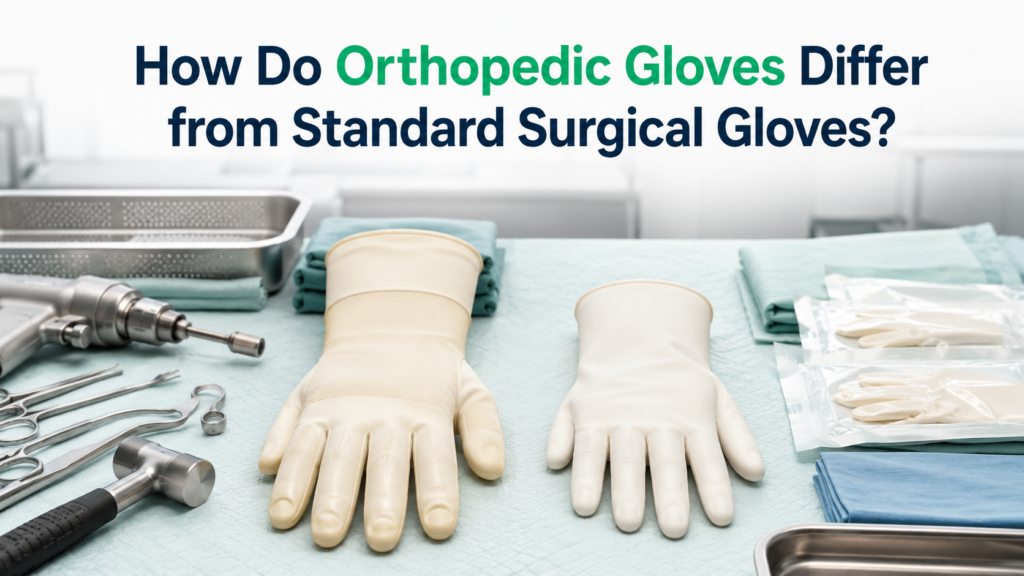
How Do Orthopedic Gloves Differ from Standard Surgical Gloves?
Orthopedic Gloves differ from standard Surgical Gloves because some bone and joint procedures place higher mechanical stress on the glove barrier. Sharp bone edges, hardware, power tools, friction, longer wear, PMMA exposure, and double-gloving needs may require heavier-duty surgical glove selection, but Orthopedic Gloves do not guarantee puncture-proof or chemical-proof protection.
This page explains orthopedic procedure stress, Orthopedic Gloves vs standard Surgical Gloves differences, material and fit selection, PMMA bone cement exposure, double-gloving and indicator systems, failure and exposure response, and a final pre-incision checklist.
This article provides educational guidance about Orthopedic Gloves and standard Surgical Gloves and does not replace product labeling, manufacturer performance data, PMMA or chemical compatibility documentation, facility operating-room protocol, surgical hand antisepsis procedure, sterile gloving training, infection-control policy, sharps safety systems, occupational-exposure procedures, or surgical team judgment. The exact procedure, glove product, material, sterile status, double-gloving system, exposure risk, and local protocol must determine whether Orthopedic Gloves are suitable.
Why do Orthopedic Gloves need different barrier properties from standard Surgical Gloves?
Orthopedic Gloves may need different barrier properties from standard Surgical Gloves because bone and joint procedures can expose the glove barrier to sharper, rougher, heavier, and longer-lasting mechanical stress.
Orthopedic Gloves belong to the wider category because medical gloves. Orthopedic glove choice builds on the same principle because Surgical barrier control. Orthopedic glove design should match procedure stress because orthopedic surgical builds.
What makes orthopedic procedures harder on gloves?
Orthopedic procedures can be harder on gloves because bone, hardware, sharp instruments, rough surfaces, power tools, and longer handling time may increase mechanical stress.
Sharp bone edges, bone fragments, orthopedic wires, screws, plates, suture needles, drill bits, saw blades, retractors, rough implant surfaces, and prolonged handling can all increase snag, friction, puncture, or fatigue pressure on the glove barrier.
Why can standard Surgical Gloves be less suitable in some orthopedic procedures?
Standard Surgical Gloves may be less suitable in some orthopedic procedures when mechanical stress, bone contact, hardware handling, or case duration exceeds the glove’s intended performance profile.
Standard Surgical Gloves may still be appropriate for many surgeries; the issue is product suitability for the specific procedure, not automatic failure. Higher-stress cases may need verified puncture resistance, tear resistance, abrasion resistance, or double-gloving compatibility.
What role do Orthopedic Gloves play?
Orthopedic Gloves are selected to support sterile surgical use under heavier mechanical handling, bone and hardware contact, verified puncture or tear resistance claims, risk-based double-gloving, and procedure-specific fit control.
They may support higher-stress handling when the product data, sterile labeling, and facility-approved use align, but they should be treated as one safety layer rather than a guarantee.
What do Orthopedic Gloves not guarantee?
Orthopedic Gloves do not guarantee no perforation, no sharps injury, no contamination, universal chemical compatibility, PMMA protection, freedom from hand fatigue, or no need for glove changes.
They are not puncture-proof, needle-proof, cement-proof, or fatigue-proof; any suspected breach, contamination, material degradation, exposure, or control problem should trigger the facility response pathway.
Sharp bone edges and fragments
Standard Glove ConsiderationMay face higher puncture or snag stress.
Orthopedic Glove ConsiderationHigher-stress glove may be selected.
VerifyProduct-specific puncture and tear data.
Implants, screws, plates, and wires
Standard Glove ConsiderationHardware may increase abrasion and snag risk.
Orthopedic Glove ConsiderationHeavier-duty design or layering may help.
VerifyManufacturer specifications and facility product records.
Power tools, drill bits, and saw blades
Standard Glove ConsiderationGloves do not replace sharps or tool controls.
Orthopedic Glove ConsiderationGlove selection is only one safety layer.
VerifySharps/tool protocol and exposure-response plan.
Rough implant surfaces and retractors
Standard Glove ConsiderationFriction and abrasion may increase wear.
Orthopedic Glove ConsiderationProduct should match procedure stress.
VerifyFacility-approved orthopedic product list.
Longer handling time
Standard Glove ConsiderationFatigue, sweating, and hidden perforation risk may increase.
Orthopedic Glove ConsiderationFit, layering, and change-out planning matter.
VerifyCase plan and change-out triggers.
How do Orthopedic Gloves differ from standard Surgical Gloves in construction and performance expectations?
Orthopedic Gloves may differ from standard Surgical Gloves in thickness, reinforcement, puncture or tear resistance claims, fit feel, fatigue profile, and double-gloving compatibility, but these differences must be verified product by product.
Category control still matters because Examination vs Surgical Gloves.
Orthopedic Gloves still need sterile surgical use because surgical sterilization. Fatigue and control matter because anatomical fit.
How does thickness differ?
Orthopedic Gloves may use a heavier or reinforced design than some standard Surgical Gloves, but exact thickness varies by manufacturer, model, material, and size.
Standard Surgical Gloves often prioritize tactile sensitivity and precise hand control, while Orthopedic Gloves may shift the balance toward higher-stress handling; exact thickness should come from product data, not universal numbers.
How does puncture or tear resistance differ?
Orthopedic Gloves may be selected for improved puncture, tear, or abrasion resistance under orthopedic stress, but resistance claims must be verified through manufacturer data and facility-approved documentation.
No glove should be called puncture-proof, and one product’s claim should not be generalized to every Orthopedic Glove or every standard Surgical Glove.
How does AQL apply to Orthopedic Gloves?
Orthopedic Gloves are still surgical gloves when intended and labeled for surgical use, so AQL should be understood as lot-quality information rather than proof that every glove will resist orthopedic damage. [eCFR]
Any stricter AQL claim should be treated as a product-specific manufacturer statement, not a universal Orthopedic Glove requirement or prediction of puncture, tear, abrasion, or PMMA performance.
How does fit differ?
Orthopedic Gloves may feel thicker, tighter, or less tactile than standard Surgical Gloves depending on material, layering, and design.
Fit should be checked for thumb movement, finger flexion, webbing tension, palm bunching, cuff stability, dexterity loss, and hand fatigue during longer cases.
How should technical claims be used?
Technical claims such as thickness, tensile strength, elongation, puncture force, tear resistance, abrasion resistance, or defect thresholds should be used only when supported by manufacturer specifications, product labeling, facility-approved records, or relevant testing reports.
General surgical glove category information can support device context, but product-level orthopedic performance must come from product-level evidence. [FDA]
Thickness
Standard Surgical GloveOften balances tactile sensitivity and control.
Orthopedic GloveMay use heavier or reinforced construction.
VerifyManufacturer size and model data.
Puncture or tear resistance
Standard Surgical GloveNot intended to be puncture-proof.
Orthopedic GloveMay claim improved resistance for orthopedic stress.
VerifyProduct testing and facility records.
AQL
Standard Surgical GloveSurgical AQL is lot-quality context.
Orthopedic GloveAny stricter claim is product-specific.
VerifyLabeling or manufacturer documentation.
Fit and fatigue
Standard Surgical GloveMay feel thinner or more tactile.
Orthopedic GloveMay feel thicker, tighter, or less tactile.
VerifySize trial, layering check, and user control.
Technical claims
Standard Surgical GloveClaims vary by product.
Orthopedic GloveClaims must not be generalized.
VerifyManufacturer specifications and testing reports.
These cards are verification prompts, not a product ranking or proof of superiority.
Which Orthopedic Glove materials should be evaluated for tearing, fatigue, and bone cement exposure?
Orthopedic Glove materials should be evaluated for tearing, fatigue, and bone cement exposure using product-specific performance data, compatibility documentation, allergy history, fit testing, and facility policy.
When may latex Orthopedic Gloves be suitable?
Latex Orthopedic Gloves may be suitable when elasticity, tactile sensitivity, and comfortable hand movement are needed and latex use is permitted by patient, staff, and facility requirements.
Latex use should still be checked against latex-protein allergy risk, facility latex policy, product labeling, and compatibility with bone cement, adhesives, antiseptics, or other expected substances.
When may polyisoprene Orthopedic Gloves be suitable?
Polyisoprene Orthopedic Gloves may be suitable when a latex-like feel is needed without natural-rubber latex proteins, especially where comfort, flexibility, and double-gloving mobility matter.
Latex-free does not mean dermatitis-free or universally compatible; additives, thickness, fit, barrier performance, and bone cement behavior should be verified by finished-product data.
When may polychloroprene or neoprene Orthopedic Gloves be suitable?
Polychloroprene or neoprene Orthopedic Gloves may be suitable when a synthetic surgical glove is needed and product-specific data supports the intended orthopedic use.
Chemical protection depends on the exact glove and substance, so PMMA compatibility, stiffness, fit, fatigue, and tactile control should not be assumed from the material name alone.
How should PMMA bone cement exposure be handled?
PMMA bone cement exposure should be handled through product-specific compatibility data and facility protocol rather than material assumptions. [PubMed]
Teams should avoid unnecessary prolonged direct glove contact with uncured cement and replace gloves if product instructions require it or if the glove becomes sticky, softened, discolored, degraded, contaminated, or difficult to use safely.
What material claims should the article avoid?
The article should avoid unsupported material claims such as universal thickness values, universal puncture-force values, universal tensile or elongation values, or universal PMMA protection claims.
It should not claim that latex always degrades quickly, polyisoprene always requires immediate removal, polychloroprene always protects against PMMA, or one material is always best.
Latex
Possible UseElasticity and tactile feedback where latex is permitted.
Main LimitLatex allergy risk and product-specific PMMA performance.
VerifyAllergy status, policy, label, manufacturer data.
Polyisoprene
Possible UseLatex-like feel without natural-rubber latex proteins.
Main LimitLatex-free does not mean dermatitis-free.
VerifyAdditives, fit, performance data, facility list.
Polychloroprene / neoprene
Possible UseSynthetic surgical glove where product data supports the case.
Main LimitChemical protection is not universal.
VerifyManufacturer compatibility data and protocol.
PMMA exposure boundary
Possible UseUse only when exact glove and cement data support contact.
Main LimitMaterial name does not prove compatibility.
VerifyExact glove, cement, instructions, and facility policy.
Unsupported claim boundary
Possible UseUse technical data only when documented.
Main LimitNo universal rankings or fake numbers.
VerifyProduct label, specifications, and approved records.
How should Orthopedic Gloves be paired with double-gloving or indicator systems?
Orthopedic Gloves should be paired with double-gloving or indicator systems according to procedure risk, sharps exposure, bone and hardware handling, case duration, facility protocol, product compatibility, and team practice.
Breach visibility can matter because indicator undergloves.
When is double-gloving used with Orthopedic Gloves?
Double-gloving may be used with Orthopedic Gloves when procedure type, sharps exposure risk, bone or hardware handling, case duration, trauma or arthroplasty conditions, facility protocol, surgeon preference, or indicator-system availability supports an added layer. [Cochrane]
Double-gloving should not be treated as universal for every orthopedic case, and it does not eliminate sharps exposure or replace glove monitoring.
How do indicator systems support Orthopedic Gloves?
Indicator systems support Orthopedic Gloves by using contrasting layers so fluid between the layers may make some outer-glove perforations easier to see. [PubMed]
Indicator systems may help teams identify some breaches earlier, but they do not guarantee detection of every puncture, every inner-glove failure, or surgical-site infection reduction.
How should Orthopedic Gloves be layered?
Orthopedic Glove layering should follow product instructions, facility protocol, sterile gloving method, size compatibility, material compatibility, team preference, and procedure risk.
One universal underglove thickness, color, material, or brand setup should not be required unless the exact product system and facility protocol specify it.
What should happen after an indicator breach appears?
After an indicator spot or suspected breach appears, the compromised layer should be replaced, the inner layer should be inspected or replaced according to protocol, and the sterile field should be reassessed.
The team should pause safely when possible, restore the barrier, replace any compromised layer, reassess field integrity, and continue only after the facility protocol allows it.
Assess orthopedic risk
CheckBone, hardware, sharps, duration, trauma, arthroplasty, or policy.
RiskUnder-layering when risk is high.
Select approved layers
CheckProduct instructions, sizing, material compatibility, facility protocol.
RiskTightness, fatigue, or incompatibility.
Don sterile layers
CheckFacility-approved sterile gloving method.
RiskContamination during setup.
Monitor indicator system
CheckWatch for indicator spot, tear, puncture, or contamination.
RiskUnnoticed outer-glove breach.
Replace and recheck
CheckReplace compromised layer and reassess field.
RiskContinued use after barrier compromise.
How should Orthopedic Gloves be managed after punctures, tears, bone cement contact, or exposure events?
Orthopedic Gloves should be managed after punctures, tears, bone cement contact, or exposure events by pausing safely when possible, replacing compromised layers, reassessing the sterile field, and following facility exposure or product protocols.
What should happen if an Orthopedic Glove puncture is detected?
If an Orthopedic Glove puncture is detected or suspected, the compromised layer should be removed and replaced, the inner layer should be inspected or replaced according to protocol, and the sterile field should be reassessed. [OSHA]
Contaminated items should be replaced when protocol requires it, and visible glove integrity should not be used as proof that no contamination or exposure occurred.
What should happen after a needlestick or sharp injury through Orthopedic Gloves?
After a needlestick or sharp injury through Orthopedic Gloves, the team should follow facility occupational-exposure procedures because Orthopedic Gloves are not puncture-proof. [OSHA]
Immediate routing should include safe stopping, glove removal, washing or flushing as appropriate, reporting, medical evaluation according to protocol, and facility post-exposure procedures.
What should happen after PMMA bone cement contact?
After PMMA bone cement contact, the team should follow manufacturer compatibility guidance and facility protocol rather than assuming the glove material is safe or unsafe.
Gloves should be replaced if product instructions require it or if they become sticky, softened, discolored, degraded, contaminated, or difficult to use safely.
What should happen if Orthopedic Gloves cause hand fatigue or poor control?
If Orthopedic Gloves cause hand fatigue or poor control, the wearer should recheck glove size, layering, material, and approved alternatives because reduced control can affect safe surgical handling.
The team may need a safe pause to change to an approved model, adjust layering, or reassess fit if thumb movement, finger flexion, webbing, palm control, or cuff stability is compromised.
What should happen if a skin reaction occurs?
If itching, redness, burning, rash, or irritation occurs, the suspected glove product should be stopped when safe, documented, and replaced with an approved alternative while persistent symptoms are routed for occupational or medical evaluation.
The record should include timing, glove material, layering, procedure duration, hand antisepsis product, PMMA or adhesive contact, and symptoms without diagnosing latex allergy or dermatitis from glove use alone.
Indicator spot, visible tear, or suspected puncture
RiskBarrier compromise.
ActionReplace compromised layer and inspect/recheck inner layer.
EscalateReassess sterile field.
Needlestick, blade, wire, bone fragment, or instrument injury
RiskOccupational exposure.
ActionStop safely, remove gloves, wash/flush as appropriate.
EscalateReport and follow exposure protocol.
PMMA bone cement contact
RiskProduct-specific compatibility concern.
ActionFollow product guidance; replace if degraded or protocol requires.
EscalateVerify exact glove/cement data.
Hand fatigue or poor control
RiskReduced dexterity and unsafe handling.
ActionRecheck size, layering, material, and fit.
EscalateSwitch approved model during safe pause.
Skin reaction
RiskIrritation or sensitivity pattern.
ActionStop suspected product when safe and document symptoms.
EscalateOccupational or medical evaluation if persistent.
Which checklist verifies safe use of Orthopedic Gloves before bone or joint surgery?
An Orthopedic Glove pre-incision checklist should verify procedure stress, surgical product category, technical documentation, AQL meaning, material, PMMA exposure, double-gloving plan, fit, change-out triggers, and exposure-response readiness.
Orthopedic Glove pre-incision safety checklist
Orthopedic Gloves are suitable before bone or joint surgery only when procedure stress, surgical labeling, technical documentation, AQL meaning, material, PMMA exposure, double-gloving, fit, change-out, and exposure-response checks align.
A completed checklist supports team review, but it does not replace product labeling, manufacturer documentation, sterile technique, facility policy, surgical team judgment, or occupational-exposure protocol.
Conclusion
Orthopedic Gloves differ from standard Surgical Gloves because bone and joint procedures may place higher mechanical, puncture, friction, fatigue, and exposure demands on the glove barrier. Their safe use depends on surgical labeling, sterile status, product-specific technical verification, material and fit selection, PMMA or bone cement compatibility checks, and a clear understanding that standard Surgical Gloves remain appropriate for many procedures when their product profile and protocol match the case.
Orthopedic Gloves are not puncture-proof, AQL is not an individual-glove guarantee, double-gloving and indicator systems are risk- or protocol-based, indicator systems do not detect every breach, and PMMA compatibility requires exact product data. Punctures, sharps injury, contamination, fatigue, skin symptoms, and material degradation require prompt replacement, field reassessment, and facility protocol.
Frequently Asked Questions
How do Orthopedic Gloves differ from standard Surgical Gloves?
Orthopedic Gloves may differ from standard Surgical Gloves through heavier-duty construction, product-specific puncture or tear resistance claims, fit profile, double-gloving compatibility, and verification for higher mechanical stress.
Are Orthopedic Gloves puncture-proof?
No. Orthopedic Gloves may support higher-stress surgical handling, but they are not puncture-proof and do not prevent every sharps injury or glove breach.
Are Orthopedic Gloves always required for orthopedic surgery?
Orthopedic Gloves are not automatically required for every orthopedic procedure; selection depends on procedure stress, product labeling, facility protocol, surgeon preference, and manufacturer-supported performance.
Does AQL prove an Orthopedic Glove will not tear or puncture?
No. AQL is lot-quality information and does not prove that an individual glove will resist puncture, tear, abrasion, PMMA exposure, or procedure-related damage.
Can Orthopedic Gloves protect against PMMA bone cement?
Orthopedic Gloves should not be assumed to protect against PMMA bone cement unless manufacturer compatibility data and facility protocol support that exact glove and cement exposure.
When should Orthopedic Gloves be changed during surgery?
Orthopedic Gloves should be changed after visible damage, suspected puncture, indicator breach, contamination, material degradation, high-risk steps, or any facility-defined change-out trigger.