
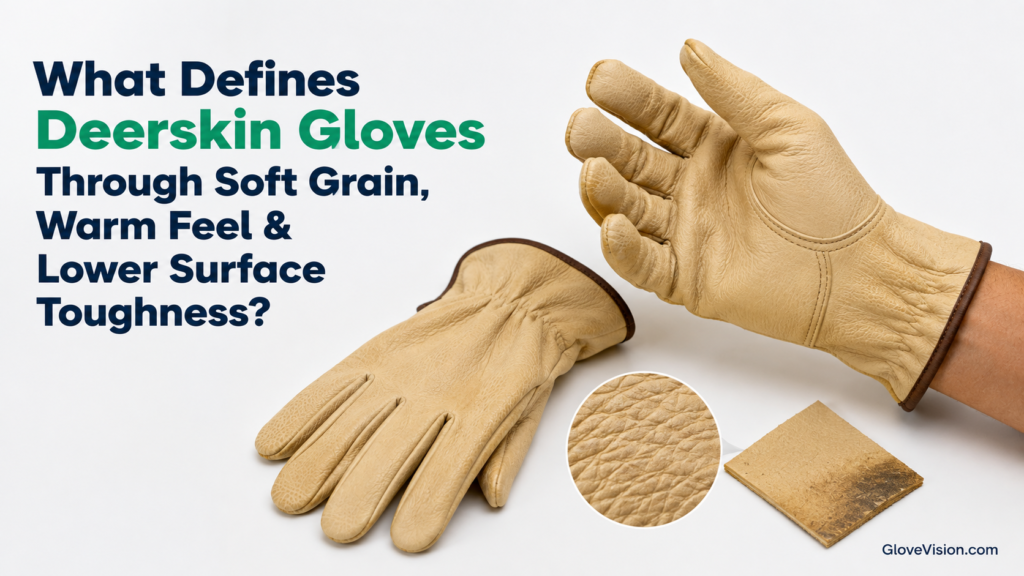
What Defines Deerskin Gloves Through Soft Grain, Warm Feel & Lower Surface Toughness?
Deerskin Gloves are processed deer-hide hand protection associated with soft hand feel, flexible conformity, comfortable handling and product-dependent perceived warmth.
Those characteristics involve trade-offs and do not automatically establish thermal insulation, surface durability, cut or puncture resistance, chemical protection or electrical protection.
What Are Deerskin Gloves, and How Do Their Soft Grain and Construction Shape Conformability?
Deerskin Gloves are made from processed deer hide whose collagen-fiber structure, grain condition, thickness, tanning, finishing, panel design and fit influence softness, stretch, flexibility, conformability and surface behavior.
What is the material composition of deer-leather gloves?
Deerskin is a variable biological material rather than a uniform manufactured sheet. Its grain layer and deeper structure contain interwoven collagen-fiber bundles whose properties vary with species, hide area, grade and processing. The broader material context belongs in the Leather Gloves guide.
What does soft grain mean in Deerskin Gloves?
“Soft grain” describes fine surface feel, low perceived stiffness, flexible bending, close conformity and smooth hand contact. It is not a standardized leather grade, protection level or abrasion rating.
What is the difference between grain deerskin and buckskin?
Grain deerskin retains the outer grain surface. Buckskin commonly describes deer hide processed with the grain removed, producing a suede-like face, although commercial terminology can vary. Missouri’s conservation guidance explicitly describes removing hair and the outer grain during traditional buckskin preparation. [Buck]
How do tanning and finishing affect Deerskin Gloves?
Tanning, fatliquoring and surface finishing may alter softness, stretch, dimensional stability, friction, moisture response, color, aging and wear. Animal source alone does not predict the finished result.
How does thickness affect Deerskin Gloves?
Thickness changes bulk, bending, tactile feedback, hand closure, cushioning and wear reserve. Thin does not automatically mean dexterous, while thick does not automatically mean protective or warm.
How does fit affect Deerskin Gloves conformability?
Correct fit supports natural finger alignment, stable palm position, controlled bunching, full hand opening, functional closure, usable thumb movement and a secure wrist. Fit must be verified through the real task, not softness alone.
How do seams and reinforcements change Deerskin Gloves?
Reinforcement can support palm or thumb-crotch durability but may add bulk and stiffness. Seam placement can create pressure, extra edges or movement restriction, so complete construction matters.
Why can Deerskin Gloves vary between products?
Species, anatomical area, hide grade, thickness, grain retention, tanning, finish, panel orientation, reinforcement and lining all vary. See 23 Glove Materials Explained for the larger material-selection framework.
| Deerskin feature | Possible contribution | What it does not guarantee |
|---|---|---|
| Fine grain surface | Soft contact feel | Abrasion rating |
| Flexible collagen network | Conformability and movement | Cut or puncture protection |
| Lower-bulk construction | Less material interference | Adequate surface toughness |
| Tanning and fatliquoring | Product-dependent suppleness | Equal performance |
| Grain removal | Suede-like surface | Greater protection |
| Surface finish | Modified friction and moisture response | Waterproofing |
| Close fit | Stable hand-to-glove contact | Thermal insulation |
Why Can Deerskin Gloves Feel Warm Without Providing Universal Cold Protection?
Deerskin Gloves may feel warm because leather, close fit, reduced airflow, lining and trapped air can reduce immediate cold-contact sensation, but actual protection depends on the complete glove and environmental conditions.
What does “warm feel” mean for Deerskin Gloves?
It may combine comfortable initial contact, close conformity, reduced interior movement and lining effects. It is subjective and is not a certified thermal rating.
Does bare deerskin provide thermal insulation?
Bare leather may contribute limited thermal resistance, but meaningful cold protection depends on thickness, lining, trapped air, wind resistance, fit, moisture and coverage. Evidence from deer fur or hair-on pelts cannot be transferred to hairless gloves.
How do linings affect Deerskin Gloves warmth?
Fleece, wool, synthetic insulation or textile liners may add thermal resistance and air space, but also bulk, moisture retention and drying time. No lining is universally superior.
How does fit affect thermal comfort?
Excess looseness may permit airflow and unstable handling; excessive tightness can compress insulation and restrict movement. Cuffs must maintain coverage without interfering with clothing.
How do moisture and wind affect warmth?
Wet leather, saturated lining, evaporation, wind penetration and cuff gaps can change thermal comfort and fit. A glove comfortable in dry, calm conditions may perform differently when wet or exposed to wind.
When do Deerskin Gloves need cold-protection evidence?
Require complete-product information for prolonged or occupational cold, subfreezing conditions, strong wind, wet snow, low activity and frostbite-risk environments.
| Warmth factor | Possible contribution | Main trade-off | Required verification |
|---|---|---|---|
| Bare deerskin shell | Comfortable initial feel | Limited insulation alone | Complete-glove thermal data |
| Close fit | Reduced internal movement | May compress insulation | Functional fit check |
| Insulating lining | Greater thermal resistance | Bulk and lower dexterity | Lining specification |
| Wind-resistant construction | Reduced convective loss | Possible moisture buildup | Complete-product evidence |
| Water-resistant treatment | May reduce uptake | Treatment may wear | Manufacturer documentation |
| Extended cuff | Reduced wrist exposure | Movement interference | Clothing-interface check |
| Dry interior | Supports comfort | Sweat may accumulate | Moisture assessment |
Where Does the Surface Toughness of Deerskin Gloves Become Limited?
Some soft or lower-bulk Deerskin Gloves may have less surface-wear reserve in severe abrasive conditions, but actual toughness must be determined from leather grade, thickness, reinforcement, construction and finished-glove testing.
What does lower surface toughness mean for Deerskin Gloves?
It describes possible scuffing, polishing, grain wear, thinning, snagging or finish loss in some constructions. It is not a formal test classification or a universal weakness.
How much abrasion resistance can Deerskin Gloves provide?
Grade, thickness, grain condition, finish, reinforcement, seams, moisture and exposure severity all affect performance. ISO 23388 separately addresses abrasion, blade cut, tear, puncture and applicable impact, and is published while marked for future revision. [Mech]
Do Deerskin Gloves automatically resist cuts or punctures?
No. Abrasion, tear, blade cut, general puncture and needle puncture require separate evidence. ISO 21420 covers general design, comfort and marking but does not establish protective properties alone. [Gen]
Can Deerskin Gloves provide impact protection?
Only when the complete glove incorporates appropriate tested knuckle, finger or backhand protection. Soft leather itself proves no impact rating.
Can Deerskin Gloves be used around heat or flame?
Only if the exact product is designed and documented for contact heat, sparks, flame, radiant heat or molten-material exposure. Seams, thread, lining and cuff must be included.
Do Deerskin Gloves provide chemical protection?
Not automatically. Leather may absorb and retain hazardous liquids; ISO 374-1:2024 addresses complete gloves intended for dangerous-chemical protection. [Chem]
Can Deerskin Gloves provide electrical protection?
ASTM F696-24 permits grain deerskin in specified protectors worn over rubber insulating gloves, but their role is mechanical protection of the insulating glove—not primary electrical insulation. [ASTM] The CDC/NIOSH summary states the same boundary explicitly. [NIOSH]
| Hazard or condition | Possible deerskin role | Evidence required | Main boundary |
|---|---|---|---|
| Light surface abrasion | Product-dependent wear resistance | Finished-glove abrasion rating | Soft grain may show wear |
| Severe rough handling | Flexible mechanical coverage | Reinforcement and abrasion evidence | Lower-bulk designs may wear faster |
| Blade cut | No automatic protection | Cut-specific testing | Leather can be cut |
| Puncture or needle | No automatic protection | Hazard-specific testing | Sharp points may penetrate |
| Impact | No verified role unless reinforced | Impact-specific testing | Deerskin alone is insufficient |
| Cold conditions | Product-dependent comfort | Complete-glove thermal evidence | Warm feel is not insulation |
| Wet conditions | Product-dependent coverage | Water-resistance evidence | Leather may absorb moisture |
| Chemicals | No verified barrier role from deerskin alone | Exact chemical and complete-glove data | Contamination may remain |
| Electrical work | Mechanical protector in an approved system | ASTM F696-24 and system requirements | Not primary insulation |
Which Deerskin Gloves Match Different Comfort and Work Requirements?
The right Deerskin Gloves depend on the required balance of softness, dexterity, grip, warmth, surface durability, coverage and hazard-specific protection.
Which Deerskin Gloves suit light general handling?
Match surface roughness, repetition and required grip to thickness, fit, seam placement, palm wear reserve and finished-product ratings. OSHA requires selection around identified hazards, task conditions and required performance. [OSHA]
Which Deerskin Gloves suit precision-oriented tasks?
Prioritize anatomical fit, controlled fingertip length, stable palm position, flexible thumb construction and low-interference seams while retaining adequate verified protection. For a different thin-strength lens, see Goatskin Gloves.
Which Deerskin Gloves suit cool or cold weather?
Evaluate temperature, duration, wind, moisture, lining, insulation, cuff, dexterity and product-level cold-performance information. Warm feel alone is not enough.
Which Deerskin Gloves suit riding or outdoor use?
Consider grip, repeated flexion, weather, surface abrasion, reinforcement, seam location, cuff interface and drying requirements. Detailed riding selection belongs to a task-specific page.
Which Deerskin Gloves suit electrical protector systems?
Use only specified protectors that fit the insulating gloves correctly, provide required coverage, satisfy dimensional requirements and pass inspection. Standalone deerskin is not insulation.
When should another glove replace Deerskin Gloves?
Select another verified construction for severe abrasion, high cut or needle hazards, heavy impact, chemical permeation, liquid impermeability, primary electrical insulation or specialized thermal exposure. Cowhide Gloves covers rugged-handling variables, while Pigskin Gloves covers a different moisture-behavior lens; neither comparison creates a universal ranking.
Handling balance
Fit and grip must coexist with verified wear resistance.
Cold balance
Lining and exposure evidence matter more than warm feel.
Outdoor balance
Weather, flexion, cuff and drying must be assessed together.
Special hazards
Use the exact rated glove or approved protection system.
How Should Deerskin Gloves Be Selected, Fitted, Maintained, and Retired?
Deerskin Gloves should be selected by exact task and hazard, fitted for stable movement, inspected for surface and structural wear, maintained according to product instructions and retired when protection or function cannot be verified.
What should be defined before selection?
Identify task, surface roughness, abrasion, sharp edges, puncture points, impact, cold, wind, moisture, heat, chemicals, electrical exposure, grip, dexterity, coverage and duration. The Glove Basics hub explains the underlying hazard and fit principles.
Which construction details should be checked?
Verify deer-hide identity, grain or buckskin construction, grade, thickness, tanning, finish, palm, fingers, thumb, reinforcement, seams, thread, backhand, lining, cuff, closure, ratings and intended use.
How should Deerskin Gloves fit be tested?
Confirm natural finger alignment, controlled fingertip space and palm bunching, full opening and functional closure, usable thumb movement, secure wrist fit and reliable task control without pain or numbness.
What should be inspected before use?
Check scuffing, polished zones, thin areas, cuts, holes, punctures, cracks, hardening, stretching, shrinkage, seams, reinforcement, lining, cuff, contamination, repairs and product markings.
How should Deerskin Gloves be cleaned, dried and stored?
Follow exact manufacturer instructions for surface cleaning, washing restrictions, water exposure, drying, conditioning, treatments, storage and decontamination. No universal care method applies.
When should Deerskin Gloves be retired?
Retire or reassess gloves when thinning, holes, cuts, open seams, failed reinforcement, hardening, deep cracks, unstable fit, restricted movement, unreliable grip, damaged lining, hazardous contamination, missing markings or unauthorized repairs prevent verification.
Hazard match
- Exact task is defined
- Abrasion severity is identified
- Cut, puncture and impact hazards are separated
- Cold, wind and moisture exposure are defined
- Chemical, thermal and electrical hazards are assessed
- Required ratings are known
Construction
- Grain or buckskin construction is identified
- Leather grade and intended use are documented
- Palm and fingers provide required coverage
- Reinforcement matches high-wear zones
- Lining and cuff match environmental conditions
- Seams and thread suit the task
Fit and function
- Fingers align naturally
- Palm bunching is controlled
- Full opening and closure are possible
- Grip remains stable
- Dexterity matches the task
- No painful pressure is present
Condition
- No holes or critical thin areas are present
- Seams remain closed
- No unacceptable cracking or hardening exists
- No unresolved contamination remains
- Lining and reinforcement remain secure
- Product identity is verifiable
Final decision
- Use: hazard match, evidence, fit and condition are acceptable
- Resize: fit interferes with control
- Select another construction: warmth or protection is inadequate
- Maintain: exact instructions permit corrective care
- Reassess: wear or deformation requires evaluation
- Replace: protection, fit, warmth or handling cannot be restored
- Do not use: suitability cannot be verified
Final pathway: Exact task and hazard → required softness and dexterity → environmental exposure → complete construction → product evidence → functional fit → condition → care requirements → use, reassess or replace.
Conclusion
Deerskin Gloves can provide soft, flexible, conforming hand coverage and a product-dependent warm feel, but these comfort characteristics do not automatically establish insulation or rugged surface protection. Grain condition, processing, thickness, construction, lining and fit control the result.
Lower surface toughness is not universal; abrasion, cut and puncture remain separate properties, while chemical, thermal and electrical protection require complete-product evidence. Continued use depends on the task, environment, fit, wear, contamination, maintenance and current condition.
Frequently Asked Questions
Are Deerskin Gloves naturally warm?
They may feel warm and comfortable, but deerskin alone does not establish cold protection. Actual warmth depends on thickness, lining, insulation, fit, wind, moisture, activity and conditions.
Are Deerskin Gloves less durable than other leather gloves?
Not universally. Some soft or lower-bulk constructions may have less wear reserve during severe abrasion, but comparisons require equivalent grade, thickness, finish, reinforcement, construction and testing.
Is buckskin the same as deerskin?
Not exactly. Deerskin identifies the animal source; buckskin commonly describes deer hide processed with its outer grain removed to create a suede-like surface, although commercial terminology varies.
Do Deerskin Gloves protect against cuts, chemicals, or electricity?
Not automatically. Each hazard requires separate finished-product evidence. Deerskin may be a mechanical protector in an approved electrical-glove system but does not replace the insulating glove.
When should Deerskin Gloves be replaced?
Replace or reassess them when thinning, holes, cuts, punctures, open seams, cracking, hardening, deformation, failed reinforcement, damaged lining, contamination, unstable fit, unreliable grip or unverifiable protection prevents continued use.