
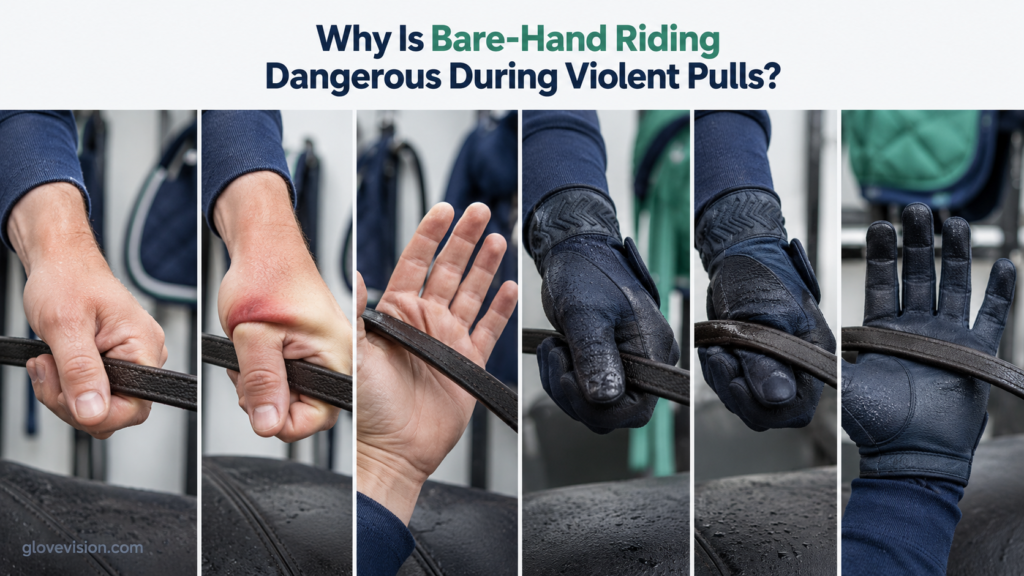
Why Is Bare-Hand Riding Dangerous During Violent Pulls?
Bare-Hand Riding places the skin directly against the reins, allowing a violent pull or sudden rein movement to transfer friction, concentrated pressure, and traction into the unprotected hand.
Suitable Riding Gloves may reduce some surface damage and grip instability, but they cannot neutralize extreme rein force, prevent every hand injury, or make rein entanglement safe.
Riding Gloves may reduce friction burns, abrasions, blistering, and some grip instability, but they cannot prevent every injury caused by a violent pull. Never wrap reins, lead ropes, or lunge lines around the fingers, thumb, hand, or wrist. Seek prompt medical assessment for severe or increasing pain, significant swelling, deformity, deep wounds, persistent numbness, weakness, color change, or reduced movement.
Why Does Bare-Hand Riding Become Dangerous During Violent Pulls?
Bare-Hand Riding becomes dangerous during violent pulls because rapidly moving or suddenly tightening reins can transfer friction, concentrated pressure, and traction directly into unprotected skin, fingers, and joints.
What Can Create a Violent Rein Pull During Bare-Hand Riding?
Unexpected horse movement, abrupt head motion, sudden speed or direction change, loss of balance, resistance, or a rein that catches or tightens can rapidly change the horse–rein–hand system. This page treats those events only as hand-exposure triggers, not as riding or horse-control instruction.
How Does a Violent Pull Transfer Rein Force During Bare-Hand Riding?
The rein forms part of the mechanical pathway between horse and rider. When it accelerates or tightens suddenly, the hand has limited time to respond. Bare skin has no intervening glove layer; clamping can increase localized pressure, while a trapped rein can concentrate loading around a small hand area.
Which Hand Areas Are Exposed During Bare-Hand Riding?
Exposure can involve the palm, base and sides of the fingers, finger webs, thumb, thumb-index web, knuckles, and wrist. The loaded zone changes with rein position, hand position, rein width, loop arrangement, direction of movement, and whether the rein slips or tightens.
Why Can Holding Tighter Make Bare-Hand Riding Risk Worse?
A tighter grip may reduce some rein movement, but it can also increase local pressure, reduce the hand’s ability to adjust quickly, and increase loading on a trapped finger. Grip strength cannot neutralize every sudden force and does not make entanglement safe.
The broader principle that sports handwear must balance protection with task control is covered in sports glove protection and control.
Horse moves or pulls suddenly → rein accelerates, tightens, or changes direction → bare hand receives direct friction and concentrated pressure → fingers slip, clamp, or become trapped → surface injury, disrupted control, or deeper traction injury may result.
How Does Bare-Hand Riding Turn Violent Rein Pulls Into Hand Injuries?
Bare-Hand Riding can expose the hand to several distinct mechanisms: skin shear, concentrated pressure, slippage, trapping, entanglement, and deeper traction. These mechanisms should not be collapsed into the single phrase “rein burn.”
How Can Fast Rein Movement Damage Bare Skin?
Relative rein movement can create tangential loading and shear within skin layers. Repeated shear cycles are central to friction-blister formation, although foot-blister evidence supports only the general mechanism rather than a specific equestrian risk estimate. [Shear]
How Can Sudden Rein Pressure Compress the Hand?
Pressure becomes more concentrated when force acts through a narrow rein section, finger web, side of a finger, trapped skin fold, or tightening loop. Possible effects include pinching, bruising, temporary numbness, painful finger-web loading, and reduced finger control.
How Can Rein Slippage Increase Bare-Hand Riding Risk?
A rein may move quickly across the palm or fingers, increasing skin shear and forcing repeated repositioning. Reflexive squeezing can then increase grip effort and local pressure, although not every instance of slippage causes injury.
How Can Finger Trapping and Rein Entanglement Change the Mechanism?
If a finger, thumb, skin fold, or hand area cannot move normally, the effective contact area may shrink while the rein continues to tighten. Loading can shift from surface friction toward concentrated compression and traction, and voluntary release may become difficult or impossible.
How Can Rein Traction Cause Deeper Hand Injuries?
Traction can damage bones, joints, tendons, nerves, blood vessels, and surrounding tissue. A retrospective equestrian hand-injury study documented severe traction mechanisms, but most traction cases involved horse handling or leading rather than mounted Bare-Hand Riding, so the evidence is used here only to establish the mechanism and protection boundary. [Hand]
Which Conditions Make Bare-Hand Riding During Violent Pulls More Dangerous?
Bare-Hand Riding becomes more hazardous when moisture, damaged reins, cold hands, fatigue, existing hand injury, or poor rein arrangement make contact less predictable or reduce deliberate release.
How Do Rain, Sweat, and Moisture Increase Bare-Hand Riding Risk?
Moisture can change skin friction, rein friction, skin softness, and the frequency of readjustment. The direction and size of the change vary by skin, rein, contamination, and material, so universal wet-friction claims should be avoided.
A controlled general comparison of palm friction and breathability and moisture exposure in glove materials can clarify the interface principle without establishing equestrian-specific performance.
How Do Rein Texture and Condition Affect Bare-Hand Riding?
Surface roughness, width, flexibility, grip sections, wear, dirt, treatment residue, moisture, and damaged edges can all change the contact interface. Roughness may increase skin exposure, while a smooth or contaminated surface may increase slippage; highly textured material can also resist deliberate adjustment.
How Do Cold Hands and Fatigue Increase Bare-Hand Riding Risk?
Cold can reduce sensation and finger mobility, while fatigue can reduce grip precision and encourage harder squeezing. Either can make adjustment or release slower and make developing pressure harder to detect.
How Does Existing Hand Damage Accelerate Bare-Hand Riding Risk?
Blistering, abrasion, cracked skin, swelling, pain, numbness, or reduced movement can lower tolerance for repeated loading. Existing symptoms should not be masked simply by gripping harder or adding protection and continuing without reassessment.
Which Rein Arrangements Create the Greatest Trapping Concern?
Loops around fingers or the thumb, slack trapped inside the hand, unpredictable crossing sections, or material caught under jewelry can concentrate traction. Reins, lead ropes, and lunge lines should never be wrapped around the fingers, thumb, hand, or wrist.
| Risk Accelerator | Interface Change | Possible Outcome | Required Correction |
|---|---|---|---|
| Wet or sweaty hands | Less predictable rein contact | Slipping or overgripping | Replace direct bare-hand contact with suitable protection |
| Abrasive or damaged rein | Concentrated surface loading | Burns, blisters, abrasions | Inspect the rein and use suitable protection |
| Cold hands | Reduced sensation and movement | Delayed adjustment or release | Use suitable weather-specific protection |
| Hand fatigue | Reduced grip precision | Excessive squeezing or slipping | Stop and reassess hand function |
| Rein loop around fingers | Concentrated traction | Severe finger or hand injury | Do not continue with reins wrapped around the hand |
| Existing skin damage | Reduced tissue tolerance | Worsening pain or abrasion | Stop and reassess before continuing |
How Should Bare-Hand Riding Be Replaced With Suitable Hand Protection?
Bare-Hand Riding should be replaced with hand protection that separates skin from the rein while preserving rein feel, finger and thumb movement, stable contact, controlled adjustment, and immediate deliberate release.
What Should Hand Protection Change About Bare-Hand Riding?
Suitable protection should cover frequent rein-contact zones, reduce direct abrasion, reduce internal hand movement, manage relevant moisture, stabilize contact, and preserve useful rein feedback. Wearing any glove does not automatically meet these requirements.
Detailed product selection and care belong on the dedicated suitable Riding Gloves page.
Why Must Hand Protection Preserve Rein Feel and Deliberate Release?
The rider should still be able to detect rein position, movement, slippage, and length changes while opening the fingers and thumb normally. Protection that substantially removes usable feedback or binds during release can introduce a different control problem.
A limited cross-sport comparison of glove fit and tactile control supports the fit-versus-feedback concept without transferring golf outcomes to riding.
Why Is Maximum Glove Grip Not the Goal?
The goal is stable and controllable rein contact—not maximum friction. Excessive palm friction can resist rein adjustment, delay deliberate release, catch unexpectedly against textured surfaces, or increase grip effort.
General protective-glove research shows that glove design can alter dexterity and grip performance, supporting a protection-versus-hand-performance trade-off rather than maximizing a single property. [Gloves]
How Should Basic Hand-Protection Fit Be Confirmed?
Fingers should align naturally, excess fingertip material should remain limited, the palm should stay smooth, the hand should not rotate inside the glove, and the thumb and wrist should move without painful restriction. uvex gives similar product-specific fit checks involving full finger placement, secure wrist fit, and pressure-point assessment. [uvex]
Where Does Hand Protection End During a Violent Pull?
Suitable Riding Gloves cannot guarantee prevention of fractures, dislocations, tendon or nerve injury, crush injury, avulsion injury, entanglement injury, or every loss-of-control event. A glove barrier may reduce surface exposure while deeper traction still reaches the hand.
How Should Bare-Hand Riding Risk Be Evaluated After a Violent Pull?
After a violent rein pull, evaluate the event, rein arrangement, direct hand exposure, release capability, visible skin condition, sensation, movement, swelling, grip function, and any warning signs before deciding whether to continue.
Which Details of the Violent Pull Should Be Considered?
Consider whether the rein moved rapidly, tightened suddenly, trapped a finger or thumb, formed a loop, prevented normal release, caused visible skin damage, or changed hand function. Do not estimate injury severity from an assumed rein-force value.
How Should the Hand Be Checked Immediately After a Violent Pull?
Check for skin breaks, friction burns, blisters, bleeding, bruising, swelling, tenderness, finger or thumb alignment, sensation, color, temperature, grip function, and finger or wrist movement. Do not force painful movement.
Why Can Minor Surface Damage Hide a Deeper Injury?
Surface appearance shows only outer tissue condition, while traction can reach joints, tendons, nerves, blood vessels, and bone. A small abrasion therefore cannot rule out deeper loading, and symptoms may evolve after the event.
Which Problems Require an Immediate Stop and Reassessment?
Stop when pain develops or worsens, numbness or tingling occurs, movement or grip changes, deliberate release is impaired, a finger becomes trapped, or protective equipment shifts or fails.
Which Symptoms Require Prompt Medical Assessment?
Prompt assessment is appropriate for severe or increasing pain, significant swelling, deformity, deep wounds, persistent numbness or tingling, weakness, skin-color change, abnormal temperature, or reduced movement. NHS guidance lists pain, swelling, bruising, difficulty moving, color or shape change, and numbness among warning features after a possible fracture; Mayo Clinic likewise highlights severe pain, swelling, deformity, reduced movement, numbness, and color change as reasons for medical evaluation. [NHS] [Mayo]
Riding context → rein and weather conditions → violent-pull likelihood → direct hand exposure → suitable hand protection → deliberate-release capability → post-pull skin and hand-function check → continue, correct, stop, or seek medical assessment.
Conclusion
Bare-Hand Riding becomes dangerous during violent pulls because sudden high rein loading can apply friction, concentrated pressure, trapping, and traction directly to unprotected skin, fingers, and joints. Not every strong pull causes injury, and surface damage is not the same mechanism or outcome as deeper traction injury.
Suitable Riding Gloves may reduce surface and grip-related risks, but they cannot neutralize extreme traction or make entanglement safe. Safer hand protection should preserve rein feel, finger and thumb movement, controlled adjustment, and immediate deliberate release while significant post-pull symptoms receive appropriate medical assessment.
Frequently Asked Questions
Can Bare-Hand Riding Cause Rein Burns?
Yes. A rein moving rapidly across uncovered skin can create shear, abrasion, or friction-burn exposure, although the outcome depends on movement, loading, contact area, rein condition, moisture, and exposure duration.
Can a Violent Rein Pull Break or Dislocate a Finger?
It can. A trapped finger or concentrated traction may injure bones, joints, tendons, nerves, blood vessels, or surrounding tissues. The visible surface condition cannot establish the full extent of injury.
Do Riding Gloves Eliminate Bare-Hand Riding Risks?
No. They remove direct bare-skin exposure and may reduce friction, abrasion, blistering, and some grip instability, but they cannot eliminate severe traction or entanglement hazards.
Is Stronger Glove Grip Always Safer During a Violent Pull?
No. Grip should remain predictable while allowing rein adjustment, finger movement, and immediate deliberate release. Maximum palm friction is not automatically safest.
What Should Be Done After a Violent Rein Pull Injures the Hand?
Stop the activity and assess the hand without forcing painful movement. Seek prompt medical assessment for severe or increasing pain, significant swelling, deformity, deep wounds, persistent numbness, weakness, color change, abnormal temperature, or reduced movement.