
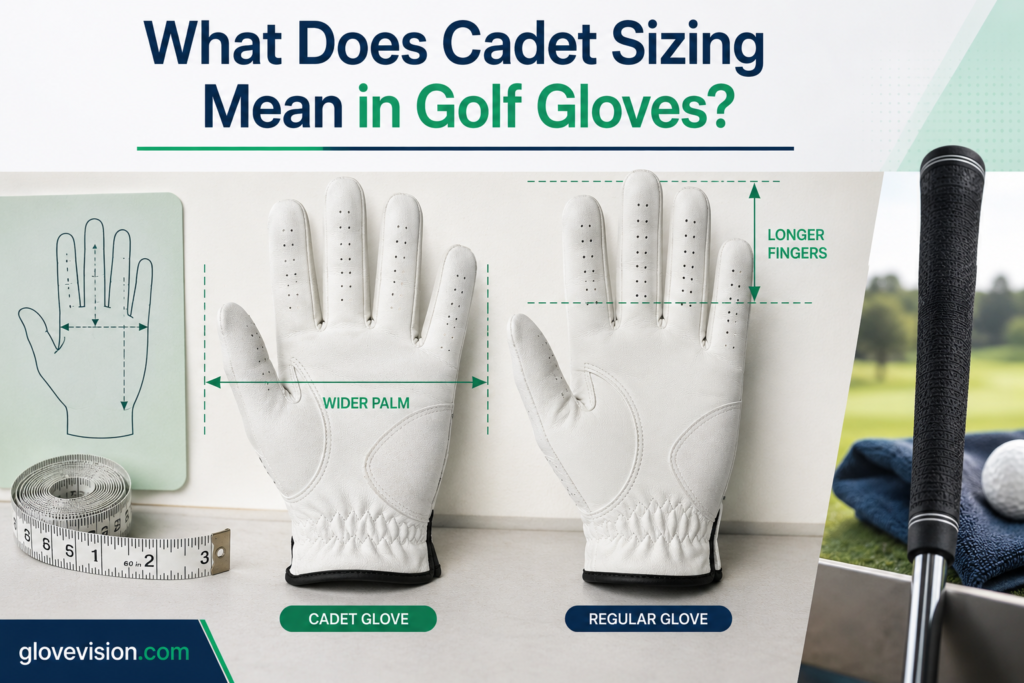
What Does Cadet Sizing Mean in Golf Gloves?
Cadet Golf Glove Sizing is a proportion-based option for golfers who need relatively more palm room and relatively shorter finger stalls than the corresponding Regular pattern. It addresses the relationship between palm dimensions and finger length rather than simply making the whole glove smaller or larger.
Cadet does not mean youth, beginner, or universally small, and there is no dependable cross-brand Regular-to-Cadet conversion. The correct size still depends on the exact manufacturer and model, the hand that will wear the glove, the maker’s measurement method, palm and finger fit, thumb alignment, closure position, hand movement, material behavior, and the actual club-grip interface.
Educational and fit notice: Cadet Golf Glove Sizing is manufacturer- and model-specific and should not be selected through a universal Regular-to-Cadet conversion. Follow the exact manufacturer’s measurement, sizing, fitting, care, and replacement guidance. A glove should not create painful compression, numbness, restricted movement, or persistent pressure, and ongoing swelling, weakness, pain, or changes in hand function should not be managed through glove sizing alone.
What Does Cadet Golf Glove Sizing Actually Mean?
Cadet Golf Glove Sizing describes an alternative palm-to-finger proportion intended for golfers who need relatively more palm room and relatively shorter finger stalls than the corresponding Regular glove pattern.
FootJoy’s current fitting guide gives a clear manufacturer example: its Regular cut uses standard palm/finger proportions, while its Cadet cut has a wider palm and shorter fingers. FootJoy also says extra material at the fingertips can be a reason to try a Cadet glove, with final fit confirmed by try-on. [FJ Fit]
Which Hand Proportions Does Cadet Sizing Usually Address?
The common pattern is a palm that is relatively broad in relation to finger length, not a “wide hand” diagnosis in isolation. The important variable is the palm-to-finger relationship inside the exact manufacturer’s pattern.
Why Does Cadet Not Mean a Children’s Golf Glove?
Cadet is a proportion category, not an age or skill category. FootJoy’s current men’s glove range includes Cadet hand configurations, confirming that Cadet sits within adult men’s Golf Gloves rather than functioning as a synonym for junior sizing. [FJ Men]
Why Is Cadet Not Simply a Smaller Regular Size?
A smaller Regular glove reduces the maker’s standard pattern rather than changing the palm-to-finger relationship in the same way as a Cadet cut. If Regular fingertips are long but sizing down compresses the palm, the problem may be proportion rather than overall scale.
Why Is Cadet Golf Glove Sizing Not Universally Standardized?
Manufacturers control their own pattern blocks, grading, measurement charts, materials, closures, thumb geometry, size availability, and hand orientations. A Cadet label is therefore not a universal measurement.
Which Cadet Misconceptions Should Be Corrected?
Cadet does not automatically mean youth, beginner, one size smaller, one size wider, or a universal conversion such as “Cadet M equals Regular L.” The wider-palm/shorter-finger description is always relative to the manufacturer’s corresponding Regular proportions.
The broader sports glove fit and equipment-interface principles help explain why fingertip volume, palm stability, finger movement, and real equipment contact should be checked together rather than reduced to one size label.
| Term | Meaning | What It Does Not Mean | Required Verification |
|---|---|---|---|
| Cadet | A manufacturer-defined alternate palm-to-finger proportion, typically relatively wider through the palm and shorter through the fingers than that maker’s Regular cut | Youth, beginner, universally small, or a standard industry dimension | Exact manufacturer, model, chart, hand orientation and try-on |
| Regular | The standard palm/finger proportion defined for that glove line | One universal average across all brands | Exact model and current Regular chart |
| Youth | An age/size-market category separate from Cadet proportion terminology | Cadet | Product age category and manufacturer sizing |
| Numerical / letter size | A size label inside one manufacturer’s grading system | A universal palm circumference, finger length or cross-brand conversion | Exact chart and measurement method |
| Cadet fit | A functional result when the alternate proportions suit the wearer’s palm, fingers, thumb, closure and movement | Proof that any golfer with a wide palm or short fingers needs Cadet | Physical fit and club-grip function check |
How Does Cadet Golf Glove Sizing Differ from Regular Sizing?
Cadet Golf Glove Sizing differs from Regular sizing primarily in the relationship between palm room and finger-stall length rather than through one universal increase or decrease in every glove dimension.
Current manufacturer examples also show that availability differs by exact model. Titleist’s Players Men’s glove offers Regular Left, Cadet Left, and Regular Right configurations, with a different size range for its Cadet Left option; TaylorMade’s Tour Preferred likewise lists a Cadet LH configuration and publishes its own Regular and Cadet size chart. [Titleist] [TaylorMade]
How Does Palm Width Differ?
Use relative language: a Cadet cut may provide more palm room than the corresponding Regular proportion, but the amount is controlled by the exact manufacturer and model. Do not publish universal inches or centimetres for “Cadet palm width.”
How Does Finger Length Differ?
Cadet finger stalls are typically relatively shorter in the manufacturer’s alternate pattern, which can reduce fingertip excess for the right hand shape. Finger width, compression, flexion, and individual finger proportions still need separate checks.
Can Thumb Geometry Differ?
Yes. Thumb length, angle, base position, gussets, and seams are model-level pattern details. A Cadet label does not guarantee ideal thumb geometry.
Can Backhand and Closure Fit Differ?
Changes in palm volume and pattern grading can change knuckle tension, backhand feel, closure reach, and how much adjustment remains after fastening.
Why Can the Same Cadet Label Fit Differently Between Products?
Manufacturer, model, material, seam placement, stretch zones, thumb construction, and grading can all change the finished fit. Carry measurements and fit requirements between products, not the label alone.
| Fit Area | Regular Pattern | Cadet Pattern | Possible Fit Failure | Verification |
|---|---|---|---|---|
| Palm | Manufacturer’s standard palm proportion | Relatively more palm room in the alternate cut | Regular may compress the palm; oversized Cadet may bunch | Palm lies substantially flat without painful pressure |
| Fingers | Manufacturer’s standard finger-stall proportion | Relatively shorter finger stalls | Regular may leave excess tips; undersized Cadet may compress fingers | Fingertips seat with minimal disruptive excess |
| Thumb | Model-specific geometry | Still model-specific; not defined by the Cadet label alone | Pulling, twisting, seam pressure or excess material | Thumb aligns naturally through opening and closure |
| Backhand | Standard line tension/volume | May interact differently with wider palm proportions | Knuckle pressure, looseness or permanent stretch | Backhand stays close without blocking flexion |
| Closure | Standard reach relative to the pattern | Reach can change with palm width and glove grading | Over-tightened tab, poor adjustment range or rotation | Closure remains secure with adjustment available |
| Overall fit | Palm and fingers fit the same Regular pattern effectively | Palm/finger relationship fits the manufacturer’s Cadet pattern better | Changing only overall size fails to solve the proportion conflict | Compare adjacent Regular/Cadet options and function-check |
Which Hand Proportions Indicate Cadet Golf Glove Sizing May Fit Better?
Cadet Golf Glove Sizing is worth comparing when a Regular glove creates a repeated palm-versus-finger fit conflict—for example, when the palm is acceptable but excess fingertip material remains, while sizing down makes the palm too tight.
When Can Excess Fingertip Material Suggest Cadet Golf Glove Sizing?
FootJoy specifically identifies extra material at the tops of the fingers as one reason to size down or try a Cadet glove in that maker’s system. It also directs golfers to physically verify the final fit rather than treating that symptom as automatic proof of Cadet sizing. [FJ Fit] Related fingertip control and fit trade-offs can be used only as a broader fingertip-fit decision pattern; industrial protection claims do not transfer to golf.
When Can Palm Tightness Suggest Cadet Golf Glove Sizing?
If finger length looks right in a Regular glove but the palm is painfully compressed, the golfer should compare palm room and finger fit together. A tight palm by itself is not enough to diagnose a Cadet requirement.
Why Can a Smaller Regular Glove Fail?
Sizing down may reduce fingertip slack while creating palm compression, finger pressure, thumb pull, seam tension, or an over-tight closure. That is a poor trade if the underlying mismatch is proportion.
Why Can a Larger Regular Glove Fail?
Sizing up may relieve palm compression but create fingertip excess, palm bunching, internal sliding, loose closure, or less consistent club contact.
Which Other Hand Features Matter?
Finger width, thumb geometry, palm depth, knuckle width, backhand volume, and individual finger proportions can still make a Cadet pattern unsuitable even when the broad palm/shorter finger relationship appears promising.
How Does Cadet Golf Glove Sizing Affect Functional Golf-Glove Fit?
Cadet Golf Glove Sizing can improve functional fit when its proportions reduce disruptive fingertip slack or palm compression while keeping the glove stable against the hand during club contact.
How Can Cadet Sizing Reduce Fingertip Bunching?
Shorter finger stalls can reduce excess material and folding when they match the wearer’s finger lengths, improving consistency between the fingertips and the glove surface.
How Can Cadet Sizing Reduce Palm Compression?
Relatively more palm room may reduce overstretch, closure strain, and restriction when the Regular cut is too narrow for the same finger length.
How Can Cadet Sizing Improve Internal Stability?
When palm and finger proportions both match, the glove can move more consistently with the hand instead of rotating, sliding, or bunching independently.
How Can Cadet Sizing Affect Tactile Feedback?
Correct proportions can keep a more consistent layer of material between the hand and club grip. That can support club feel, but it should not be described as automatically improving swing mechanics or shot accuracy.
How Can Incorrect Cadet Sizing Restrict Movement?
A Cadet glove can still be too small, too short in selected fingers, wrong through the thumb, over-tight at the closure, or poorly matched at the seams. The broader Golf Gloves fit and swing-control support explains the performance consequence of functional golf-glove fit without turning this sizing page into swing coaching.
How Should Cadet Golf Glove Sizing Be Measured and Compared?
Cadet Golf Glove Sizing should be measured using the exact manufacturer’s specified method because brands may use different combinations of hand length, palm width, circumference, finger length, or fit templates.
For example, FootJoy’s current method uses middle-finger length and hand circumference around the first knuckle excluding the thumb, then applies FootJoy-specific comparison logic and requires try-on for final confirmation. Those measurements and rules should not be exported as a universal industry formula. [FJ Fit]
Which Hand Should Be Measured?
Measure the hand that will wear the glove. Many golfers wear a glove on the lead hand, but actual hand orientation and paired systems should follow the golfer’s intended product use.
Which Measurements Are Relevant?
Use only the dimensions requested by the exact manufacturer and chart. Depending on the system, that may include hand length, palm width or circumference, and finger length; do not invent a universal measurement set.
How Should Manufacturer Charts Be Used?
Identify the manufacturer and exact model, confirm hand orientation, follow the maker’s measurement technique, locate the Regular result, check whether Cadet is offered, compare the Cadet option separately, shortlist adjacent sizes where needed, and physically try the glove on.
How Should Borderline Sizing Be Handled?
Do not automatically size up or down. Compare palm tension, fingertip space, thumb alignment, closure reach, and movement across the closest available options.
Can Regular Sizing Be Converted Directly to Cadet?
No reliable universal conversion exists. FootJoy publishes its own Regular-versus-Cadet logic, while TaylorMade publishes a different manufacturer-specific chart with its own Regular and Cadet measurements; this is precisely why cross-brand conversion tables should not be invented. [FJ Fit] [TaylorMade]
| Step | What to Check | Rule | Do Not Assume |
|---|---|---|---|
| Playing hand | Measure the hand that will actually wear the glove | Lead-hand convention is only a starting point | Left/right orientation is interchangeable |
| Manufacturer | Identify the exact brand | Measurement methods are brand-specific | One chart applies to every brand |
| Model | Confirm that the exact model offers Cadet | Availability varies by model and hand orientation | Every golf glove has a Cadet cut |
| Measurement method | Follow the maker’s specified landmarks and technique | Use only measurements the chart requests | A universal hand-measurement method |
| Hand / palm measurement | Use hand length, palm width or circumference only where specified | Keep units and landmarks exact | A generic palm number converts directly to Cadet |
| Finger measurement | Use the required finger length/proportion | FootJoy, for example, uses middle-finger length plus hand circumference | Every brand measures every finger |
| Regular comparison | Locate the appropriate Regular result | Regular establishes the model-specific baseline | Regular means the same dimensions across brands |
| Cadet comparison | Compare the maker’s Cadet option separately | Look for a proportion solution, not a memorized conversion | Cadet M equals another brand’s Cadet M |
| Borderline size | Try adjacent options when practical | Palm, fingertips, thumb and closure decide the compromise | Automatically size up or down |
| Try-on | Physically verify the shortlisted size | Measurements shortlist; fit confirms | The label alone proves correct fit |
How Should Cadet Golf Glove Sizing Be Fitted and Function-Checked?
Cadet Golf Glove Sizing should be accepted only when the palm, fingers, thumb, seams, closure, and complete glove remain correctly aligned through normal hand opening, closure, and contact with the golfer’s actual club grip.
How Should the Palm Fit?
The palm should remain substantially flat and stable without major bunching, painful compression, or internal rotation.
How Should Fingers Fit?
Fingertips should seat correctly with minimal disruptive excess, no painful compression, and enough freedom for natural opening and closure.
How Should the Thumb Fit?
Check thumb length, angle, base position, seam alignment, and movement separately. Good finger fit does not guarantee good thumb fit.
How Should Closure Fit?
FootJoy uses closure position as part of its own fit verification, illustrating why the closure is a functional sizing signal rather than a cosmetic feature. Apply the exact maker’s guidance and confirm secure retention without excessive pressure. [FJ Fit]
How Should Cadet Golf Glove Sizing Be Checked on a Club Grip?
Using an unloaded club in a controlled setting, check natural finger wrap, stable palm contact, no twisting, no fingertip folding, no painful seam pressure, and usable tactile feedback. Related hand-to-handle fit and grip mechanics supplies only general hand-to-handle interface logic and should not be used to infer golf performance from lifting gloves.
Which Problems Require Rejection?
Pain, numbness, finger compression, significant bunching, internal sliding, thumb pull, restricted closure, or unstable club contact requires another size, cut, model, or manufacturer. The broader palm fit and grip stability can support general palm-alignment and bunching logic without transferring industrial coating performance to Golf Gloves.
| Check | Good Sign | Failure Sign | Decision |
|---|---|---|---|
| Palm flatness | Palm is substantially flat and stable | Major folds, bunching or painful compression | Try another size/cut/model |
| Fingertip seating | Fingers reach the stalls without disruptive excess | Loose folds or painful compression | Compare adjacent Cadet/Regular options |
| Finger movement | Hand opens and closes normally | Restricted flexion or seam pressure | Reject the fit |
| Thumb | Natural length, angle and base alignment | Pulling, twisting, numbness or seam pressure | Reassess model/size |
| Seams | No painful ridge in the club-contact area | Pressure or twisted seam | Reject or change construction |
| Closure | Secure with adjustment available | Tab over-pulls, barely reaches or shifts | Reassess palm volume/size |
| Internal stability | Hand does not slide or rotate inside the glove | Palm or fingers move independently of the glove | Try a closer proportion match |
| Hand opening | Glove follows the hand without extreme tension | Backhand or palm blocks opening | Reject |
| Hand closure | Natural finger wrap remains possible | Glove resists closure or folds under the palm | Reject |
| Club-grip contact | Palm stays aligned on an unloaded club and feedback remains usable | Twisting, fingertip folding or bunching | Change size/cut/model |
What Problems Indicate That Cadet Golf Glove Sizing Is Incorrect?
Cadet Golf Glove Sizing is incorrect when the supposed proportion advantage fails to resolve the palm/finger mismatch or introduces new problems involving thumb alignment, closure reach, internal stability, pressure, movement, or club contact.
Why Is Fingertip Excess Still Present?
The Cadet size may still be too large, the model’s finger pattern may remain too long, individual fingers may differ from the pattern, or the glove may have stretched with use.
Why Is the Palm Still Too Tight?
The size may be too small, the model may still be too narrow, the closure may be over-tightened, or the material may have stiffened.
Why Does Thumb Pressure Occur?
Thumb geometry, seam position, palm mismatch, or closure distortion can create pressure even when the palm-to-finger proportions otherwise look appropriate.
Why Does Palm Bunching Occur?
Oversizing, permanent stretch, the wrong pattern block, internal layer movement, or an unstable closure can leave loose material across the palm.
Why Can Fit Change During Play?
Moisture, heat, repeated hand movement, material stretch, closure changes, and wear can alter the glove’s dimensions and internal stability. Reassess the current glove rather than assuming the original size remains functionally correct forever.
Which Buying Mistakes Should Be Avoided?
Avoid universal conversion charts, palm-only sizing, ignoring thumb and closure fit, assuming leather will stretch into correctness, undersizing for “control,” or oversizing for “comfort.”
When Should the Glove Be Replaced Rather Than Resized?
Replace the glove when permanent stretching, holes, separated seams, failed closure, distorted thumb geometry, or material deterioration destroys reliable fit. Do not solve wear-related looseness by assuming the wearer’s hand size changed.
| Problem | Possible Cause | What to Compare | Likely Next Step |
|---|---|---|---|
| Long fingertips | Cadet size still too large, finger pattern too long, stretch, individual finger proportions | Palm fit + adjacent Cadet size + another model | Try adjacent size or different pattern |
| Tight palm | Size too small, model too narrow, closure over-tightened, material stiffness | Finger fit + larger Cadet + Regular alternative | Do not wait for painful stretch |
| Thumb pressure | Thumb geometry, seam, palm mismatch or closure distortion | Same size in another model/manufacturer | Change model/size if pressure persists |
| Palm bunching | Oversizing, permanent stretch, wrong pattern or liner movement | Fresh glove + smaller/alternate cut | Resize or replace worn glove |
| Internal sliding | Too much volume, moisture, stretch or closure failure | Palm/finger fit + closure + current condition | Reassess size or replace |
| Closure mismatch | Palm volume or backhand geometry does not match the pattern | Adjacent size/cut and closure position | Change size/cut/model |
| Restricted movement | Excess compression, short stalls, seam tension or stiff material | Hand opening/closure and adjacent size | Reject restrictive fit |
| Fit changes during play | Moisture, heat, repeated movement, material stretch or wear | Dry fit vs used fit and glove condition | Reassess material/model or replace |
How Should Cadet Golf Glove Sizing Be Compared Across Brands and Materials?
Cadet Golf Glove Sizing should be transferred between brands by carrying over the golfer’s hand measurements and fit requirements—not by assuming that the same Cadet size label represents the same glove dimensions.
Current product pages illustrate that Cadet is not tied to one construction. Titleist’s Players Men’s offers a Cadet Left option in a Cabretta-leather glove, Callaway’s Weather Spann offers Cadet options in a synthetic/leather construction, and TaylorMade’s Tour Preferred offers Cadet LH in a premium-leather model. [Titleist] [Weather Spann] [TaylorMade]
Why Can Cadet Sizing Differ Across Brands?
Pattern block, size grading, available sizes, thumb geometry, seams, closure, materials, and stretch zones all remain manufacturer- and model-specific.
How Does Leather Affect Fit?
Leather may conform or stretch with use depending on the exact construction, moisture exposure, care, and wear, but expected stretch should never be used to justify painful or distorted initial sizing.
How Do Synthetic Materials Affect Fit?
Synthetic constructions may differ in shape retention, flexibility, stretch, ventilation, and moisture response. These are product-level behaviors, not properties of Cadet sizing itself.
How Do Hybrid Materials Affect Fit?
Callaway’s current Weather Spann combines proprietary synthetic material with strategically placed leather and micro-ventilation while offering Cadet configurations, demonstrating that Cadet describes a sizing configuration rather than one material system. [Weather Spann]
How Should a Known Cadet Size Transfer to a New Product?
Carry over known hand measurements and fit requirements, then use the new brand’s current chart, confirm model-level Cadet availability, compare material and pattern differences, try on the glove, and check it with the actual club grip.
Which Evidence Should Support Selection?
Prefer the exact manufacturer, exact model, current size chart, current Cadet availability, material construction, hand orientation, fit instructions, practical return/exchange options, care guidance, and the glove’s current condition.
How Should Cadet Golf Glove Sizing Be Chosen for the Best Functional Fit?
Cadet Golf Glove Sizing should be selected by determining whether the golfer has a genuine palm-to-finger proportion mismatch, then verifying the exact manufacturer’s chart, anatomical fit, closure position, hand movement, club-grip interaction, material behavior, and current glove condition.
Which Final Questions Should Be Answered?
Confirm the glove hand, manufacturer and model, Cadet availability, required measurements, whether Regular leaves fingertip excess, whether sizing down compresses the palm, whether Cadet resolves both problems, palm flatness, fingertip seating, thumb alignment, closure adjustment, hand opening and closure, internal stability, club-grip contact, material behavior, and the ability to exchange a poor fit.
Which Final Rule Should Guide Cadet Golf Glove Sizing?
Choose Cadet Golf Glove Sizing only when the Cadet proportions produce a better complete anatomical and functional fit than the manufacturer’s Regular alternatives—not simply because the golfer has a wide palm, short fingers, or has previously worn a Cadet label from another brand.
Conclusion
Cadet Golf Glove Sizing generally changes the relationship between palm width and finger length to better accommodate golfers whose palms are relatively broad compared with their fingers, but the label does not define one universal set of measurements.
Cadet is a proportion category, not youth, beginner, or a universally smaller glove. Palm and finger fit must be considered together; thumb and closure geometry still require separate checks; painful tightness is not correct fit; expected leather stretch is not a sizing solution; manufacturer charts control numerical sizing; and final try-on with a controlled club-grip check confirms whether the exact glove remains stable, mobile, and functional.
Frequently Asked Questions
Does Cadet Golf Glove Sizing Mean Children’s Sizing?
No. Cadet is a proportion-based golf-glove sizing category, not an age or skill category. It is commonly offered within adult men’s Golf Gloves.
Is Cadet Golf Glove Sizing Smaller Than Regular Sizing?
Not in every dimension. Cadet patterns generally change palm-to-finger proportions rather than simply reducing the entire glove uniformly.
How Do I Know Whether I Need Cadet Golf Glove Sizing?
Compare Cadet sizing when a Regular glove leaves excess fingertip material while a smaller Regular size makes the palm too tight or otherwise distorts the fit.
Can I Convert a Regular Golf Glove Size Directly to Cadet Sizing?
Not reliably. Use the exact manufacturer’s Regular and Cadet sizing guidance and confirm the result through palm, finger, thumb, closure, and functional fit checks.
How Should Cadet Golf Glove Sizing Fit?
The palm should remain substantially flat and stable, the fingers should seat without disruptive excess or painful compression, the thumb should align naturally, and the closure should secure the glove without restricting hand or wrist movement.