
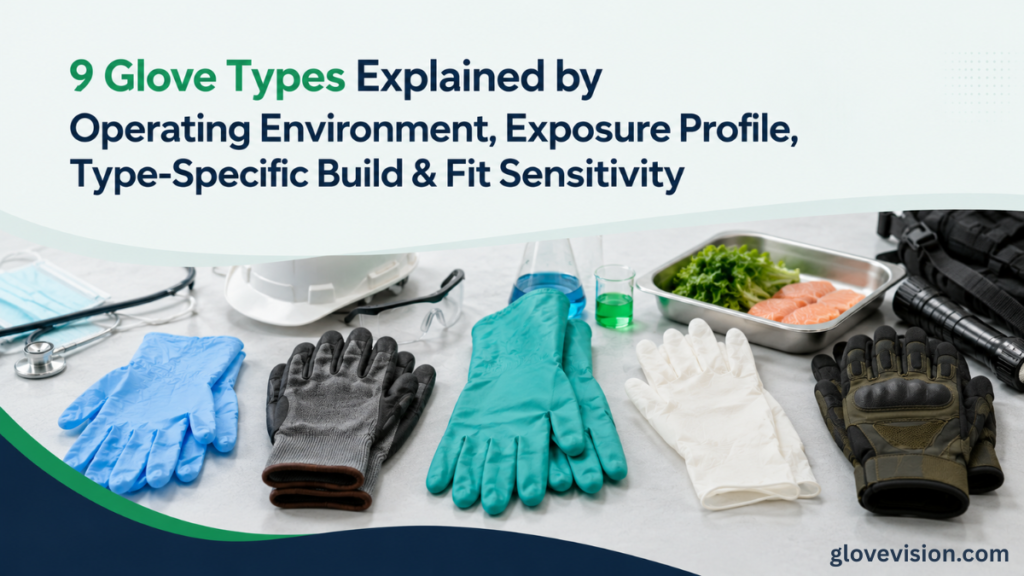
9 Glove Types Explained by Operating Environment, Exposure Profile, Type-Specific Build & Fit Sensitivity
Glove types are broad hand-protection categories that help users match a glove to the operating environment, exposure profile, protection purpose, and fit sensitivity of a task.
This page explains why glove type matters, how the 9 major categories differ, how to screen exposure profile, how fit sensitivity changes by use case, which mistakes cause glove failure, and how to finalize a safer starting category before deeper verification.
This article is for educational glove-selection guidance only and does not replace workplace PPE rules, manufacturer instructions, SDS guidance, or professional safety evaluation. For chemical, medical, food, electrical, heat, cut, or regulated tasks, verify glove labeling, compatibility data, standards, exposure limits, and workplace requirements before relying on a glove for protection.
Why does choosing the right glove type matter for safety, dexterity, and task control?
Choosing the right glove type matters because each hand-protection category balances safety, dexterity, comfort, hygiene, compliance, and task control differently.
The rule is simple: match the glove category to the primary task hazard before considering comfort, price, or style. Under-protection can expose the hand to cuts, abrasions, punctures, chemical burns, harmful substances, thermal hazards, contamination, or temperature extremes; over-protection can reduce movement, trap heat, increase fatigue, and make the glove less likely to be worn correctly. [OSHA]
A heavy cut-resistant work glove may be a reasonable starting category around sharp industrial materials, but that same glove can be too bulky for light gardening, food handling, medical examination, or precision assembly. The safer first move is to identify the environment and exposure before choosing a glove type.
Start with where the glove will be used: healthcare, food service, lab work, cleaning, industrial work, sports, tactical duty, fashion wear, or short-duration hygiene.
Screen the dominant exposure first: chemical, mechanical, biological, thermal, wet or oily surfaces, contamination control, dexterity, comfort, or appearance.
Confirm labeling, manufacturer data, SDS guidance, standards, and workplace rules before relying on a glove for safety-sensitive protection.
Which of the 9 major glove types fits each operating environment?
The 9 major glove types fit different operating environments: medical, disposable, work, food handling, laboratory or chemical-resistant, household cleaning, tactical, sports, and fashion use.
If the environment is clinical, choose medical gloves and verify labeling. If the environment is mechanical, choose work gloves and verify tested performance. If the environment is chemical, laboratory, food, wet work, sports, tactical, fashion, or quick hygiene, choose the category that matches that setting and confirm its limitations before use.
When should you choose medical gloves?
Medical gloves are selected for healthcare, examination, procedure, and clinical hygiene settings where barrier protection and infection-control rules matter.
Medical gloves are usually disposable and may include nitrile, latex, vinyl, neoprene, or synthetic alternatives, but medical use depends on intended-use labeling rather than material name alone. Clinical tasks need stricter barrier and labeling checks because medical gloves are defined by clinical contact, sterile barrier needs, and precision fit. [FDA]
Medical gloves help reduce contamination risk in medical contexts, but they are not puncture-proof and they do not replace hand hygiene. Users should verify medical-grade labeling, material, puncture limits, intended use, task rules, and workplace infection-control requirements before relying on them. [CDC]
When should you choose disposable gloves?
Disposable gloves fit short-duration tasks where hygiene, quick replacement, or surface cleanliness matters more than long-term durability.
Short-use tasks need labeling and material checks because disposable gloves are defined by material choice, thickness, color signals, and short-use limits. A disposable glove should not automatically be treated as chemical-resistant, cut-resistant, food-contact suitable, or medical-grade unless its material, labeling, task suitability, and change-out rules support that use.
Disposable gloves should be replaced when torn, contaminated, degraded, or used between different tasks. Washing single-use gloves for reuse is a failure risk in safety-sensitive hygiene, medical, food, or contamination-control contexts.
When should you choose work gloves?
Work gloves fit tool handling, rough surfaces, abrasion, cuts, punctures, grip demands, impact risk, and general labor.
Work gloves include leather, coated knit, synthetic, cut-resistant, reinforced, and impact-resistant designs, but exact protection depends on construction and tested performance. Mechanical tasks need stronger protection logic because work gloves are defined by mechanical hazards, trade-specific builds, and tool-control fit.
Cut, abrasion, puncture, grip, and impact are separate protection questions. Hand-protection classifications can help frame these performance areas, but the glove still needs task-specific verification instead of assumptions from thickness or appearance. [ANSI/ISEA]
When should you choose food handling gloves?
Food handling gloves fit food preparation and service tasks where reducing bare-hand contact and cross-contamination risk is the main purpose.
Food handling gloves can support ready-to-eat food handling and task separation, but they do not replace handwashing, safe food handling, or local food-safety rules. Food-contact work needs task discipline because food handling gloves are defined by food contact, task discipline, and short-duration barrier needs. [FDA Food Code]
Food gloves should be changed when contaminated, torn, or used between different tasks. Not every disposable glove is suitable for food handling, so food-contact suitability and jurisdiction rules need confirmation.
When should you choose laboratory or chemical-resistant gloves?
Laboratory and chemical-resistant gloves fit lab work, chemical handling, biological samples, solvents, acids, bases, and exposure-controlled tasks that require compatibility verification.
Laboratory gloves are not one universal category. Nitrile, neoprene, butyl, laminate, PVC, and specialty polymers may appear in lab or chemical contexts, but chemical selection requires the exact chemical name, concentration, exposure time, contact pattern, breakthrough data, degradation data, permeation data, SDS guidance, and manufacturer compatibility information. [NIOSH]
Glove appearance or thickness is not enough to prove chemical suitability. Lab glove selection depends on exposure duration because laboratory gloves are defined by chemical contact duration, material resistance, and bio-containment boundaries.
When should you choose household cleaning gloves?
Household cleaning gloves fit dishwashing, wet work, mild detergent exposure, and routine home cleaning where water resistance and comfort matter.
Household gloves are usually built for repeated wet work and mild cleaning tasks, so cuff length, lining, water resistance, grip texture, cleaning-agent compatibility, and skin comfort matter. Domestic wet work needs reuse and splash tolerance because household gloves are defined by wet cleaning, outdoor puncture, chemical splash, and reuse tolerance.
Household gloves are not automatically suitable for strong solvents, industrial chemicals, sharp tools, or high heat. The category screens the task, but it does not approve the glove for every cleaning exposure.
When should you choose tactical gloves?
Tactical gloves fit security, outdoor duty, military-style, and high-control environments where grip, abrasion protection, impact padding, and hand control matter.
Tactical gloves prioritize control, abrasion resistance, impact zones, padding, grip, wrist stability, and movement. High-control environments need protection without losing movement because tactical gloves differ by mission environment, dexterity demand, and impact-puncture control.
Tactical gloves should not be assumed to provide chemical, medical, electrical, cut, or thermal protection unless the glove is specifically rated and verified for that use.
When should you choose sports gloves?
Sports gloves fit athletic activities where grip, cushioning, warmth, wrist support, blister prevention, or equipment control matters.
Cycling, lifting, skiing, gym training, rowing, golf, baseball, and similar activities can create different friction, padding, breathability, wrist support, warmth, and grip requirements. Athletic glove selection depends on activity-specific contact because sports gloves are defined by game contact, impact management, grip control, and sport-specific fit.
Sports glove protection is activity-specific rather than universal. A glove that supports grip and cushioning in one sport may not protect against sharp tools, chemicals, heat, medical exposure, or regulated workplace hazards.
When should you choose fashion gloves?
Fashion gloves fit appearance, formal wear, mild warmth, and light daily use rather than certified safety protection.
Fashion gloves focus on style, comfort, lining, mild warmth, weather feel, and outfit coordination. They should not be used as safety gloves unless they meet the relevant protective requirements for the actual task.
| Glove Type | Main Environment | Common Materials | Main Benefit | Must Verify Before Use |
|---|---|---|---|---|
| Medical gloves | Healthcare, examination, procedure, clinical hygiene | Nitrile, latex, vinyl, neoprene, synthetic alternatives | Barrier support and contamination reduction | Medical-grade labeling, intended use, puncture limits, infection-control rules |
| Disposable gloves | Short-duration hygiene, cleanup, surface protection | Nitrile, vinyl, latex, polyethylene, synthetic blends | Quick replacement and contamination control | Task risk, material strength, labeling, change-out rule |
| Work gloves | Tools, rough surfaces, labor, abrasion, cuts, impact | Leather, coated knit, synthetic, cut-resistant fibers, reinforced materials | Mechanical protection and grip | Cut, abrasion, puncture, grip, and impact requirements |
| Food handling gloves | Food preparation, service, ready-to-eat handling | Vinyl, nitrile, polyethylene, latex alternatives | Reduced bare-hand contact and cross-contamination control | Food-contact suitability, handwashing, glove changes |
| Laboratory / chemical-resistant gloves | Lab work, chemical handling, samples, solvents, acids, bases | Nitrile, neoprene, butyl, laminate, PVC, specialty polymers | Chemical or contamination barrier when verified | Chemical, concentration, exposure time, breakthrough, degradation, SDS, compatibility chart |
| Household cleaning gloves | Dishwashing, wet work, mild detergents, home cleaning | Latex, nitrile, PVC, rubber blends, lined materials | Water resistance and repeated wet-work comfort | Cuff length, lining, cleaning-agent compatibility, skin comfort |
| Tactical gloves | Security, outdoor duty, high-control environments | Leather, synthetic blends, reinforced fabrics, padded materials | Grip, control, abrasion resistance, impact padding | Grip, padding, wrist closure, control sensitivity, task rules |
| Sports gloves | Cycling, lifting, skiing, gym, equipment handling | Leather, synthetic mesh, padded fabrics, insulated materials | Grip, cushioning, blister prevention, warmth, control | Activity fit, breathability, padding, wrist support |
| Fashion gloves | Formal wear, appearance, mild warmth, daily style | Leather, wool, cotton, synthetic fabrics, fleece, suede | Style, comfort, and light weather coverage | Weather exposure, lining, comfort, non-safety limitations |
How do you evaluate the exposure profile before choosing between glove categories?
The exposure profile should be evaluated before choosing a glove category because the dominant hazard determines whether the user needs chemical, mechanical, thermal, biological, wet-grip, or dexterity-focused protection.
The dominant exposure controls the first screening decision. Some tasks involve multiple exposures, but the highest-consequence hazard should be verified first before comfort, style, or generic material names influence the choice.
How should chemical exposure guide glove type selection?
Chemical exposure should guide glove type selection by forcing the user to verify the exact chemical, concentration, exposure time, and contact pattern before choosing a glove.
The selection question is not “Which glove looks thick?” but “Which glove has manufacturer-supported compatibility data for this chemical and this use pattern?” Breakthrough time, permeation, degradation, SDS guidance, and workplace PPE rules all matter.
How should mechanical exposure guide glove type selection?
Mechanical exposure should guide glove type selection by identifying whether the main threat is abrasion, cut, puncture, tear, impact, vibration, or grip loss.
Work gloves, coated gloves, leather gloves, cut-resistant gloves, and impact-resistant gloves may be starting categories, but ratings, construction, surface contact, and tool-control demands decide whether that category is enough.
How should thermal exposure guide glove type selection?
Thermal exposure should guide glove type selection by separating cold, heat, sparks, steam, flame, and brief hot-surface contact into different protection demands.
The glove must match the exact thermal exposure instead of relying on thickness alone. Cold handling, steam, flame, radiant heat, sparks, and brief hot-surface contact can require different materials, construction, ratings, and work rules.
How should biological or contamination exposure guide glove type selection?
Biological or contamination exposure should guide glove type selection by clarifying whether the goal is hygiene, infection-control support, food-contact safety, or sample handling.
Medical gloves, food handling gloves, disposable gloves, and lab gloves serve different contamination contexts. Gloves should be changed between tasks where contamination transfer matters, and glove use does not replace hand hygiene.
How should wet or oily exposure guide glove type selection?
Wet or oily exposure should guide glove type selection by testing whether the glove can preserve grip on slippery, greasy, detergent-covered, or water-exposed surfaces.
Smooth glove surfaces can fail in wet or oily conditions even when the glove feels protective. Textured, coated, waterproof, dipped, micro-foam, sandy, or wet/oil-grip designs may be stronger starting categories when surface control is the main issue.
How should dexterity exposure guide glove type selection?
Dexterity exposure should guide glove type selection by identifying whether the task requires fine touch, small-part handling, trigger/control sensitivity, or precise finger movement.
Thinner, closer-fitting glove types may improve control, but dexterity must not override the primary hazard requirement. A glove that feels precise but fails the main exposure is the wrong category.
| Exposure Type | Key Question | Risk of Wrong Choice | Best Starting Glove Category | Verification Needed |
|---|---|---|---|---|
| Chemical | What chemical, concentration, exposure time, and contact pattern will the glove face? | False safety from thickness or generic material names | Laboratory or chemical-resistant gloves | Manufacturer compatibility chart, SDS, breakthrough, degradation, permeation data |
| Mechanical | Is the main threat abrasion, cut, puncture, tear, impact, vibration, or grip loss? | Tearing, hand injury, poor tool control | Work gloves, coated gloves, leather gloves, cut-resistant gloves, impact gloves | Cut, abrasion, puncture, grip, and impact requirements |
| Thermal | Is the exposure cold, heat, sparks, steam, flame, or hot-surface contact? | Burns, cold injury, melting, moisture transfer, false protection | Thermal task-specific gloves | Temperature source, exposure duration, heat/cold rating, workplace rules |
| Biological / contamination | Is the goal hygiene, infection-control support, food-contact safety, or sample handling? | Cross-contamination, infection-control failure, food-safety failure | Medical, food handling, disposable, or lab gloves | Labeling, glove changes, hand hygiene, workplace rules |
| Wet / oily | Will the surface be wet, greasy, oily, slippery, or detergent-covered? | Grip loss, tool slips, poor handling control | Textured, coated, waterproof, wet/oil-grip glove types | Surface condition, grip texture, cuff coverage, cleaning-agent compatibility |
| Dexterity | Does the task require fine touch, small parts, tactile feedback, or precise controls? | Over-bulky glove, reduced movement, unsafe control | Thin, close-fitting, precision-focused glove types | Tactile feedback, fit, finger length, palm tension, primary hazard requirement |
How does fit sensitivity change across different glove types?
Fit sensitivity changes across glove types because some tasks require close tactile feedback, while others require thicker protection, grip stability, cuff coverage, or long-wear comfort.
Fit sensitivity is not the same as exact sizing. It describes how strongly fit affects safety, dexterity, compliance, fatigue, and task control for a given glove category.
What fit sensitivity matters for fine-touch or precision tasks?
Fine-touch tasks require thin, close-fitting gloves that preserve tactile feedback while still meeting the primary hazard requirement.
Medical work, lab handling, inspection, electronics, precision assembly, and small-part handling can fail when finger length, palm tension, fingertip feel, or tear risk is wrong. Thin gloves may improve touch, but they are not automatically protective enough for every hazard.
What fit sensitivity matters for heavy mechanical protection?
Heavy mechanical protection requires gloves that balance reinforcement, grip, and impact or cut protection without blocking safe tool control.
Work gloves, reinforced gloves, coated gloves, cut-resistant gloves, and impact gloves can become unsafe if excessive bulk reduces hand closure, tool feel, or movement. Users may also avoid gloves that feel too stiff, hot, or tiring.
What fit sensitivity matters for long-wear tasks?
Long-wear tasks require gloves that control heat, sweat, rubbing, liner feel, and hand fatigue over the full work period.
A technically stronger glove can still fail in practice if people avoid wearing it. Comfort, sweat control, heat buildup, liner feel, rubbing, and fatigue influence whether the glove is usable for the real task duration.
What fit sensitivity matters for wet work?
Wet work requires gloves that combine cuff coverage, water resistance, inner comfort, and grip texture without allowing water entry or trapped moisture to undermine use.
Household cleaning gloves, dishwashing gloves, wet-work gloves, and coated work gloves can fail when cuffs are too short, linings irritate the hand, grip texture is weak, or sweat buildup makes continued use uncomfortable.
What fit sensitivity matters for sports or tactical control?
Sports and tactical gloves require grip, palm feel, joint movement, wrist closure, and padding placement to support control without blocking movement.
Protection and performance must be balanced because finger flexion, palm feel, wrist closure, padding placement, and control sensitivity affect how the user moves, grips, and reacts during activity.
| Glove Type | Typical Fit Priority | Dexterity Need | Common Fit Failure | When to Use a Sizing Tool |
|---|---|---|---|---|
| Medical gloves | Close fit and barrier feel | High | Tearing, fingertip drag, wrist roll, palm tension | When gloves tear, slip, pinch, or reduce exam/task control |
| Disposable gloves | Quick fit and easy change-out | Medium to high depending on task | Baggy fingers, tearing, poor cuff seal | When repeated tearing or slipping occurs |
| Work gloves | Protection, grip, and safe tool control | Medium | Excessive bulk, poor grip, reduced hand closure | When tool control or fatigue becomes a problem |
| Food handling gloves | Clean handling and quick replacement | Medium | Loose fit, contamination during task switching | When gloves slip or slow safe handling |
| Lab / chemical-resistant gloves | Barrier fit, cuff coverage, and controlled handling | Medium to high | Poor cuff overlap, sweating, tactile loss, false chemical confidence | When chemical handling requires precise fit and layered PPE |
| Household cleaning gloves | Cuff coverage, lining comfort, wet grip | Low to medium | Water entry, liner discomfort, hand sweating | When gloves rub, leak, or feel unstable |
| Tactical gloves | Grip, joint movement, control sensitivity | High | Blocked finger flexion, poor palm feel, stiff knuckles | When control sensitivity or wrist closure fails |
| Sports gloves | Activity-specific control and comfort | Medium to high | Blisters, palm bunching, padding misalignment | When grip, cushioning, or movement feels wrong |
| Fashion gloves | Comfort, warmth, appearance | Low | Tight seams, poor lining, limited movement | When comfort or hand movement is poor |
What common glove type mistakes cause protection or performance failure?
Common glove type mistakes cause failure when the glove category does not match the real task hazard, surface condition, fit demand, change-out rule, or verification requirement.
The failure signal usually points to a category mismatch, verification gap, or fit-control problem. The fix is not to guess harder; it is to re-screen the exposure, confirm the glove category, and route the decision to the right deeper support when needed.
Why does a glove tear quickly at the palm, thumb web, or fingertips?
A glove that tears quickly at the palm, thumb web, or fingertips usually signals wrong size, weak construction, poor task match, or excessive mechanical stress.
Tearing can come from poor sizing, friction, sharp edges, repeated gripping, or material weakness. Re-check size, task friction, glove construction, and whether a heavier work glove category is needed.
Why does a glove lose grip in wet or oily conditions?
A glove that feels protective but loses grip in wet or oily conditions usually has the wrong surface finish or coating for the contact environment.
Wet, oily, greasy, or detergent-covered surfaces can defeat smooth glove surfaces. Textured, dipped, micro-foam, sandy, waterproof, or wet/oil-grip designs may be more appropriate when handling control is the failure signal.
Why can gloves cause itching, redness, rash, or suspected allergic reaction?
Glove-related itching, redness, rash, or suspected allergic reaction can come from latex proteins, rubber accelerators, sweat, occlusion, friction, soaps, or repeated glove use.
Users should stop using the suspected glove if symptoms occur and document the reaction pattern. Persistent, worsening, painful, swollen, or recurring symptoms deserve medical or occupational guidance rather than self-diagnosis.
Why do users avoid wearing a glove that protects well?
Users often avoid wearing a protective glove when overprotection creates heat buildup, stiffness, poor dexterity, rubbing, or hand fatigue.
Compliance is part of protection. The better glove type is the one that meets the primary hazard while remaining usable through breathability, movement, liner comfort, dexterity, and fatigue control.
Why is it unsafe to choose chemical gloves because they look thick?
Choosing chemical gloves because they look thick is unsafe because chemical resistance depends on tested compatibility, breakthrough time, permeation, and degradation, not appearance alone.
Thick gloves can still fail against specific chemicals. Manufacturer compatibility charts, SDS guidance, exposure time, concentration, contact pattern, and degradation behavior must support the chemical decision.
Why is reusing disposable gloves too long a failure risk?
Reusing disposable gloves too long creates failure risk because single-use gloves can tear, become contaminated, degrade, or transfer contamination between tasks.
Disposable gloves need task-based change-out rules. They should be replaced when torn, contaminated, degraded, or after switching tasks, and they should not be washed for reuse in safety-sensitive contexts.
| Failure Signal | Likely Cause | Corrective Action | Better Owner Page/Tool if Needed |
|---|---|---|---|
| Tears at palm, thumb web, or fingertips | Wrong size, weak construction, excessive friction, poor task match | Re-check size, task friction, glove construction, and protection category | Glove Size Guide / Sizerra Pro / Glove Durability page |
| Loses grip in wet or oily conditions | Smooth finish or wrong coating | Choose textured, dipped, sandy, micro-foam, waterproof, or wet/oil-grip design where appropriate | Glove Materials / Glove Recommendation Engine |
| Itching, redness, rash, or suspected reaction | Latex proteins, accelerators, sweat, occlusion, friction, soaps, repeated use | Stop suspected glove, document pattern, consider synthetic alternatives, seek guidance if persistent | Glove Allergy Tracker / medical or occupational guidance |
| Users avoid wearing it | Overprotection, heat buildup, stiffness, poor dexterity, discomfort | Select a glove that still meets the primary hazard while improving fit and comfort | Glove Comfort Troubleshooter / Glove Recommendation Engine |
| Used for chemicals because it looks thick | False confidence from appearance | Verify compatibility, breakthrough, degradation, permeation, and SDS guidance | Glove Hazard Match Tool / Glove Materials |
| Disposable glove reused too long | Cost-saving behavior, weak change-out rule, misunderstanding single-use design | Replace when torn, contaminated, degraded, or after switching tasks | Glove Care / workplace policy / infection-control guidance |
How can you finalize the correct glove type before use or purchase?
The correct glove type should be finalized by defining the task, identifying the dominant exposure, choosing the broad category, verifying the main hazard, checking fit sensitivity, and routing deeper decisions to the right page or tool.
First, define whether the glove is for healthcare, food handling, cleaning, lab work, industrial work, sports, tactical use, fashion, or general disposable protection. Then identify the main exposure: chemical, biological, mechanical, thermal, wet/oily, contamination, grip, comfort, or style.
Next, choose the broad glove type that matches the task environment before comparing specific materials or products. Verify the primary hazard requirement, then check whether the task needs high dexterity, heavy protection, long-wear comfort, grip control, cuff coverage, or tactile feel.
Finally, confirm the glove’s task-specific limits. Chemical, medical, food, thermal, cut, electrical, and regulated uses require manufacturer data, labeling, SDS requirements, workplace PPE rules, and relevant standards before the glove is relied on for protection.
- ✓Define the task environment before choosing a glove type.
- ✓Identify the dominant exposure: chemical, mechanical, thermal, biological, wet/oily, dexterity, contamination, comfort, or style.
- ✓Choose the broad glove category that matches the task environment.
- ✓Verify the primary hazard requirement before considering comfort, price, or appearance.
- ✓Check whether the task needs high dexterity, heavy protection, long-wear comfort, grip control, cuff coverage, or tactile feel.
- ✓Confirm the glove’s material, labeling, and performance limits where safety use is involved.
- ✓Set a change-out rule for disposable, medical, food handling, lab, or contamination-sensitive tasks.
- ✓Check manufacturer data, SDS guidance, workplace PPE rules, and relevant standards for chemical, medical, food, heat, cut, electrical, or regulated tasks.
- ✓Route deeper decisions to the correct GloveVision page or tool before relying on the glove for protection.
Glove type selection should be treated as a screening step, not a final safety approval. For medical, chemical, food, electrical, heat, cut, or regulated workplace tasks, users should verify glove labeling, manufacturer data, SDS guidance, workplace PPE rules, and applicable standards before relying on a glove for protection.
Conclusion
Glove types are best understood as broad screening categories that connect a task environment, exposure profile, protection purpose, and fit sensitivity before deeper material, sizing, hazard, or product decisions are made.
Category selection is only the first step. Regulated or hazardous tasks still require verification through glove labeling, manufacturer data, SDS guidance, workplace PPE rules, and applicable standards before relying on the glove for protection.
Frequently Asked Questions
What are the main types of gloves?
The main types of gloves are medical gloves, disposable gloves, work gloves, food handling gloves, laboratory or chemical-resistant gloves, household cleaning gloves, tactical gloves, sports gloves, and fashion gloves. Each type fits a different environment, exposure profile, protection purpose, and fit sensitivity.
Are disposable gloves the same as medical gloves?
Disposable gloves are not automatically the same as medical gloves because “disposable” describes replacement style, while “medical” describes an intended medical-use category. Disposable gloves should not be used for medical tasks unless labeling supports that use.
Which glove type is best for chemicals?
Chemical tasks require laboratory or chemical-resistant gloves selected against the exact chemical, concentration, exposure time, and contact pattern. No broad glove type is universally chemical-safe, so compatibility charts, SDS guidance, breakthrough time, permeation, and degradation must be checked.
Do thicker gloves always protect better?
Thicker gloves do not always protect better because safety depends on tested material performance, construction, labeling, standards, and task fit. Thickness may support durability in some contexts, but it does not prove chemical, cut, heat, food, or medical suitability.
When should I use a glove tool instead of this guide?
A glove tool is better when the decision requires hazard-first matching, task-first recommendation, exact sizing, material comparison, or fit troubleshooting. The page selects the broad category; deeper decisions should be routed to the right page or tool.