
Why Are Isocyanates Poorly Matched With Latex Gloves?
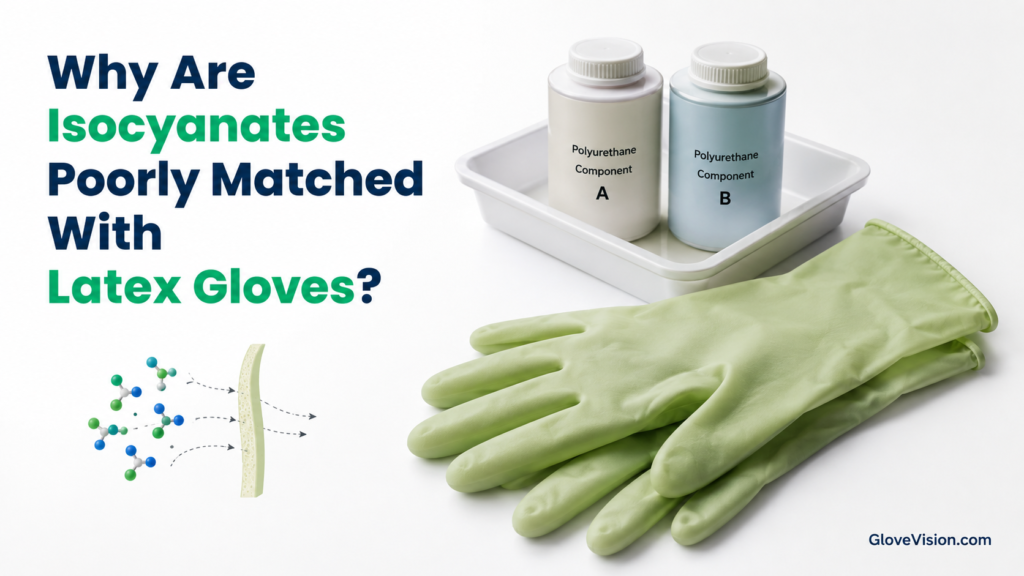
Isocyanates and Latex Gloves: Why the Match Often Fails Why Are Isocyanates Poorly Matched With Latex Gloves? Isocyanates are reactive chemicals used in many polyurethane products, and Latex Gloves cannot be assumed to resist every monomer, oligomer, prepolymer or commercial formulation. Thin disposable latex may permeate or lose performance during meaningful contact, while carrier solvents […]
Which Paint-Thinner Exposures Weaken Latex Gloves?

Paint Thinner and Latex Gloves: Exposure and Safety Limits Which Paint-Thinner Exposures Weaken Latex Gloves? Paint thinner is a variable solvent category, and different formulations may permeate, swell, soften, make tacky, distort or mechanically weaken Latex Gloves before a hole or obvious surface change appears. Performance depends on the exact formulation, ingredient concentrations, temperature, contact […]
Where Does Latex Chemical Resistance Become Limited?

Latex Chemical Limits: Permeation, Damage & Selection Where Does Latex Chemical Resistance Become Limited? Latex Gloves use a crosslinked natural-rubber film that can interact with chemicals through surface contact, partitioning, absorption and diffusion. Chemical failure can arise through molecular permeation of intact film, physical penetration through a defect, or degradation that changes the rubber’s properties. […]
How Does Latex Preserve Tactile Sensitivity?

Latex Glove Tactile Sensitivity: Fit, Film & Feedback How Does Latex Preserve Tactile Sensitivity? Latex Gloves can preserve useful tactile feedback by placing a thin, flexible, close-contact film with relatively low bending resistance between an object and fingertip skin, allowing object-induced pressure and texture changes to deform the film and stimulate skin mechanoreceptors. Actual performance […]
What Gives Natural Rubber Latex Its Close Hand Conformity?
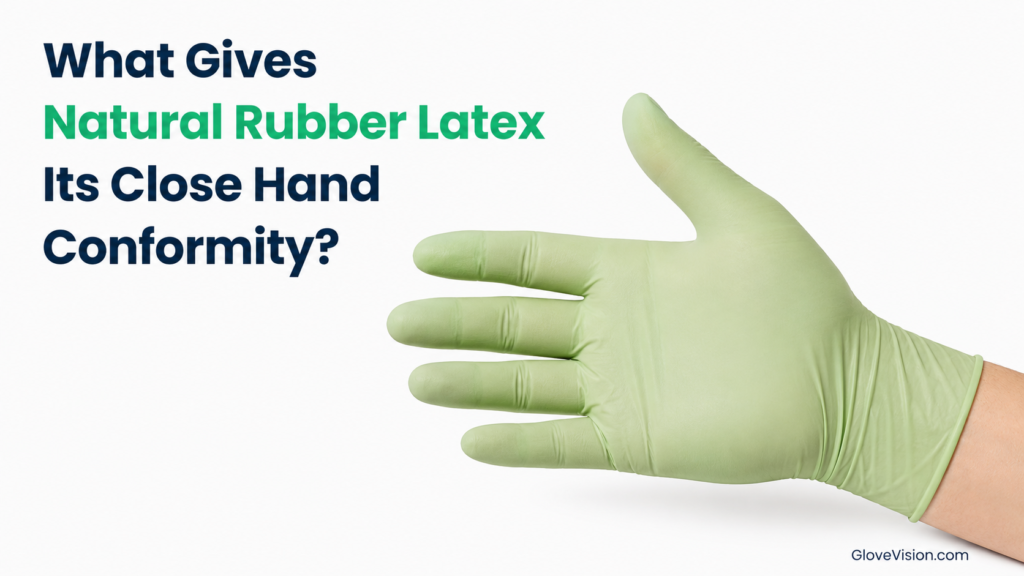
Latex Glove Conformity: Fit, Geometry & Elastic Tension What Gives Natural Rubber Latex Its Close Hand Conformity? Latex Gloves combine flexible polyisoprene chains, vulcanized crosslinks, thin-film construction, low-force stretching, and elastic recovery to follow detailed hand contours and maintain close surface contact. Useful conformity still depends on size, former geometry, finger length, palm width, thumb […]
How Do Latex Structure and Elasticity Shape Glove Behavior?

Latex Gloves: Structure, Elasticity & Fit Behavior How Do Latex Structure and Elasticity Shape Glove Behavior? Latex Gloves translate natural rubber latex, flexible cis-1,4-polyisoprene chains, and vulcanized crosslinks into reversible stretching, close hand conformity, mobility, and tactile response. Their actual behavior depends on formulation, crosslink density, thickness, geometry, size, temperature, chemical exposure, repeated strain, aging, […]