
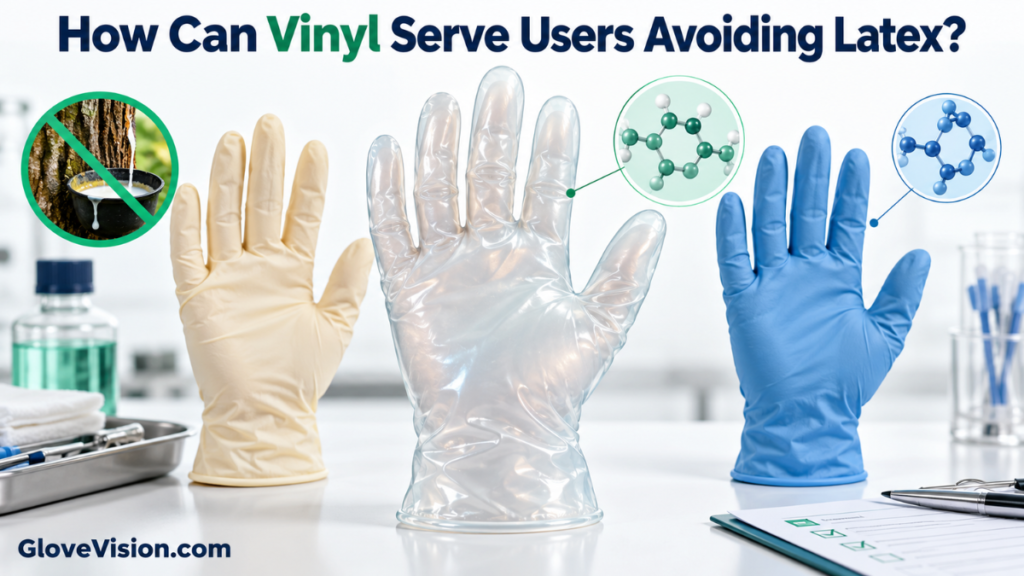
How Can Vinyl Serve Users Avoiding Latex?
Vinyl/PVC Gloves can help users avoid natural rubber latex because PVC is a synthetic polymer rather than natural rubber. FDA specifically identifies PVC medical gloves, along with nitrile and polyurethane, as synthetic alternatives for people allergic to natural rubber latex.
That material advantage removes the natural-rubber-latex source from a confirmed PVC glove, but it does not guarantee freedom from irritation, formulation-related sensitivity, fit problems, puncture, or inadequate chemical protection. Selection therefore moves from latex-avoidance mechanism to remaining skin-reaction boundaries, practical task fit, barrier limitations, synthetic alternatives, and exact-product verification.
What Makes Vinyl/PVC Gloves Useful for Avoiding Natural Rubber Latex?
Vinyl/PVC Gloves are useful for natural-rubber-latex avoidance because PVC is a synthetic material rather than natural rubber latex. When the exact product is confirmed as a PVC construction made without natural rubber latex as a manufacturing material, the natural-rubber-latex protein source associated with the glove material is removed.
Why Does PVC Remove the Natural-Rubber-Latex Protein Source?
PVC is polyvinyl chloride, a synthetic polymer system distinct from natural rubber latex. FDA’s natural-rubber device guidance distinguishes synthetic materials that do not include natural rubber in their formulations from products containing natural rubber latex. This material distinction addresses the natural-rubber-latex source; it does not establish freedom from every other possible skin or workplace exposure. [FDA]
Why Does This Matter for Sensitized Users?
FDA states that some people are allergic to natural rubber latex used in some medical gloves. FDA advises those users to choose medical gloves made from other synthetic materials and specifically identifies PVC, nitrile, and polyurethane as examples. [FDA]
Why Is “Synthetic” the Relevant Material Distinction?
The first classification on this page is natural rubber latex material versus synthetic glove material. PVC belongs to the synthetic side of that distinction. For the broader material context, see Vinyl/PVC glove material.
Why Should the Exact Manufacturer Label Still Be Checked?
FDA states that medical-glove manufacturers must identify on package labeling the materials used to make the gloves. The same FDA guidance advises people with natural rubber latex allergy to choose appropriately identified synthetic medical-glove materials. Users should therefore verify the actual material declaration rather than relying on glove color or an unauthenticated marketplace description.
Why Is “Vinyl” the Same Material Category as PVC Here?
In ordinary glove terminology, a vinyl glove refers to a flexible PVC glove construction. The polymer identity still needs to be confirmed for the exact product rather than inferred from appearance alone. See the vinyl and PVC material category for the broader terminology relationship.
What Is the Correct Latex-Avoidance Rule?
Start with the need to avoid natural rubber latex, confirm the exact synthetic PVC product and manufacturer material statement, then treat skin tolerance, fit, chemical protection, physical integrity, and task performance as separate questions.
| Selection Factor | PVC Position | Practical Meaning |
|---|---|---|
| Natural rubber latex base material | Different from PVC | PVC provides a synthetic material alternative |
| Natural-rubber-latex proteins | Not derived from the PVC barrier | The specific NRL protein source is removed from confirmed PVC barrier material |
| Manufacturer material statement | Must still be checked | Confirms the exact product rather than an assumption |
| “Latex-free” wording | Use cautiously | Prefer precise manufacturer and FDA-style material wording |
| Powder status | Separate issue | Does not prove absence of natural rubber latex |
| Formulation factors | Product-specific | Skin tolerance remains a separate question |
| Barrier performance | Product-specific | Latex avoidance does not prove task protection |
| Fit and comfort | Product-specific | Require a separate usability assessment |
Which Skin-Reaction Boundaries Still Apply to Vinyl/PVC Gloves?
Vinyl/PVC Gloves remove the natural-rubber-latex protein source from a confirmed PVC barrier, but users can still experience non-latex skin problems related to irritation, occlusion, friction, chemical exposure, fit, or product-specific formulation factors.
How Is Natural-Rubber-Latex Protein Allergy Different?
FDA’s natural-rubber medical-device guidance describes sensitivity associated with natural latex proteins and distinguishes devices made from synthetic materials that do not include natural rubber in their formulations. This natural-rubber-protein issue is different from irritation or a reaction associated with another substance.
Can Vinyl/PVC Gloves Still Cause Irritation?
Yes. Sweating, prolonged occlusion, friction, wet work, repeated hand cleansing, chemical contamination, and poor fit can contribute to skin irritation. A skin reaction that occurs while wearing PVC should therefore not automatically be classified as an allergy.
Can Synthetic Gloves Still Have Product-Specific Formulation Factors?
Yes. Synthetic material identity answers the natural-rubber-latex question, but it does not establish that every commercial PVC glove has an identical formulation or will be tolerated identically by every user. Exact product information should be reviewed where formulation concerns are relevant. See Vinyl/PVC structure behavior.
Why Must Other Skin Reactions Be Separated From Latex Allergy?
A reaction associated with natural-rubber-latex proteins, a delayed response to another chemical, and non-allergic irritation are not interchangeable explanations. GloveVision therefore treats the observation “skin reaction under a PVC glove” as a reason to investigate rather than as proof of a particular allergy.
Why Is “Hypoallergenic” Not Proof of Natural-Rubber-Latex Avoidance?
OSHA specifically warns users not to assume that hypoallergenic gloves, glove liners, or powderless gloves are non-latex or latex-free. Material identity should therefore be confirmed directly rather than inferred from those descriptions. [OSHA]
Why Should Absolute “Latex-Free” Medical Claims Be Treated Carefully?
FDA states that medical-product claims such as “latex-free,” “does not contain natural rubber latex,” and “does not contain latex” can imply an assurance that cannot reliably be made. FDA instead recommends scientifically precise wording indicating when natural rubber latex was not used as a material in manufacture. [FDA]
What If a User Develops a Significant or Recurrent Reaction?
Do not assume the cause from appearance or timing alone. Review the exact product and available material information, consider another appropriately protective synthetic glove where suitable, and seek appropriate medical evaluation for significant, recurrent, respiratory, or systemic reactions.
| Concern | Natural-Rubber-Latex Protein Involved? | PVC Implication |
|---|---|---|
| Type I natural-rubber-latex allergy | Yes | Confirmed synthetic PVC removes that glove-material source |
| Irritant dermatitis | Not necessarily | Can still occur |
| Reaction to another substance | Not necessarily | Exact product and exposure require review |
| Occlusion and sweating | No | Can still occur |
| Friction or poor fit | No | Product design and sizing matter |
| Chemical breakthrough | No | Barrier performance must be verified independently |
| Another latex-containing item | Possibly | A PVC glove alone does not remove other exposure sources |
Which Tasks Best Fit Vinyl/PVC Gloves for Users Avoiding Natural Rubber Latex?
Vinyl/PVC Gloves fit best when natural rubber latex needs to be avoided and the exact PVC product also satisfies the barrier, puncture, fit, grip, integrity, and duration requirements of a comparatively modest task.
When Can Medical Examination Tasks Favor Vinyl/PVC Gloves?
FDA identifies PVC medical gloves as one synthetic alternative for people allergic to natural rubber latex, while FDA-recognized ASTM D5250-19(2023) covers specified polyvinyl chloride gloves for medical examinations, diagnostic and therapeutic procedures, and handling contaminated medical material. This evidence is medical-glove specific and should not be transferred to generic industrial PVC performance. [FDA/ASTM]
When Can Light General Handling Favor PVC?
PVC can be practical for selected light-handling tasks when natural rubber latex avoidance matters, chemical challenge is limited, sharp-object exposure is low, glove integrity is appropriate, and the exact product fits the handling requirements.
When Can Food Handling Favor Vinyl/PVC Gloves?
Only when the exact glove meets the applicable intended-use and food-contact requirements. PVC material identity alone does not establish food-contact suitability.
When Can Selected Aqueous Chemical Tasks Favor PVC?
OSHA’s generic glove chart describes PVC as low cost, with very good physical properties and medium chemical resistance, and lists strong acids and bases, salts, other water solutions, and alcohols among generic use areas. These categories are screening guidance rather than exact-product approvals; the actual chemical, conditions, duration, and glove construction still require verification. [OSHA]
When Does Frequent Replacement Support Vinyl?
Frequent replacement can support a disposable PVC workflow when protection is already adequate, contamination control benefits from glove changes, and the resulting consumption and interruption remain practical. Faster replacement cannot correct chemical incompatibility.
When Does PVC Become a Poorer Task Match?
Another construction may warrant comparison when work requires greater puncture resistance, more elasticity or close fit, demanding solvent protection, prolonged immersion, extended high-consequence chemical resistance, or another specialized barrier characteristic.
Where Do Barrier and Durability Limits Reduce the Value of Vinyl/PVC Gloves?
Natural-rubber-latex avoidance cannot justify Vinyl/PVC Gloves when the exact PVC product does not provide the chemical, physical, integrity, or duration performance required by the task.
Why Is Latex Avoidance Separate From Chemical Protection?
Natural-rubber-latex avoidance addresses a material and allergen-source question. Chemical resistance addresses whether a barrier can resist the actual chemical exposure. The two questions must be verified independently.
Why Can Organic Solvent Work Reduce PVC Suitability?
Depending on the exact chemical and PVC construction, organic-chemical exposure may create compatibility or degradation concerns. This does not mean every organic solvent is incompatible with every PVC glove; exact-product evidence is required. See vinyl barrier limits.
Why Does Duration Matter?
Longer contact can increase the importance of chemical permeation and material degradation. A synthetic glove that successfully avoids natural rubber latex can therefore still be unsuitable for prolonged chemical exposure.
Why Can Thin Disposable Construction Limit Physical Protection?
A thin disposable construction may provide less material against some puncture, abrasion, tear, or prolonged-contact demands than a heavier exact construction. Thin does not automatically mean inadequate, and thick does not automatically mean chemically suitable.
Why Does Physical Integrity Matter?
In the medical-glove context, FDA warns that sharp objects can puncture medical gloves and directs users to change medical gloves if they rip or tear. Those instructions illustrate why intact barrier condition remains important even when the glove material successfully avoids natural rubber latex. [FDA]
Which Task Variables Must Still Be Verified?
OSHA identifies the chemical or chemicals handled, contact frequency and duration, immersion or splash, concentration, temperature, abrasion/puncture/tear requirements, coverage, dexterity, grip, glove features, size, comfort, and price among glove-selection factors. [OSHA]
When Should the Exact PVC Product Be Rejected?
Reject, switch, or escalate when chemical evidence is inadequate, physical demands exceed the product, duration exceeds the applicable evidence, fit prevents safe use, glove integrity is damaged, or another appropriately verified synthetic construction better matches the complete task.
How Should Vinyl/PVC Gloves Be Compared and Verified for Users Avoiding Natural Rubber Latex?
Vinyl/PVC Gloves should be selected for natural-rubber-latex avoidance only when the exact product is confirmed as an appropriate synthetic construction and independently passes the task’s barrier, physical, fit, grip, integrity, and duration requirements.
When Can Nitrile Be Compared With PVC?
FDA lists both nitrile and PVC among synthetic medical-glove alternatives for people allergic to natural rubber latex. An exact nitrile product may therefore be compared when its verified characteristics better match the task; this does not establish nitrile as universally superior to PVC.
When Can Polyurethane Be an Option?
FDA also identifies polyurethane among synthetic medical-glove alternatives. Its suitability still depends on the exact product, intended use, barrier evidence, fit, and mechanical requirements.
When Can Neoprene or Polychloroprene Be Relevant?
A verified synthetic polychloroprene or neoprene product can be considered when natural rubber latex avoidance is required and the exact product’s chemical, mechanical, fit, or duration characteristics better match the task. The polymer name alone should not be used to infer every detail of a commercial formulation.
Why Can’t Latex Avoidance Rank Synthetic Materials?
Synthetic alternatives can differ in chemical barrier performance, puncture and tear resistance, elasticity, fit, dexterity, grip, duration, intended-use requirements, cost, and individual tolerability. Avoiding natural rubber latex establishes a material-selection boundary; it does not determine the best performer for every task.
When Can Vinyl Remain the Most Practical Option?
PVC can remain practical when the exact material declaration is clear, task protection is adequate, mechanical demands are appropriate, fit is acceptable, planned replacement is useful, and cost or workflow advantages emerge only after those protection requirements are met. See the vinyl selection tradeoff.
| Selection Need | PVC Direction | Other Synthetic Direction |
|---|---|---|
| Avoid natural rubber latex | Strong candidate when exact material is confirmed | Nitrile, polyurethane, and other verified synthetics may also qualify |
| Low-cost frequent changes | Can provide practical value after protection is established | Compare total lifecycle burden |
| Stronger puncture requirement | Thin PVC may be less suitable for the exact task | Compare verified alternative construction |
| Greater elasticity or close fit | Product-specific | Compare an exact elastomeric synthetic product |
| Aggressive chemical exposure | Conditional | A specialist synthetic barrier may be required |
| Light-duty handling | Can be practical | Specialist construction may add little if not needed |
| Known formulation concern | Product-specific | Compare exact product information and suitable alternatives |
| Medical examination task | Use an appropriately specified PVC medical product | Appropriate nitrile or polyurethane products may also qualify |
What Material Label Should Be Verified?
For medical gloves, FDA states that manufacturers must identify on package labeling the materials used to make the gloves. Confirm PVC or polyvinyl chloride, the exact product’s intended use, and the manufacturer’s applicable natural-rubber-latex statement.
Why Should “Latex-Free” Wording Be Checked Rather Than Assumed?
FDA recommends scientifically precise medical-product labeling about whether natural rubber latex was used as a manufacturing material rather than absolute claims such as “latex-free.” Use the exact manufacturer’s verified wording instead of creating a broader claim.
Why Should Powder-Free Status Not Be Used as the Material Test?
Powder status and polymer identity answer different questions. OSHA specifically warns that powderless gloves should not automatically be assumed to be non-latex or latex-free. Material identity therefore still requires direct verification.
Which Product Details Matter Beyond Natural-Rubber-Latex Status?
Verify the exact manufacturer and model, material composition, intended use, size, fit, thickness, cuff, surface or grip design, relevant formulation information where available, applicable standards or certification, and barrier performance.
Which Task Performance Must Be Checked?
Assess barrier integrity, puncture and tear requirements, chemical resistance, dexterity, grip, coverage, contact duration, and the intended-use requirements applicable to the task.
What If a User Has Reacted to a PVC Glove?
Do not assume natural rubber latex contamination, PVC allergy, additive allergy, or irritant dermatitis from the reaction alone. Review the exact product and available formulation information, consider another appropriately protective synthetic option, and seek professional evaluation when the reaction is significant or recurrent.
When Is Evidence Insufficient?
Escalate the decision when material identity is unclear, the manufacturer’s natural-rubber-latex statement is unclear, relevant packaging information is missing, required barrier evidence is unavailable, intended use does not match the task, reaction history creates uncertainty, or task severity exceeds the available PVC evidence.
Use natural-rubber-latex avoidance as the first gate, then independently verify skin, task, barrier, and alternative-product requirements.
Material Gate
- PVC/polyvinyl chloride confirmed.
- Exact manufacturer and model confirmed.
- Manufacturer material labeling reviewed.
- Natural-rubber-latex wording reviewed.
- Unqualified “latex-free” assumption avoided.
Skin-Tolerance Gate
- Previous reactions considered.
- Relevant formulation information reviewed where available.
- Hypoallergenic wording not treated as proof of NRL avoidance.
- Powder-free wording not treated as proof of NRL avoidance.
- Significant or recurrent reactions escalated appropriately.
Task Gate
- Correct intended-use category confirmed.
- Size and fit appropriate.
- Dexterity adequate.
- Grip adequate.
- Puncture and tear requirements addressed.
- Coverage appropriate.
Barrier Gate
- Chemical resistance checked where relevant.
- Contact duration supported.
- Glove integrity adequate.
- Applicable standard or certification confirmed.
- Medical-product evidence not transferred to industrial use.
Alternative Gate
- Nitrile considered where task requirements favor comparison.
- Polyurethane considered where relevant.
- Other verified synthetic materials compared when necessary.
- All alternatives independently meet barrier and task requirements.
What Should Readers Remember About Natural-Rubber-Latex Avoidance With Vinyl/PVC Gloves?
Vinyl/PVC Gloves can be useful when natural rubber latex must be avoided because PVC is a synthetic material and therefore does not provide the natural-rubber-latex material source associated with natural-latex protein exposure. FDA specifically identifies PVC medical gloves among synthetic alternatives for people allergic to natural rubber latex. The practical principle is to avoid the allergen source first, then independently verify the glove.
That benefit does not make PVC universally skin-safe or task-suitable. Product-specific formulation factors, fit, irritation, chemical barrier, puncture resistance, grip, duration, integrity, and intended use remain separate requirements, so vinyl should be selected only when the exact PVC product both meets the natural-rubber-latex avoidance need and adequately performs the complete task.
Which Questions Clarify Natural-Rubber-Latex Avoidance With Vinyl/PVC Gloves?
Do Vinyl/PVC Gloves Avoid Natural Rubber Latex?
Yes, when the exact product is confirmed as a PVC construction made without natural rubber latex as a manufacturing material. PVC is synthetic, and FDA lists PVC medical gloves among synthetic alternatives for people with natural rubber latex allergy.
Can Vinyl/PVC Gloves Prevent Natural-Rubber-Latex Allergy Reactions?
A confirmed PVC glove removes the natural-rubber-latex protein source associated with the glove material itself. It does not prevent exposure from other natural-rubber-latex products or prevent unrelated irritation or reactions to other substances.
Can Vinyl/PVC Gloves Still Cause a Skin Reaction?
Yes. Sweating, friction, occlusion, chemical exposure, fit, or product-specific formulation factors can still contribute to skin problems. A reaction under a PVC glove should not automatically be labeled latex allergy or PVC allergy.
Are Vinyl/PVC Gloves Better Than Nitrile for Avoiding Natural Rubber Latex?
Both can provide synthetic alternatives when their exact material composition is confirmed. FDA lists both PVC and nitrile among synthetic medical-glove options for people with natural rubber latex allergy. The better task choice depends on the exact product’s fit, puncture resistance, chemical barrier, grip, dexterity, duration, intended use, and individual tolerability.
What Should Users Check Before Choosing Vinyl/PVC Gloves to Avoid Natural Rubber Latex?
Confirm the exact material and manufacturer’s natural-rubber-latex statement, then check intended use, fit, relevant formulation information, physical integrity, chemical or barrier performance, duration, and applicable standards. Do not rely solely on terms such as “hypoallergenic,” “powder-free,” or an unverified “latex-free” marketplace claim.