
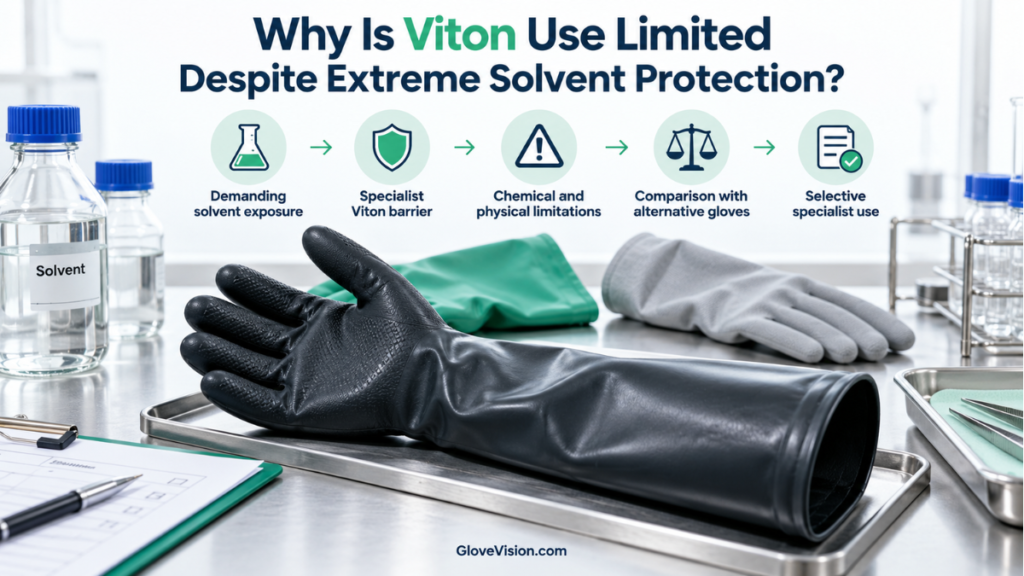
Why Is Viton Use Limited Despite Extreme Solvent Protection?
Viton Gloves remain specialist products because their strongest advantage is useful resistance to selected demanding organic-solvent environments rather than universal chemical protection. This can make them valuable for particular solvent tasks while adding little value where another verified barrier already provides adequate protection.
The trade-off is grade- and product-specific. Viton™ families differ in fluid-resistance characteristics, while finished gloves can differ in construction, thickness, grip, coverage, and physical performance. The decision therefore moves from specialist solvent value through chemical boundaries and task limits to exact-product comparison and verification.
What Practical Trade-Off Most Limits Viton Gloves Adoption?
The main trade-off limiting Viton Gloves adoption is specialist solvent protection versus complete-task efficiency. Their resistance can be valuable for selected difficult chemicals, but that advantage must outweigh chemical-family limitations, physical requirements, workflow complexity, and the availability of simpler adequate barriers.
What Do Viton Gloves Gain Through Chemical Specialization?
OSHA categorizes Fluoro-elastomer (Viton) as an organic-solvent glove material and lists chlorinated solvents, aliphatics, and alcohols among its generic use areas. This is useful material-level screening information, not compatibility approval for every chemical or finished Viton Glove. [OSHA]
What Can Viton Gloves Give Up Through Specialization?
OSHA’s generic glove-selection table lists poor physical properties and poor resistance to some ketones, esters, and amines as disadvantages of Fluoro-elastomer (Viton). These are broad material-level cautions rather than universal ratings of every finished Viton Glove. [OSHA]
Why Is Maximum Solvent Resistance Not the Same as the Best Glove?
Selection must also consider grip, dexterity, abrasion, puncture, repeated flexing, fit, cuff coverage, contact duration, mechanical stress, and removal. The broader glove materials explained framework helps separate polymer reputation from finished-product selection.
Why Does Specialization Reduce Routine Adoption?
Specialist protection may be needed only during selected process stages. If another verified glove adequately controls the hazard during other stages, deploying a specialist barrier throughout the entire workflow may add little protective value. Selective use can therefore be more rational than universal deployment.
Why Is Cost a Secondary Rather Than Primary Gate?
The correct sequence is adequate protection → task suitability → deployment and replacement model → actual cost. Cost should compare products that already provide acceptable protection and complete-task performance.
What Question Defines the Viton Gloves Adoption Trade-Off?
Does this exact Viton Glove solve a chemical-protection problem that another adequately protective product cannot solve as effectively for the complete task?
Viton Gloves Specialist-Value vs Adoption-Limit Table
| Decision Area | Screening Direction | Adoption Limitation |
|---|---|---|
| Chlorinated solvents | OSHA generic Viton use area | Exact chemical and finished-product data still required |
| Aliphatic chemicals | OSHA generic Viton use area | Complete formulation and product evidence still matter |
| Alcohols | OSHA generic Viton use area | Individual chemicals and exposure conditions require verification |
| Ketones | Important conventional caution zone | Some specialty Viton chemistry can differ |
| Esters | Important conventional caution zone | Specialty formulations can change the profile |
| Amines | Important conventional caution zone | ETP chemistry can differ from conventional fluoroelastomers |
| Physical performance | Finished products require task-level assessment | Generic OSHA guidance flags poor physical properties |
| Deployment cost | Can be justified where specialist protection is necessary | Compare cost only after protection and task gates |
Why Does Solvent Protection Give Viton Gloves Specialist Value?
Viton Gloves gain specialist value when an organic-solvent exposure falls inside a supported material or product resistance zone and the exact finished glove provides an adequate barrier while remaining usable for the complete task.
Why Do Organic Solvents Strengthen the Case for Viton Gloves?
OSHA identifies Fluoro-elastomer (Viton) as an organic-solvent glove material and specifically lists chlorinated solvents, aliphatics, and alcohols in its generic “use against” guidance. This supports Viton as a screening candidate for relevant solvent work, but the table does not establish chemical-specific breakthrough performance for an individual glove model. [OSHA]
Why Does Exact Chemical Identity Still Matter?
Broad chemical-family guidance is only a starting point. Selection should move from the named chemical or complete formulation to applicable evidence for the exact finished glove, including the conditions represented by the test or manufacturer data.
Why Does Viton Family Identity Affect Specialist Value?
Chemours identifies four major Viton™ fluoroelastomer families—A, B, F, and ETP—and states that fluid resistance is a major differentiator between them. Chemours also identifies resistance to hydrocarbon fluids and resistance to amines or caustics among the considerations used to select an appropriate fluoroelastomer. [Viton]
Why Does Exposure Consequence Increase the Need for Evidence?
As the consequence of barrier failure increases, generic material reputation becomes less useful than chemical-specific and product-specific evidence. Higher consequence can strengthen the case for a specialist barrier, but it cannot compensate for unsupported compatibility.
Why Must Polymer Evidence and Finished-Glove Evidence Stay Separate?
Chemours’ Viton material data describe fluoroelastomer families and their performance characteristics. Those data help explain differences between Viton chemistries, but they do not by themselves establish the permeation performance, construction, thickness, seams, interfaces, or safe use conditions of a particular finished chemical-protective glove.
Which Chemical Boundaries Most Restrict Viton Gloves Use?
The main chemical boundary is that useful Viton performance in one solvent family cannot be transferred automatically to every other chemical. OSHA identifies some ketones, esters, and amines as generic Fluoro-elastomer limitations, while Chemours documents specialty ETP chemistry with a different resistance profile.
Why Do Some Ketones Limit Conventional Viton?
OSHA’s generic glove-selection guidance lists poor resistance to some ketones among Fluoro-elastomer/Viton disadvantages. Chemours separately states that Viton™ Extreme ETP-600S provides resistance to low-molecular-weight ketones beyond conventional fluoroelastomers. Together, these sources show why “Viton” cannot be treated as one universal ketone-resistance category. [Viton]
Why Can Esters Limit Viton Gloves Adoption?
OSHA generically places some esters among Fluoro-elastomer/Viton weak zones. Chemours states that Viton™ Extreme ETP-600S provides resistance to low-molecular-weight esters beyond conventional fluoroelastomers, making formulation identity important when ester exposure is involved. [OSHA]
Why Do Amines and High-pH Chemicals Need Special Attention?
Chemours states that Viton™ Extreme ETP-600S is inherently resistant to base attack and describes resistance in highly caustic solutions and amines. That is specialty-polymer evidence; it does not establish that an unspecified commercial Viton Glove contains ETP-600S or is suitable for a particular amine or high-pH exposure. [Viton]
Why Does Family Identity Matter More Than the Word “Viton”?
Chemours identifies A, B, F, and ETP as four major Viton™ fluoroelastomer families with distinct performance characteristics. Its selection guide states that fluid resistance differs between families and that end-use requirements determine the appropriate fluoroelastomer. [Viton]
Why Can Mixed Solvents Complicate a Viton Gloves Match?
A mixture cannot safely be reduced to the reputation of one major ingredient. A co-component can introduce a different chemical-resistance requirement, so the complete formulation should be considered when selecting the finished glove.
When Should Viton Gloves Be Rejected or Escalated Chemically?
Reject or escalate when the chemical is unidentified, the mixture is unresolved, relevant material or product identity is unavailable, applicable finished-glove evidence is absent, degradation is unacceptable, or intended exposure conditions exceed those represented by the available evidence.
Viton Gloves Chemical-Boundary Matrix
| Chemical Zone | Evidence-Level Direction | Critical Qualification | Selection Response |
|---|---|---|---|
| Chlorinated solvents | OSHA generic use area | Individual chemicals and products differ | Require chemical-specific finished-product evidence |
| Aliphatics | OSHA generic use area | Mixtures and additives can change exposure | Verify complete formulation and product |
| Alcohols | OSHA generic use area | Material-level guidance is not a wear-time claim | Verify exact chemical and finished glove |
| Some ketones | OSHA generic limitation | ETP-600S has a different specialty profile | Identify exact material/product or compare alternatives |
| Some esters | OSHA generic limitation | ETP-600S can differ from conventional fluoroelastomers | Require formulation and product evidence |
| Amines / caustic fluids | Family-sensitive zone | ETP chemistry can differ substantially | Do not infer finished-glove suitability from the Viton name |
| Complex mixtures | Cannot be resolved from one ingredient alone | A co-component may control selection | Prefer mixture-specific finished-product evidence |
How Do Physical Performance and Task Demands Limit or Justify Viton Gloves?
Viton Gloves are useful only when their chemical advantage survives the physical task. OSHA’s generic Fluoro-elastomer guidance flags poor physical properties as a material-level disadvantage, making finished-product construction and task-level evaluation important.
Why Do Physical Properties Matter Even When Chemical Resistance Is Strong?
Abrasion, puncture, tear, repeated flexing, tool handling, gripping pressure, and cuff stress can challenge a chemical-protective glove. Chemical compatibility therefore does not remove the need to evaluate physical integrity during the intended task.
Why Must Dexterity Be Evaluated at Product Level?
Generic material guidance does not establish the dexterity of every finished Viton Glove. Thickness, construction, fit, flexibility, surface design, layering, and the manipulation required by the task can all affect usability.
Why Can Thickness Affect Both Barrier and Handling?
Thickness can influence both the barrier construction and how a glove bends or transmits tactile feedback. However, different glove models may also use different formulations or constructions, so thickness alone should not be used as a universal ranking of chemical protection or dexterity.
Why Must Grip Be Evaluated Independently?
Grip should be evaluated under the actual handling conditions: dry work, wet handling, contaminated surfaces, tool use, container handling, and any manipulation requiring controlled force.
Why Can Mechanical Damage Eliminate the Solvent Advantage?
A chemically resistant barrier still depends on physical integrity. Punctures, tears, excessive abrasion, damaged interfaces, or other breaches can compromise protection even when the intact material has useful chemical resistance.
Which Tasks Can Still Justify Viton Gloves?
Specialist use can be justified where the exact chemical exposure requires the protection supported by an exact finished Viton product and that product also meets the physical, coverage, handling, and workflow requirements of the task.
Why Can Selective Process-Stage Use Be More Rational Than Routine Use?
A workplace can reserve a specialist glove for the stage where its verified chemical resistance is required and use another adequate product for unrelated stages. This follows the broader logic described in Fluoroelastomer adoption limits.
How Should Viton Gloves Be Compared and Verified Before Specialist Use?
Viton Gloves should be selected only after the exact chemical requirement has been matched to applicable evidence for the finished glove and compared fairly with other chemically adequate products under equivalent exposure and task conditions.
When Can Nitrile Be More Practical?
Nitrile can remain in the comparison where exact product data support the controlling chemical and the finished glove better matches the required physical performance, dexterity, grip, or workflow. Generic material reputation is not enough for the chemical decision.
When Can Neoprene Be More Practical?
Evaluate exact neoprene products when chemical-specific evidence is adequate, broader task usability matters, and Viton specialization adds no necessary protection. See Neoprene specialization trade-offs.
When Can Butyl Be a Better Specialist?
OSHA’s generic glove-selection table describes Butyl as a specialty glove for polar organics and lists glycol ethers, ketones, and esters among its use areas. That can justify evaluating an exact Butyl product when those chemicals control the task, while product-specific evidence remains necessary. See Butyl selection trade-offs.
When Can PVA Be Relevant?
OSHA describes PVA as a specialty glove material for organic solvents and identifies water sensitivity as a disadvantage. That makes water exposure and the complete formulation important when an exact PVA product is considered. See PVA selection trade-offs.
When Can a Multilayer Barrier Be More Appropriate?
An exact multilayer product can deserve comparison when the solvent mixture exceeds the available support for the Viton product, several chemical requirements must be addressed, or another finished barrier has stronger applicable evidence while remaining usable for the task. “Multilayer” alone is not an automatic performance ranking.
How Should Alternatives Be Compared Fairly?
Hold constant the exact chemical or mixture, concentration, temperature, contact pattern, duration, test method, test endpoint, coverage requirement, and mechanical task. Do not compare an exact permeation result for one product against only a generic compatibility description for another.
Viton Gloves Specialist-or-Alternative Decision Matrix
| Exposure / Task | Viton Direction | Alternative Direction | Required Evidence |
|---|---|---|---|
| Chlorinated solvent | Generic Viton use area; evaluate exact product | Compare another verified solvent barrier | Chemical-specific finished-product data |
| Aliphatic chemical | Generic Viton use area | Compare other adequate products where task demands favor them | Exact chemical and product evidence |
| Alcohol exposure | Generic Viton use area | Compare simpler adequate barriers where supported | Exact chemical and exposure evidence |
| Low-MW ketone | Conventional caution; specialty chemistry can differ | Compare applicable Butyl or another verified barrier | Exact formulation and finished-product data |
| Selected ester | Conventional caution; formulation-sensitive | Compare applicable Butyl or another verified product | Exact chemical and product evidence |
| Amine / high-pH chemical | Family identity is critical | Compare another verified product where evidence is stronger | Exact formulation and finished-product evidence |
| High mechanical demand | Chemistry alone is insufficient | Compare suitable protective systems | Chemical + physical task evidence |
| Complex mixed-solvent process | Generic material reputation is insufficient | Compare products supported for the complete formulation | Mixture-specific evidence where available |
What Chemical Information Must Be Confirmed?
Record the exact chemical name, CAS number where useful, concentration, complete mixture, temperature, splash or continuous-contact pattern, immersion where relevant, duration, and frequency. Define the exposure before relying on material reputation.
Which Viton Family or Formulation Must Be Identified?
Where available, determine the Viton family or formulation represented by the evidence. Chemours identifies A, B, F, and ETP as major families and documents differences in performance characteristics between them. Do not assign a particular family to a commercial glove unless reliable product documentation identifies it.
Which Finished-Glove Details Must Match?
Verify manufacturer, model, disclosed material or formulation, homogeneous or composite construction, thickness, underlying layers where present, length and cuff, grip finish, liner, seams or interfaces, coverage, and relevant test documentation.
How Should Permeation and Degradation Data Be Interpreted?
ASTM F739-20 identifies breakthrough detection time, standardized breakthrough time, permeation rate, and cumulative permeation as key measures for comparing protective-clothing materials against a test chemical. ASTM also states that data obtained with the method cannot be used to infer safe exposure levels. A laboratory breakthrough result therefore should not automatically be treated as a workplace glove-change time. [ASTM]
Which Physical and Workflow Gates Must Be Passed?
Assess grip, dexterity, abrasion, puncture, tear, repeated flexing, fit, coverage, safe removal, inspection, replacement, supported decontamination or reuse where applicable, storage, contamination history, and task switching.
How Should Cost Be Evaluated?
Use the sequence chemical adequacy → physical and task suitability → replacement or supported reuse strategy → lifecycle burden → actual product cost. Cost should compare products that already pass the required protection gates.
Viton Gloves Adoption Verification Checklist
Chemical Gate
- Exact chemical is identified.
- CAS number and concentration are confirmed where applicable.
- Complete mixture is reviewed.
- Temperature is defined.
- Contact pattern, duration, and frequency are documented.
- Viton specialist resistance is relevant to the actual hazard.
Material / Family Gate
- Relevant Viton family or formulation is identified where available.
- Conventional and specialty evidence are distinguished.
- Polymer evidence is not transferred directly to a finished glove without support.
Product Gate
- Exact manufacturer and model are confirmed.
- Construction is identified.
- Thickness is documented.
- Composite layers are understood where present.
- Cuff and coverage are appropriate.
- Applicable test evidence is reviewed.
Barrier Performance
- Applicable permeation data are reviewed.
- The breakthrough endpoint is understood.
- Degradation information is reviewed where available.
- Test conditions are compared with intended use.
- No safe-wear time is inferred automatically from breakthrough time.
Physical Task
- Grip is adequate.
- Dexterity is adequate.
- Abrasion, puncture, and tear demands are addressed.
- Repeated flexing is acceptable.
- Fit and coverage are adequate.
- Safe removal can be performed.
Alternative / Lifecycle Gate
- Other chemically adequate products have been considered.
- Alternative comparisons use equivalent evidence.
- Inspection and replacement criteria are defined.
- Reuse or decontamination is used only where supported.
- Actual lifecycle burden is assessed.
- Cost is evaluated only after chemical and task adequacy.
Final Decision
What Should Readers Remember About Why Viton Gloves Remain Limited?
Viton Gloves remain specialist products because useful organic-solvent resistance does not translate into uniform protection across every chemical family. Generic guidance supports Viton consideration for chlorinated solvents, aliphatics, and alcohols while identifying limitations with some ketones, esters, and amines; specialty Viton chemistry can also change parts of that profile.
The final decision therefore belongs to the exact material information, finished glove, exposure, and task—not the Viton name alone. Chemical identity, mixture composition, applicable permeation and degradation evidence, construction, physical performance, workflow, and adequately protective alternatives determine whether the specialist advantage is worth using.
Which Questions Clarify Why Viton Gloves Have Limited Adoption?
Are Viton Gloves Resistant to Every Solvent?
No. Generic OSHA guidance identifies useful organic-solvent applications for Fluoro-elastomer/Viton but also identifies poor resistance to some ketones, esters, and amines. Specialty Viton formulations can have different profiles. Exact material identity, finished-glove construction, chemical identity, concentration, temperature, and applicable product evidence must determine suitability.
Why Aren’t Viton Gloves Used for Every Chemical Task?
Because their strongest value is specialist protection rather than universal chemical coverage. Another product may already provide adequate chemical protection while better matching the task’s mechanical, ergonomic, coverage, replacement, or workflow requirements. Specialist performance adds the most value where it solves a verified protection need.
Do All Viton Gloves Have the Same Chemical Resistance?
No. Chemours identifies A, B, F, and ETP as major Viton™ fluoroelastomer families with different performance characteristics. Finished gloves can also differ in formulation, thickness, layering, cuffs, and construction. The Viton name alone therefore cannot replace exact-product evidence.
Does Strong Solvent Protection Mean Viton Gloves Always Have Poor Dexterity?
No. Generic material-level guidance cannot establish the dexterity of every finished Viton Glove. Finished products can differ in thickness, construction, fit, flexibility, and surface design. Dexterity should therefore be assessed against the manipulation required by the real task.
When Are Viton Gloves Worth Their Practical Trade-Off?
They are worth considering when the exact product closes a necessary chemical-protection gap and still works for the complete task. Applicable evidence should support the controlling chemical and intended exposure conditions, while the finished glove must also satisfy physical integrity, grip, dexterity, fit, coverage, removal, inspection, and workflow requirements. If another verified product already meets those requirements, Viton specialization may add little practical value.