
How Do Boxing Gloves Shape Impact Delivery?
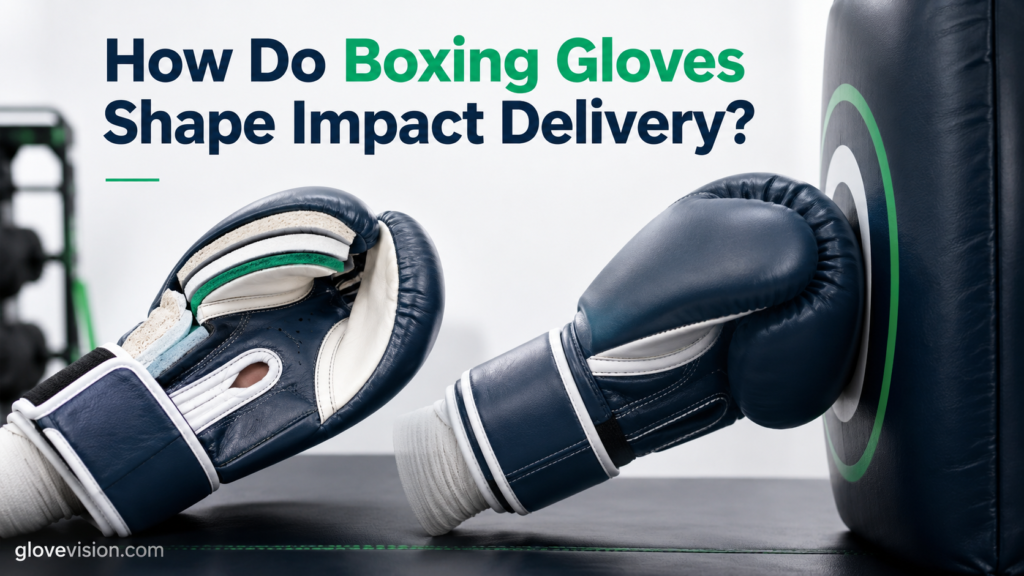
Boxing Gloves shape impact delivery by deforming during contact, changing the effective contact area and loading interval, redistributing surface pressure, and influencing fist stability and impact orientation.
Padding does not erase momentum or make a punch safe. Actual impact depends on punch velocity, effective mass, glove construction, impact angle, target response, fist alignment, contact location, and padding condition.
Educational and safety notice: Boxing Gloves may reduce some hand and surface-impact risks but cannot prevent concussion, brain injury, fractures, or every hand, thumb, or wrist injury. Boxing activities should follow qualified supervision, applicable rules, appropriate glove matching, and medical return-to-participation guidance.
What Impact Variables and Contact Mechanics Do Boxing Gloves Change?
Boxing Gloves can change effective contact area, surface-pressure distribution, the force-time curve, loading rate, contact duration, and impact orientation without eliminating the underlying transfer of momentum and mechanical energy.
How Do Boxing Gloves Affect Peak Force and Loading Rate?
Peak force is the highest measured force during a defined contact event; loading rate describes how rapidly force rises. Padding can reduce, delay, or reshape a measured peak under specific test conditions, but the result depends on padding, velocity, effective mass, angle, target compliance, and glove condition. [Punch]
How Do Boxing Gloves Affect Contact Pressure and Area?
Surface pressure depends on local force distribution and effective contact area. A padded striking surface can deform around a target and spread contact, while compacted or uneven padding can create concentrated zones. Lower surface pressure does not prove lower internal or head loading.
How Do Boxing Gloves Affect Contact Time, Impulse, Momentum, and Energy?
Contact time is duration of engagement; impulse is force integrated over time and relates to change in momentum for a defined system. Padding may temporarily store, dissipate, return, and transmit mechanical energy, so impulse, momentum, and energy should not be treated as interchangeable. [Impulse]
How Does Boxing Gloves Padding Deform During Contact?
Padding can pass through initial compression, progressive deformation, temporary energy storage, damping, and recovery. If most usable deformation is consumed, it can bottom out. Prototype research should remain prototype-specific rather than being generalized to conventional Boxing Gloves. [Padding]
How Do Thickness, Stiffness, and Layering Differ?
Thickness is available material depth; stiffness is resistance to deformation; density describes mass per volume where documented; layering describes interaction among materials. None should be used alone to rank protection.
The broader framework for sports glove impact and fit requirements shows why padding, contact zones, alignment and condition must be evaluated together. General impact-absorbing foam mechanics can clarify deformation and bottoming-out, but goalkeeper evidence does not establish Boxing Gloves performance.
| Variable | Meaning | Possible Glove Effect | Does Not Prove |
|---|---|---|---|
| Peak force | Highest force during contact | May reduce, delay, or reshape a peak | Impact is harmless |
| Loading rate | Speed of force development | Padding may slow force rise | Momentum is eliminated |
| Contact pressure | Local force distribution over area | Broader contact may reduce local pressure | Internal injury cannot occur |
| Contact time | Duration of engagement | Padding may alter duration | Impulse is necessarily lower |
| Impulse | Force integrated over time | Force-time profile may change | Energy disappears |
| Target acceleration | Motion response of target | Changes with loading and direction | Concussion is prevented |
How Do Boxing Gloves Shape Fist Alignment and Impact Direction?
Boxing Gloves influence impact direction by shaping how the hand closes, where the knuckles sit beneath the padding, how the thumb integrates with the fist, and whether the wrist remains stable.
How Does Boxing Gloves Mass Affect Impact Delivery?
Glove mass changes the moving hand-glove system and can affect movement velocity, timing, energy demand, and fatigue. The net result is setup-dependent, so ounce weight alone cannot predict force, impulse, or acceleration. [Mass]
How Does Boxing Gloves Geometry Affect Fist Closure?
Finger-compartment shape, interior volume, grip bar, palm geometry, knuckle position, padding bulk, and hand-wrap thickness can influence closure. A mismatch can create excess gripping effort, internal movement, knuckle misalignment, or unpredictable contact orientation.
How Do Thumb and Wrist Construction Affect Alignment?
Evaluate thumb angle, compartment length, internal pressure, closure security, adjustment consistency, and glove rotation. An attached thumb or firm wrist closure can support positioning but cannot guarantee injury prevention.
What Does Effective Mass Mean in Boxing Impact?
Effective mass is movement-dependent and reflects how much of the moving body system contributes to a particular impact; it is not simply body, arm, fist, or glove mass. [Eff. Mass]
Which Boxing Gloves Match Training, Sparring, and Competition?
Boxing Gloves should be selected first by intended activity and applicable rules, then by complete construction, wrapped-hand fit, padding condition, thumb geometry, wrist stability, and supervision requirements.
Which Boxing Gloves Suit Bag and Pad Work?
For bag work, evaluate repeated-impact durability, padding recovery, wrist stability, fist closure, fit, and condition. For pad work, add feedback, target compatibility, and coach requirements. The heaviest glove is not automatically best for either task.
Which Boxing Gloves Suit Sparring?
Use the gym- or coach-required specification, maintained padding, secure wrapped-hand fit, pre-use inspection, and applicable sanctioning requirements. Sparring Boxing Gloves cannot make repeated head impacts safe.
Which Boxing Gloves Suit Competition?
Competition use must follow the current governing body, commission, event, and division requirements. USA Boxing maintains an official rulebook page, while professional regulation can depend on the supervising commission. [USA] [ABC]
Why Should Boxing Gloves Not Be Selected by Ounce Weight Alone?
Nominal ounce mass does not independently establish padding thickness, stiffness, distribution, contact area, thumb geometry, wrist support, dynamic-impact performance, anatomical fit, or condition. The comparison between puncher-versus-pillow Boxing Gloves can support construction-level evaluation, but informal labels do not replace exact evidence.
| Activity | Primary Requirement | Checks | Main Warning |
|---|---|---|---|
| Heavy bag | Durability and hand protection | Padding recovery, closure, fit | Compacted knuckle zone |
| Pad work | Feedback and stable fit | Padding, closure, coach needs | Glove rotation |
| Technical training | Control and alignment | Fist closure, wrist stability | Internal movement |
| Sparring | Rule-compliant maintained glove | Gym spec and inspection | Injury risk remains |
| Competition | Current rule compliance | Approved glove, mass, closure, wraps | Rules vary |
How Should Properly Fitted Boxing Gloves Be Prepared and Function-Checked?
Properly fitted Boxing Gloves should accommodate the complete wrapped hand while allowing stable fist closure, correct knuckle placement, natural thumb position, secure wrist alignment, and minimal internal rotation.
How Should Boxing Gloves Fit the Fingers, Knuckles, and Thumb?
Fingers should reach their intended positions, knuckles should align beneath the main padding, the hand should not slide internally, full comfortable fist closure should remain possible, and the thumb should sit naturally without forced positioning.
How Should Hand Wraps Fit Inside Boxing Gloves?
Wrap volume must not prevent fist closure, move the knuckles out of position, disable the wrist closure, or create intolerable pressure. Use the exact wrap and glove combination required by the activity and applicable rules.
How Should Boxing Gloves Support Wrist Stability?
The closure should hold a stable glove position during a controlled unloaded assessment without painful restriction, exposed hardware, or glove rotation. General hand grip and wrist-alignment mechanics can clarify stability concepts, although lifting evidence does not establish boxing-impact performance.
What Should Be Inspected Before Boxing Gloves Are Used?
Inspect product identity, outer shell, knuckle padding, symmetry, permanent depressions, hard spots, seams, lining, thumb attachment, wrist closure, moisture, and contamination. Keep live-impact verification within qualified boxing supervision.
What Problems Show Boxing Gloves Are Mismatched, Worn, or Unreliable?
Boxing Gloves become unsuitable when padding deterioration, poor fit, incorrect activity matching, unstable alignment, moisture, or structural damage makes impact behavior or hand positioning unpredictable.
Why Do Knuckles Feel Excessive Impact Through Boxing Gloves?
Possible causes include bottomed-out or compacted padding, poor knuckle alignment, unsuitable construction, incomplete fist closure, incorrect size, or incompatible wrap volume. Pain should not be treated merely as a glove-selection problem.
Why Do Boxing Gloves Rotate or Restrict Fist Closure?
Oversizing, loose closures, wrong wrap volume, worn lining, excess interior space, poor thumb alignment, or deformed construction can cause rotation. Restriction can also result from undersizing, stiff geometry, misplaced grip bars, or bunched lining.
Why Do Boxing Gloves Develop Hard or Flat Knuckle Zones?
Repeated compression, uneven wear, moisture, material aging, internal layer separation, and unsuitable storage can change padding. Hard or permanently flat areas are condition warnings rather than proof of predictable protection.
How Can Moisture and Care Affect Boxing Gloves?
Moisture can contribute to lining movement, material deterioration, stiffness, delamination, contamination, closure wear, and altered fit. Follow exact product instructions rather than applying one universal washing, soaking, heating, disinfecting, deodorizing, sun-drying, or leather-treatment method.
When Should Boxing Gloves Be Reassigned or Replaced?
Remove, reassign, or replace Boxing Gloves when padding becomes inconsistent or shifts, hard spots develop, shell or seams fail, the thumb attachment or closure becomes unreliable, interior fit changes substantially, or activity suitability cannot be verified.
General padded glove grip and feedback trade-offs help explain why bulk or interior movement can impair control, but boxing requires its own evidence.
| Symptom | Possible Cause | Check | Decision |
|---|---|---|---|
| Sharp knuckle impact | Compacted or bottomed-out padding | Padding and alignment | Replace or change glove |
| Glove rotates | Oversizing or closure mismatch | Wrapped-hand fit | Resize or change construction |
| Fist will not close | Size, wrap, or geometry mismatch | Finger and grip-bar position | Refit or change model |
| Thumb forced outward | Thumb-compartment mismatch | Controlled unloaded check | Reject glove |
| Wrist unstable | Closure or fit mismatch | Wrist alignment | Adjust or change glove |
| Hard knuckle zone | Padding deterioration | Condition inspection | Remove from activity |
Conclusion
Boxing Gloves shape impact delivery by changing dynamic contact area, surface-pressure distribution, the force-time curve, loading rate, fist stability, and impact orientation. They do not remove momentum, eliminate energy transfer, or make punches harmless.
Select the complete glove by intended activity, current rules, padding behavior, wrapped-hand fit, fist and knuckle alignment, thumb position, wrist stability, supervision, and condition—not by ounce weight or visible padding alone.
Frequently Asked Questions
Do Boxing Gloves Reduce Punching Force?
They may reduce, delay, or reshape certain peak-force measurements under specific conditions, but they do not eliminate impulse, momentum, energy transfer, target acceleration, or injury risk.
Do Heavier Boxing Gloves Reduce Impact More?
Not automatically. Glove mass, padding construction, movement velocity, wrapped-hand fit, target compliance, impact direction, and padding condition interact, so ounce weight alone cannot predict impact reduction.
Do Softer Boxing Gloves Protect a Sparring Partner Better?
Not universally. Softer padding may deform more readily, but performance also depends on thickness, stiffness, recovery, bottoming-out resistance, contact area, construction, condition, and impact conditions.
Why Do Boxing Gloves Increase Contact Area?
Their padded, rounded striking surface can deform during contact, potentially distributing surface force across a broader dynamic contact area than an unpadded fist.
When Should Boxing Gloves Be Replaced?
Replace Boxing Gloves when padding becomes hard, flat, displaced, asymmetrical, or unreliable, or when the shell, seams, thumb attachment, lining, fit, or closure can no longer maintain predictable activity-appropriate function.