
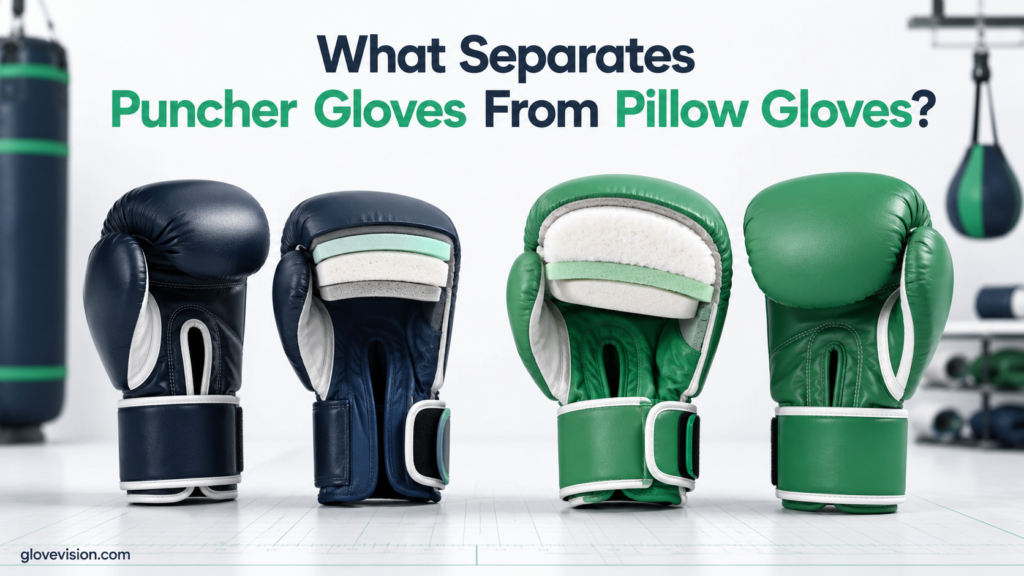
What Separates Puncher Gloves From Pillow Gloves?
Puncher Gloves are generally associated with compact, responsive padding and direct target feedback, while Pillow Gloves are generally associated with softer, broader, or higher-volume cushioning.
Neither term has a standardized technical definition. Meaningful differences come from the exact glove’s padding, compression, fist geometry, fit, intended activity, applicable rules, and current condition.
Educational and safety notice: Neither Puncher Gloves nor Pillow Gloves can make boxing impacts harmless or prevent every hand, facial, or brain injury. Follow qualified coaching, gym policies, applicable rules, and medical return-to-participation guidance.
What Do Puncher Gloves and Pillow Gloves Mean in Construction Terms?
Puncher Gloves and Pillow Gloves are informal descriptions that become useful only when translated into exact padding, geometry, fit, and condition variables.
Why Are Puncher Gloves an Informal Category?
The nickname commonly points to compact padding, a firmer or more responsive feel, lower perceived cushioning, and direct target feedback. It does not prove increased punch power or greater delivered force.
Why Are Pillow Gloves an Informal Category?
The nickname commonly points to a softer initial feel, broader padding coverage, greater padding volume, and a more cushioned sensation. It does not prove impact attenuation or sparring safety.
Which Variables Should Replace the Informal Labels?
Verify padding thickness, stiffness, density where documented, layer count and order, distribution, compression depth, rebound, bottoming-out resistance, knuckle coverage, and interior fist geometry. A boxing-glove damping study quantified damping and compression ratio and directly compared new with worn 10 oz competition gloves. [Damping]
How Do Thickness, Stiffness, Density, and Layering Differ?
Thickness is material depth; stiffness is resistance to deformation; density is mass per unit volume where documented; layering describes how multiple materials or zones interact. A thick pad can be soft or firm, and more layers do not automatically improve impact management.
The wider framework for sports glove padding and fit requirements shows why contact zones, alignment, cushioning, feedback, and condition belong in one product-level evaluation. General impact-absorbing foam behavior can clarify deformation, recovery, and bottoming-out, but goalkeeper evidence cannot establish Boxing Glove performance.
| Informal Label | Common Implication | Variables to Verify | Cannot Prove |
|---|---|---|---|
| Puncher Gloves | Compact, responsive feel | Thickness, stiffness, distribution | Greater punch power |
| Pillow Gloves | Soft, broad cushioning | Compression, rebound, bottoming-out | Harmless impact |
| Sparring gloves | Intended partner use | Rules, padding, fit, condition | Universal approval |
| Competition gloves | Event-specific use | Current governing requirements | Routine sparring suitability |
How Do Puncher Gloves and Pillow Gloves Differ in Feedback and Loaded Behavior?
Puncher Gloves and Pillow Gloves may feel different because their padding compresses and distributes contact differently, but subjective feedback does not establish measured impact performance.
Why Do Puncher Gloves Often Feel More Direct?
A firmer initial response, compact knuckle profile, less perceived deformation, and lower cushioning sensation can create closer target feedback. More direct feedback does not prove greater delivered force.
Why Do Pillow Gloves Often Feel Softer?
Greater initial compression, broader material coverage, and thicker comfort layers can reduce the wearer’s perception of target hardness. Softer hand feel does not prove superior impact attenuation.
How Can Contact Area and Contact Time Differ?
Softer or broader padding may deform around a target, while compact padding may preserve a different contact profile. Target shape, angle, padding distribution, and target compliance all matter. Longer contact also does not mean momentum or transferred loading disappears.
The broader explanation of how Boxing Gloves shape impact delivery separates contact area, pressure, loading rate, impulse, momentum, and target response without treating them as interchangeable outcomes.
How Does Bottoming-Out Change Pillow Gloves?
A soft material can use much of its available compression, allowing deeper structures to carry more loading. Repeated use can increase permanent compaction, so a glove that feels soft at rest may become harsher under load.
Prototype drop-test research found that changing target padding altered measured peak impact force and peak rate of force development. Those findings remain prototype- and test-specific and do not define commercial Puncher or Pillow categories. [Prototype]
How Do Puncher Gloves and Pillow Gloves Compare Across Boxing Activities?
Puncher Gloves and Pillow Gloves should be compared by intended activity, required feedback, cushioning, fit, durability, current rules, and product condition rather than by nickname alone.
How Do Puncher Gloves and Pillow Gloves Compare for Heavy-Bag and Pad Work?
For heavy-bag work, evaluate knuckle protection, durability, wrist stability, feedback, fist closure, repeated-impact recovery, and glove rotation. For pad work, add target construction and coach preference. Responsive profiles may feel clearer; cushioned profiles may feel more comfortable; either can fail if padding deteriorates.
How Do Puncher Gloves and Pillow Gloves Compare for Technical Training?
Prioritize full fist closure, natural thumb position, manageable bulk, wrist stability, comfortable repetition, useful feedback, and qualified supervision. Profile terminology is secondary to function.
How Do Puncher Gloves and Pillow Gloves Compare for Sparring?
Require gym approval, applicable specifications, maintained padding, secure wrapped-hand fit, partner-safety policies, qualified supervision, and pre-session inspection. A Pillow Glove label is not evidence of sparring suitability.
How Do Puncher Gloves and Pillow Gloves Compare for Competition?
Competition suitability depends on the current governing body, event specification, permitted glove mass, approved closure, equipment inspection, product authenticity, and compliant wraps—not on the informal profile label. USA Boxing publishes the rulebook currently governing its sanctioned events. [USA]
Why Does Ounce Weight Not Define Either Profile?
Glove mass alone cannot establish padding distribution, stiffness, layering, compression behavior, or target feedback. In a small study using multiple glove masses, glove mass itself did not significantly affect peak impact force; the authors concluded that cushioning rather than glove mass would affect peak force under their test conditions. [Mass]
| Activity | Primary Requirement | Profile Tendency | Required Verification |
|---|---|---|---|
| Heavy bag | Durability and hand protection | Either | Recovery and fit |
| Pad work | Feedback and stability | Often responsive | Coach and target needs |
| Technical training | Alignment and manageable bulk | Either | Fist, thumb, wrist fit |
| Sparring | Maintained cushioning and compliance | Often cushioned | Gym approval and inspection |
| Competition | Governing-body compliance | Event-specific | Exact approved specification |
How Should Puncher Gloves and Pillow Gloves Be Compared and Function-Checked?
Puncher Gloves and Pillow Gloves should be compared with the complete wrapped hand inside them, because padding feel alone cannot establish fist closure, thumb alignment, wrist stability, or activity suitability.
How Should the Padding Be Compared?
Compare initial firmness, visible thickness, knuckle coverage, light compression depth, rebound, hard spots, internal movement, and left-to-right symmetry. Do not perform destructive or unsafe impact tests.
How Should Wrapped-Hand Fit, Thumb Position, and Wrist Stability Be Compared?
Verify knuckle alignment beneath the intended padding, full fist closure, minimal internal rotation, acceptable fingertip space, compatible wrap volume, natural thumb position, and a stable closure without painful restriction.
General hand grip and wrist-alignment mechanics support checking hand position and stability, although lifting evidence does not prove Boxing Glove impact performance.
What Condition Differences Must Be Checked?
Inspect the shell, knuckle padding, padding symmetry, permanent depressions, hard zones, seams, lining, thumb attachment, wrist closure, moisture, contamination, and exact product identity.
What Misconceptions and Wear Problems Distort Puncher Gloves vs Pillow Gloves Comparisons?
Puncher Gloves vs Pillow Gloves comparisons become unreliable when marketing assumptions replace construction evidence or when wear changes the padding from its original behavior.
Do Puncher Gloves Increase Punching Power?
Not automatically. Direct feedback should not be confused with greater measured impact. Research on expert boxers found that reductions in momentum across the punching arm segments were closely related to impact impulse, showing why a glove nickname cannot establish punch impulse by itself. [Impulse]
Do Pillow Gloves Make Sparring Safe?
No. Pillow Gloves do not make sparring safe. Olympic-boxer laboratory research measured both translational and rotational head acceleration during straight punches, reinforcing why a cushioning label cannot be treated as concussion prevention. [Head]
Does Softer Padding Always Protect Better—or Firmer Padding Always Transfer More Force?
No. Results depend on thickness, damping, contact area, velocity, target compliance, wrapped-hand fit, complete construction, and condition. Soft padding can bottom out or compact permanently, while firmer padding can behave differently across loads and targets.
Which Buying Mistakes Should Be Avoided?
Avoid selecting by nickname, ounce weight, price, softness, or appearance alone. Do not ignore hand shape, wrap volume, thumb position, wrist stability, gym rules, current padding condition, or the exact product’s intended activity.
Broader padded glove grip and feedback trade-offs help explain why bulk, compression, and interior movement can change control, but boxing suitability requires activity-specific evidence.
When Should Either Profile Be Reassigned or Replaced?
Remove, reassign, or replace when padding no longer recovers consistently, hard or flat knuckle zones develop, padding becomes asymmetric, layers shift, shells or seams fail, thumb attachments or closures become unreliable, fit changes substantially, or suitability cannot be verified.
| Problem | Possible Cause | Check | Decision |
|---|---|---|---|
| Puncher glove feels painful | Compact, damaged, or misaligned padding | Knuckle fit and padding | Resize, change, or replace |
| Pillow glove feels harsh | Bottoming-out or deterioration | Compression and recovery | Replace or change construction |
| Glove rotates | Oversizing or closure mismatch | Wrapped-hand fit | Resize |
| Fist cannot close | Geometry or wrap mismatch | Finger and grip-bar position | Change model |
| Thumb feels forced | Thumb-compartment mismatch | Unloaded fist assessment | Reject |
| Sparring approval unclear | Label used as evidence | Gym and rule verification | Do not use until approved |
| Padding feels uneven | Migration or compression | Compare both gloves | Reassess or replace |
Conclusion
Puncher Gloves and Pillow Gloves are informal descriptions of different padding experiences—not standardized performance categories. Puncher-style commonly implies compact or responsive padding, while Pillow-style commonly implies softer or higher-volume cushioning; neither label proves construction, measured impact performance, or activity approval.
Translate the nickname into exact construction, compression, fit, feedback, activity, rule, and condition evidence. Softness does not guarantee protection, firmness does not prove greater punching power, ounce weight does not define the padding profile, and final suitability depends on the complete maintained product.
Frequently Asked Questions
Are Puncher Gloves Harder Than Pillow Gloves?
Often, but not universally. Puncher Gloves commonly have a firmer or more compact feel, while Pillow Gloves commonly feel softer or more cushioned. Exact construction and loaded behavior must be checked for the individual product.
Do Puncher Gloves Make Punches More Powerful?
Not automatically. They may provide more direct feedback, but punch impact depends on athlete mechanics, velocity, effective mass, alignment, glove construction, and target response.
Are Pillow Gloves Better for Sparring?
They may be considered when the exact maintained product, fit, gym approval, and applicable rules support that use. The informal label alone does not establish sparring suitability.
Can Boxing Gloves Be Both Puncher-Style and Well Cushioned?
Yes. A layered construction may combine responsive target feedback with substantial cushioning. Performance depends on the complete glove rather than one informal label.
Which Profile Should a Buyer Choose?
Choose by intended activity, applicable rules, desired feedback, cushioning needs, wrapped-hand fit, fist closure, thumb alignment, wrist stability, padding durability, and current condition.